This is AI generated Response.
Asked by: Firdos
Created at: 2025-12-07 15:25:08
Final Answer:
RenderedRaw Text
Did you like this answer?
Here’s a **stepwise solution** for part (a) (i):
---
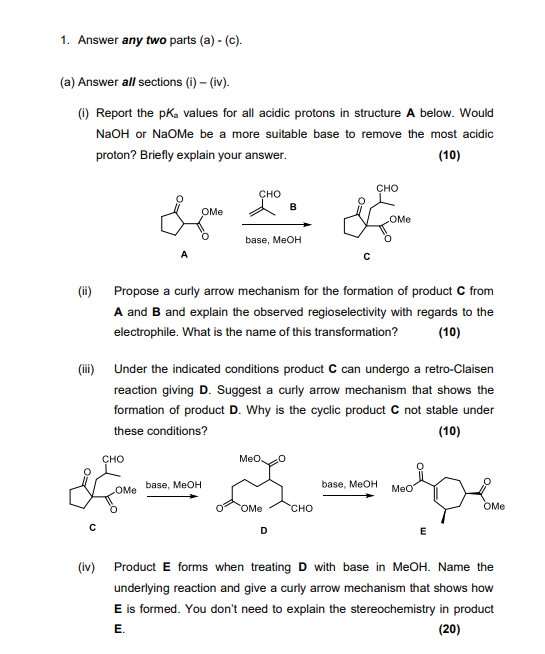
## (i) Report the pKa values for all acidic protons in structure A. Would NaOH or NaOMe be a more suitable base to remove the most acidic proton? Briefly explain your answer.
---
### **Step 1: Identify Acidic Protons and Their pKa Values**
- **Structure A:**
Structure A is a methyl ester of a cyclic β-ketoester (a derivative of dimedone).
- **Acidic protons present:**
1. **α-protons** (protons on the carbon adjacent to both carbonyl groups, between the keto and ester)
2. **Protons on the methyl group of the ester** (–COOCH₃)
3. **Other ring protons** (not significantly acidic compared to α-protons)
- **Typical pKa values:**
- **α-Proton (between carbonyls):** pKa ≈ **10–11**
- **Ester methyl protons:** pKa ≈ **25**
- **Other ring protons:** pKa > **40** (not significantly acidic)
#### **Conclusion of Step 1:**
The **most acidic proton** in A is the **α-proton** (between the two carbonyls) with a pKa of ~10–11.
---
### **Step 2: Choice of Base (NaOH vs. NaOMe)**
- **NaOH**: Strong base, water as the conjugate acid (pKa ~15.7)
- **NaOMe**: Strong base, methanol as the conjugate acid (pKa ~15.5)
**Both** bases are strong enough to deprotonate an α-proton with pKa ~10–11.
However, **NaOMe** is used in MeOH (the solvent), which is compatible with the reaction medium and avoids ester hydrolysis (saponification) that can occur with NaOH (especially in water).
#### **Conclusion of Step 2:**
**NaOMe** is a more suitable base because:
- It is strong enough to deprotonate the α-proton.
- It is non-aqueous (prevents unwanted hydrolysis of the ester).
- It matches the solvent (MeOH) used in the reaction.
---
### **Final Answer**
**The most acidic proton in structure A is the α-proton (pKa ≈ 10–11). NaOMe is a more suitable base than NaOH for removing this proton, as it is strong enough, prevents ester hydrolysis, and is compatible with the methanol solvent.**
Question:
Please solve all parts
This is AI generated Response.
Asked by: Firdos
Created at: 2025-12-07 15:26:07
Final Answer:
RenderedRaw Text
Did you like this answer?
## Solution for Part (a) (i) and (ii)
---
### **(i) Report the pKa Values and Suitable Base**
#### **Step 1: Identify Acidic Protons and Their pKa Values**
- **Structure A:**
Structure A is a methyl ester of a cyclic β-ketoester.
- **Acidic protons present:**
1. **α-protons** (adjacent to both carbonyls)
2. **Methyl group protons** in the ester (–COOCH₃)
3. **Other ring protons** (less acidic)
- **Typical pKa values:**
- **α-Proton:** pKa ≈ **10–11**
- **Ester methyl protons:** pKa ≈ **25**
- **Other ring protons:** pKa > **40**
#### **Conclusion of Step 1:**
The most acidic proton is the **α-proton** with a pKa of ~10–11.
---
#### **Step 2: Choice of Base (NaOH vs. NaOMe)**
- **NaOH (Sodium Hydroxide):**
A strong base with water as a conjugate acid (pKa ~15.7).
- **NaOMe (Sodium Methoxide):**
A strong base with methanol as a conjugate acid (pKa ~15.5).
**Comparison:**
- Both bases are strong enough to deprotonate the α-proton (pKa ~10–11).
- **NaOMe** is preferred because:
- It minimizes hydrolysis of the ester.
- It is compatible with the reaction solvent (MeOH).
#### **Conclusion of Step 2:**
**NaOMe is the more suitable base for deprotonating the α-proton, as it avoids ester hydrolysis and suits the solvent conditions.**
---
### **(ii) Propose a Curly Arrow Mechanism for the Formation of Product C from A and B**
#### **Step 1: Mechanism Overview**
- **Reactants:**
- **A:** Cyclic β-ketoester with α-proton.
- **B:** Nucleophile (e.g., an enolate or another electrophile).
**Mechanism Steps:**
1. **Deprotonation of A:** Use NaOMe to remove the α-proton, forming an enolate.
2. **Nucleophilic Attack:** The enolate attacks the electrophile B, leading to the formation of product C.
#### **Conclusion of Step 1:**
The mechanism involves deprotonation to form an enolate that attacks B, resulting in C.
---
#### **Step 2: Regioselectivity and Transformation Name**
- **Regioselectivity:**
The selectivity is determined by the stability of the enolate formed. More substituted enolates are more stable and thus preferentially react at the more electrophilic site in B.
- **Transformation Name:**
This reaction is indicative of a **Claisen condensation**.
#### **Conclusion of Step 2:**
The regioselectivity is based on enolate stability, leading to product C from the reaction of A and B through a Claisen condensation.
---
### **Final Answer for Part (a)**
1. The most acidic proton in structure A is the α-proton (pKa ≈ 10–11). NaOMe is more suitable than NaOH for deprotonation due to avoidance of hydrolysis and compatibility with the solvent.
2. The mechanism for forming product C involves deprotonation to form an enolate which then attacks B. The reaction is a Claisen condensation, with regioselectivity based on enolate stability.
VIPSolutions focuses on clear, step‑by‑step explanations so you can learn quickly. Whether you need an AI‑generated walkthrough or a short hint to get unstuck, each solution is organized for fast reading and easy review later.
Search similar questions, compare approaches, and bookmark the best answers for revision. Our goal is simple: quick, reliable study help that feels natural—not noisy.
 VIPSolutions
 1. Answer any two parts @)- ©).
(a) Answer aif sectons () (4).
(0) Report the pK, values for al acidic protons in structure A below. Woud
NaOH or NaOMe be a more suitable base to remove the most acid
proton? Brel explain your answer. (0)
ano
co
o o
i
4 ove AN { [owe
© base eon 3
A c
(Propose a curly amow mechanism for th formation of product C fom
A and B and explain the observed regioselctviy with regards 1 the
elecirophie, Whats the name of his tansfomation? (10)
(Under th indicated conditions product C can undergo a reto-Clasen
reaction giving D. Suggest a curly amow mechanism that shows the
formation of product D. Why is the cyclic product C not stable under
these condilons? (0)
go woo R
: [ owe ee base MeOH 15 p
© one “oro oe
c ° :
(Product E forms when treating D with base in MeOH. Name the
undering reaction and give a curly amow mechanism that shows how
Es fomed. You dort nee 1 explain the stereochemisty in product
e @)