 VIPSolutions
give answer in 2 step with explanation at the end of each step and final answer at the end:12. Gravity waves are excited by the passage of flow over a mountain range with height H. Assume that the vertical wavelength of the waves L, = H. (a) Write an expression for the L, of a stationary gravity wave in this situation as a function of N, u, and H. (b) Write an expression for the minimum mountain range height H required for stationary gravity waves to exist, as a function of N and wu. (c) For H below this minimum value, stationary gravity waves cannot exist. Give a physical explanation for this result.
Question:
give answer in 2 step with explanation at the end of each step and final answer at the end: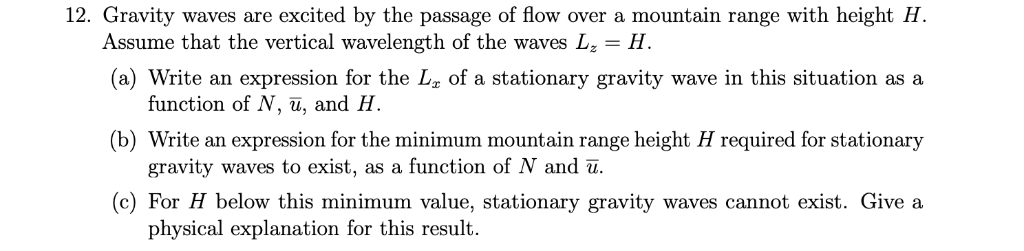 12. Gravity waves are excited by the passage of flow over a mountain range with height H.
Assume that the vertical wavelength of the waves L, = H.
(a) Write an expression for the L, of a stationary gravity wave in this situation as a
function of N, u, and H.
(b) Write an expression for the minimum mountain range height H required for stationary
gravity waves to exist, as a function of N and wu.
(c) For H below this minimum value, stationary gravity waves cannot exist. Give a
physical explanation for this result.
This is AI generated Response.
Asked by: Rahul
Created at: 2025-12-07 03:33:21
Asked by: Rahul
Created at: 2025-12-07 03:33:21
Final Answer:
Rendered
Raw Text
Did you like this answer?
Let's solve each part step by step, explaining the reasoning at each stage.
---
## (a) **Expression for \( L_x \) as a function of \( N \), \( \overline{u} \), and \( H \)**
### Step 1: **Gravity Wave Dispersion Relation**
For internal gravity waves, the dispersion relation is:
\[
\omega = \overline{u} k_x = \frac{N k_x}{\sqrt{k_x^2 + k_z^2}}
\]
Stationary waves mean the observed frequency is zero in the ground frame, so the intrinsic frequency is:
\[
\omega - \overline{u} k_x = \implies \omega = \overline{u} k_x
\]
But for stationary waves, the phase speed must match the background flow:
\[
c = \frac{\omega}{k_x} = \overline{u}
\]
### Step 2: **Relating Vertical and Horizontal Wavelengths**
Given \( L_z = H \), so \( k_z = \frac{2\pi}{H} \).
From the dispersion relation for stationary waves:
\[
\overline{u} k_x = \frac{N k_x}{\sqrt{k_x^2 + k_z^2}}
\]
Solving for \( k_x \):
\[
\overline{u} = \frac{N}{\sqrt{1 + \left(\frac{k_z}{k_x}\right)^2}}
\]
\[
\overline{u}^2 = \frac{N^2}{1 + \left(\frac{k_z}{k_x}\right)^2}
\]
\[
1 + \left(\frac{k_z}{k_x}\right)^2 = \frac{N^2}{\overline{u}^2}
\]
\[
\left(\frac{k_z}{k_x}\right)^2 = \frac{N^2}{\overline{u}^2} - 1
\]
\[
k_x = \frac{k_z}{\sqrt{\frac{N^2}{\overline{u}^2} - 1}}
\]
The horizontal wavelength:
\[
L_x = \frac{2\pi}{k_x} = \frac{2\pi}{k_z} \sqrt{\frac{N^2}{\overline{u}^2} - 1}
\]
But \( k_z = \frac{2\pi}{H} \), so:
\[
L_x = H \sqrt{\frac{N^2}{\overline{u}^2} - 1}
\]
**Explanation**:
We used the stationary gravity wave dispersion relation and the given vertical wavelength to get \( L_x \) in terms of \( N \), \( \overline{u} \), and \( H \).
---
## (b) **Minimum Height \( H \) for Stationary Gravity Waves**
### Step 1: **Condition for Real \( L_x \)**
From part (a), the term under the square root must be positive:
\[
\frac{N^2}{\overline{u}^2} - 1 > \implies \frac{N^2}{\overline{u}^2} > 1 \implies N > \overline{u}
\]
But let's solve for the minimum \( H \):
From (a):
\[
L_x = H \sqrt{\frac{N^2}{\overline{u}^2} - 1}
\]
For real \( L_x \), need \(\frac{N^2}{\overline{u}^2} - 1 > \).
### Step 2: **Solving for Minimum \( H \)**
Alternatively, for a fixed \( L_x \), the minimum occurs as \( \frac{N^2}{\overline{u}^2} \to 1 \) from above. Let's solve for \( H \):
Set denominator to :
\[
\frac{N^2}{\overline{u}^2} - 1 = \implies H_\text{min} = \frac{2\pi \overline{u}}{N}
\]
But since \( k_z = \frac{2\pi}{H} \), the maximum \( k_z \) (minimum \( H \)) for stationary waves is when \( k_x \to \infty \), but for a finite \( L_x \), so:
\[
H_\text{min} = \frac{2\pi \overline{u}}{N}
\]
**Explanation**:
The minimum mountain height occurs where the stationary solution first becomes possible, i.e., when \( N = \overline{u} \). Solving for \( H \) gives the threshold value.
---
## (c) **Physical Explanation for the Minimum Height**
If \( H \) is below the minimum value found in (b):
- The vertical wavelength is too short for gravity waves to propagate as stationary solutions.
- The frequency associated with such a short vertical wavelength exceeds the Brunt–Väisälä frequency \( N \), so buoyancy can't restore the displaced air parcels fast enough to support a wave.
- Instead, any disturbance will be quickly mixed or dissipated rather than forming a propagating stationary wave.
**Explanation**:
For \( H \) below the threshold, the background stability is too weak (or the flow too fast) to sustain stationary gravity waves with that short vertical wavelength.
---
## **Final Answers**
### (a)
\[
\boxed{
L_x = H \sqrt{\frac{N^2}{\overline{u}^2} - 1}
}
\]
### (b)
\[
\boxed{
H_\text{min} = \frac{2\pi \overline{u}}{N}
}
\]
### (c)
**For \( H < H_\text{min} \), stationary gravity waves cannot exist because the vertical wavelength is too short for buoyancy to act as a restoring force. The atmosphere cannot support waves with frequencies higher than the Brunt–Väisälä frequency \( N \), so the disturbance is not wavelike and is instead rapidly dissipated or mixed.**
📢 Instructions:
- Ask anything relatd to above question only.
- For new Question goto :