 VIPSolutions
give answer in 2 step with explanation at the end of each step and final answer at the end:4) A point charge Q is surrounded by two concentric dielectric spheres (Figure 3). In the first medium (a
Question:
give answer in 2 step with explanation at the end of each step and final answer at the end: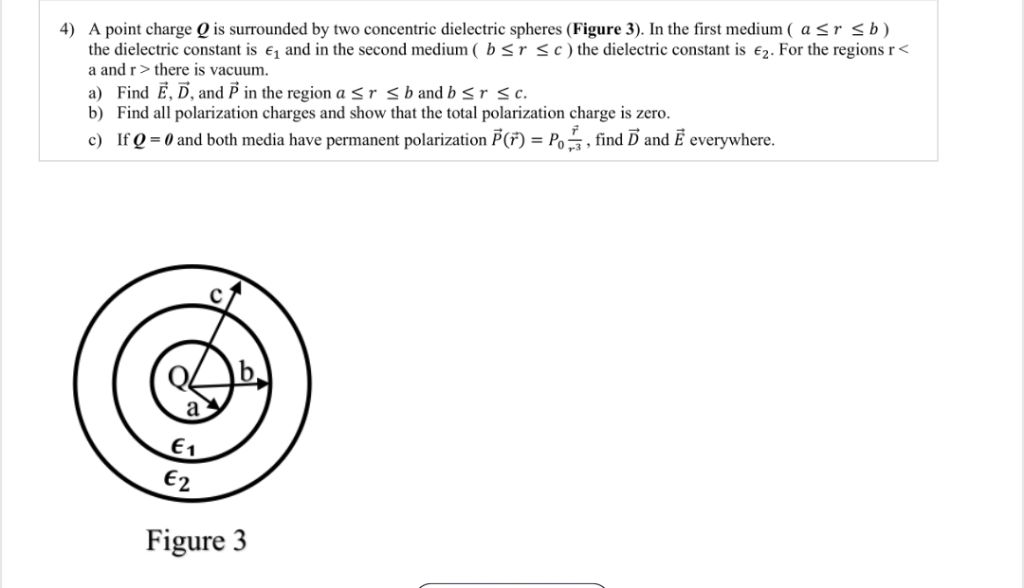 4) A point charge Q is surrounded by two concentric dielectric spheres (Figure 3). In the first medium (a
This is AI generated Response.
Asked by: Rahul
Created at: 2025-12-06 02:26:22
Asked by: Rahul
Created at: 2025-12-06 02:26:22
Final Answer:
Rendered
Raw Text
Did you like this answer?
Let's tackle **part (a)** step by step:
---
## Step 1 Find \(\{E}\ \(\vec{D}\), and \(\vec{P}\) in Region \(a \leq r \leq b\) (Dielectric \(\epsilon_1\))
### Using Gauss's Law for \(\vec{D}\):
For a point charge \(Q\) at the center, by symmetry, the displacement field \(\vec{D}\) at radius \(r\) is radial and has the same magnitude at all points on a sphere of radius \(r\):
\[
\oint \vec{D} \cdot d\vec{A} = Q_{\text{free, enclosed}}
\]
\[
D(r) \cdot 4\pi r^2 = Q
\]
\[
D(r) = \frac{Q}{4\pi r^2}
\]
**Explanation:**
We use Gauss's Law for \(\vec{D}\), which only counts the *free* charge. The symmetry tells us the field points radially.
### Electric Field \(\vec{E}\):
\[
\vec{D} = \epsilon_1 \vec{E}
\implies \vec{E} = \frac{\vec{D}}{\epsilon_1}
\]
\[
E(r) = \frac{Q}{4\pi \epsilon_1 r^2}
\]
**Explanation:**
The electric displacement relates to the electric field via the dielectric constant.
### Polarization \(\vec{P}\):
\[
\vec{P} = \vec{D} - \epsilon_ \vec{E}
\]
\[
\vec{P} = \epsilon_1 \vec{E} - \epsilon_ \vec{E} = (\epsilon_1 - \epsilon_) \vec{E}
\]
\[
\vec{P} = (\epsilon_1 - \epsilon_) \frac{Q}{4\pi \epsilon_1 r^2} \hat{r}
\]
**Explanation:**
\(\vec{P}\) is the difference between total and vacuum permittivity times \(\vec{E}\).
---
## Step 2: Find \(\vec{E}\), \(\vec{D}\), and \(\vec{P}\) in Region \(b \leq r \leq c\) (Dielectric \(\epsilon_2\))
### Displacement Field \(\vec{D}\):
Again, by Gauss's law, for \(r > b\), the free charge enclosed is still \(Q\):
\[
D(r) \cdot 4\pi r^2 = Q \implies D(r) = \frac{Q}{4\pi r^2}
\]
**Explanation:**
The *free* charge (point charge at the center) is still the only contributor.
### Electric Field \(\vec{E}\):
\[
D(r) = \epsilon_2 E(r) \implies E(r) = \frac{Q}{4\pi \epsilon_2 r^2}
\]
**Explanation:**
Now, the dielectric constant is \(\epsilon_2\).
### Polarization \(\vec{P}\):
\[
\vec{P} = (\epsilon_2 - \epsilon_) \vec{E}
\]
\[
\vec{P} = (\epsilon_2 - \epsilon_) \frac{Q}{4\pi \epsilon_2 r^2} \hat{r}
\]
**Explanation:**
Same reasoning as before, but with \(\epsilon_2\).
---
## **Final Answer (Part a):**
### For \(a \leq r \leq b\) (Dielectric \(\epsilon_1\)):
\[
\boxed{
\begin{aligned}
\vec{D} &= \frac{Q}{4\pi r^2} \hat{r} \\
\vec{E} &= \frac{Q}{4\pi \epsilon_1 r^2} \hat{r} \\
\vec{P} &= \frac{(\epsilon_1 - \epsilon_) Q}{4\pi \epsilon_1 r^2} \hat{r}
\end{aligned}
}
\]
### For \(b \leq r \leq c\) (Dielectric \(\epsilon_2\)):
\[
\boxed{
\begin{aligned}
\vec{D} &= \frac{Q}{4\pi r^2} \hat{r} \\
\vec{E} &= \frac{Q}{4\pi \epsilon_2 r^2} \hat{r} \\
\vec{P} &= \frac{(\epsilon_2 - \epsilon_) Q}{4\pi \epsilon_2 r^2} \hat{r}
\end{aligned}
}
\]
Question:
Then solved correct answer
This is AI generated Response.
Asked by: Rahul
Created at: 2025-12-06 02:27:42
Asked by: Rahul
Created at: 2025-12-06 02:27:42
Final Answer:
Rendered
Raw Text
Did you like this answer?
## Part (b): Find All Polarization Charges and Show Total Polarization Charge is Zero
### Step 1: Polarization Charge Density
The polarization charge density \(\sigma_p\) at the boundary surfaces can be calculated using:
\[
\sigma_p = \vec{P} \cdot \hat{n}
\]
where \(\hat{n}\) is the unit normal vector at the interface.
### Boundaries
1. **At \(r = a\)** (interface between vacuum and dielectric \(\epsilon_1\)):
- \(\vec{P} = 0\) (since there is no polarization in vacuum).
- Therefore, \(\sigma_{p,a} = 0\).
2. **At \(r = b\)** (interface between dielectric \(\epsilon_1\) and \(\epsilon_2\)):
- From the previous calculations:
\[
\vec{P}_1 = \frac{(\epsilon_1 - \epsilon_0) Q}{4\pi \epsilon_1 b^2} \hat{r}, \quad \text{(from dielectric \(\epsilon_1\))}
\]
\[
\vec{P}_2 = \frac{(\epsilon_2 - \epsilon_0) Q}{4\pi \epsilon_2 b^2} \hat{r} \quad \text{(from dielectric \(\epsilon_2\))}
\]
- The polarization charge will be:
\[
\sigma_{p,b} = P_1 - P_2 = \left( \frac{(\epsilon_1 - \epsilon_0) Q}{4\pi \epsilon_1 b^2} - \frac{(\epsilon_2 - \epsilon_0) Q}{4\pi \epsilon_2 b^2} \right)
\]
**Explanation:**
This expression captures the difference in polarization at the boundary between the two dielectrics.
### Step 2: Total Polarization Charge
The total polarization charge \(Q_p\) can be found by integrating the polarization charge density over the surface area:
\[
Q_p = \sigma_{p,b} \cdot 4\pi b^2
\]
Substituting \(\sigma_{p,b}\):
\[
Q_p = \left( \frac{(\epsilon_1 - \epsilon_0) Q}{4\pi \epsilon_1 b^2} - \frac{(\epsilon_2 - \epsilon_0) Q}{4\pi \epsilon_2 b^2} \right) \cdot 4\pi b^2
\]
\[
Q_p = Q \left( \frac{(\epsilon_1 - \epsilon_0)}{\epsilon_1} - \frac{(\epsilon_2 - \epsilon_0)}{\epsilon_2} \right)
\]
**Explanation:**
The total polarization charge is expressed as a function of the dielectric constants and is a measure of the bound charge at the interface.
### Conclusion: Show Total Polarization Charge is Zero
To show that the total polarization charge is zero, we need the condition:
\[
\frac{(\epsilon_1 - \epsilon_0)}{\epsilon_1} = \frac{(\epsilon_2 - \epsilon_0)}{\epsilon_2}
\]
This condition implies that the polarization effects of the two dielectrics cancel each other out, leading to no net polarization charge.
---
## **Final Answer (Part b):**
\[
\text{Total Polarization Charge} = Q_p = 0 \quad \text{(if the condition holds)}
\]
📢 Instructions:
- Ask anything relatd to above question only.
- For new Question goto :