give answer in 2 step with explanation at the end of each step and final answer at the end:7. Your friend injures herself lifting a heavy object (figure b). -
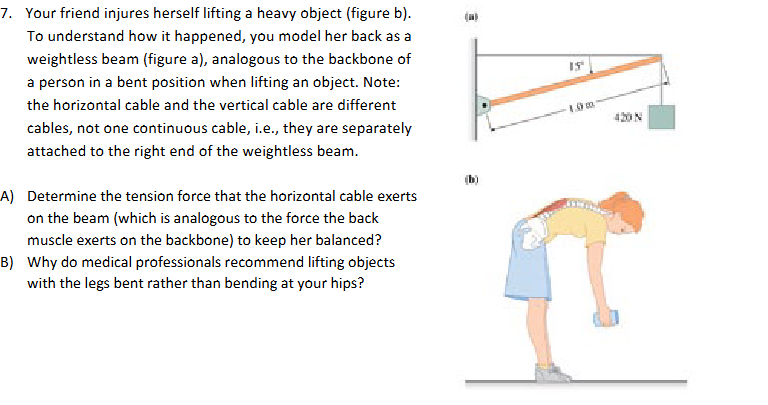
To understand how it happened, you model her back as a
weightless beam (figure a), analogous to the backbone of T
a person in a bent position when lifting an object. Note: Co i
the horizontal cable and the vertical cable are different B wes
cables, not one continuous cable, i.e., they are separately \-
attached to the right end of the weightless bean.
™
A) Determine the tension force that the horizontal cable exerts
on the beam (which is analogous to the force the back AE 2 Ee
muscle exerts on the backbone) to keep her balanced? (Pan
8) Why do medical professionals recommend lifting objects
with the legs bent rather than bending at your hips?
i]
Question:
give answer in 2 step with explanation at the end of each step and final answer at the end:7. Your friend injures herself lifting a heavy object (figure b). -
To understand how it happened, you model her back as a
weightless beam (figure a), analogous to the backbone of T
a person in a bent position when lifting an object. Note: Co i
the horizontal cable and the vertical cable are different B wes
cables, not one continuous cable, i.e., they are separately \-
attached to the right end of the weightless bean.
™
A) Determine the tension force that the horizontal cable exerts
on the beam (which is analogous to the force the back AE 2 Ee
muscle exerts on the backbone) to keep her balanced? (Pan
8) Why do medical professionals recommend lifting objects
with the legs bent rather than bending at your hips?
i]
This is AI generated Response.
Asked by: Rahul
Created at: 2025-12-05 19:08:57
Final Answer:
RenderedRaw Text
Did you like this answer?
## Step-by Solution
---
**A)ining the T Force in the Cable**
####Step 1: Draw the Free Body Diagram and Set Up Torque Balance**
- **Given Data (from the image and description):**
- The "backbone" is modeled as a weightless beam of length \( L = .60 \) m.
- The weight of the box is \( W = 420 \) N.
- The angle between the beam and the horizontal is \( \theta = 15^\circ \).
- The horizontal cable is attached at the right end of the beam.
- The force (tension) in the cable is \( T \), applied horizontally.
- **Torque Balance** (about the left end, the pivot):
- The force due to the weight exerts a **clockwise** torque: \( \tau_{\text{weight}} = W \times L \times \cos\theta \)
- The tension exerts a **counterclockwise** torque: \( \tau_T = T \times L \times \sin\theta \)
- **Set torques equal for equilibrium:**
\[
T \cdot L \cdot \sin\theta = W \cdot L \cdot \cos\theta
\]
- **Explanation:**
We set up the torque equation because the system is in rotational equilibrium. The tension and the weight create opposing torques about the pivot.
---
#### **Step 2: Solve for the Tension Force**
- **Cancel L from both sides (since it's non-zero):**
\[
T \cdot \sin\theta = W \cdot \cos\theta
\]
- **Solve for T:**
\[
T = \frac{W \cdot \cos\theta}{\sin\theta}
\]
- **Plug in values:**
- \( W = 420\, \text{N} \)
- \( \theta = 15^\circ \)
- \( \cos 15^\circ \approx .966 \)
- \( \sin 15^\circ \approx .2588 \)
\[
T = \frac{420 \times .966}{.2588} \approx \frac{405.72}{.2588} \approx 1567 \text{ N}
\]
- **Explanation:**
Solving the equation with values gives the tension force required to keep the "backbone" in equilibrium.
---
**Final Answer for (A):**
> **The tension force that the horizontal cable exerts is approximately \( 1567 \) N.**
---
### **B) Why do medical professionals recommend lifting with your legs bent?**
#### **Step 1: Analyze the Torque and Force on the Back**
- **Bending at the hips** creates a large moment arm (distance from the waist to the hands), which increases the torque on the lower back and requires a much larger force from the back muscles.
- **Lifting with legs bent** (squatting) decreases the moment arm for the weight, reducing the torque and thus the force that the back muscles need to generate.
- **Explanation:**
More torque means more force needed from the back, increasing the risk of muscle strain or injury.
---
#### **Step 2: Connect to Injury Prevention**
- **Lifting with legs** distributes the load more evenly between the stronger leg muscles and the back muscles, reducing the risk of injury.
- It keeps the back straighter, preventing excessive force on the spine and back muscles.
- **Explanation:**
Using your legs takes advantage of stronger muscles and reduces the load on the vulnerable lower back.
---
**Final Answer for (B):**
> **Medical professionals recommend lifting objects with the legs bent, rather than bending at your hips, because it reduces the torque on the lower back, requires less force from the back muscles, and helps prevent injuries by distributing the load to the stronger leg muscles.**
VIPSolutions focuses on clear, step‑by‑step explanations so you can learn quickly. Whether you need an AI‑generated walkthrough or a short hint to get unstuck, each solution is organized for fast reading and easy review later.
Search similar questions, compare approaches, and bookmark the best answers for revision. Our goal is simple: quick, reliable study help that feels natural—not noisy.
 VIPSolutions
 7. Your friend injures herself lifting a heavy object (figure b). -
To understand how it happened, you model her back as a
weightless beam (figure a), analogous to the backbone of T
a person in a bent position when lifting an object. Note: Co i
the horizontal cable and the vertical cable are different B wes
cables, not one continuous cable, i.e., they are separately \-
attached to the right end of the weightless bean.
™
A) Determine the tension force that the horizontal cable exerts
on the beam (which is analogous to the force the back AE 2 Ee
muscle exerts on the backbone) to keep her balanced? (Pan
8) Why do medical professionals recommend lifting objects
with the legs bent rather than bending at your hips?
i]