 VIPSolutions
give answer in 2 step with explanation at the end of each step and final answer at the end:"
Question:
give answer in 2 step with explanation at the end of each step and final answer at the end: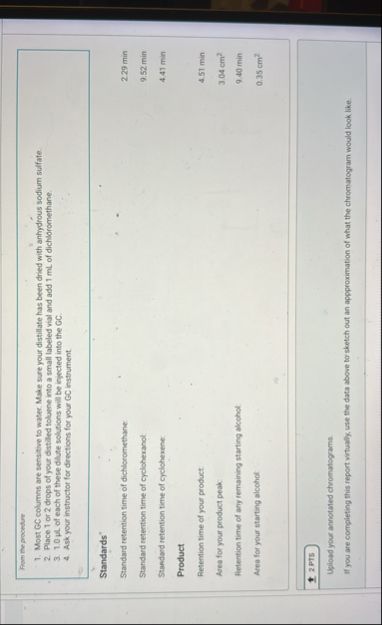 "
This is AI generated Response.
Asked by: Rahul
Created at: 2025-12-05 13:43:26
Asked by: Rahul
Created at: 2025-12-05 13:43:26
Final Answer:
Rendered
Raw Text
Did you like this answer?
## Step 1: Understanding the Data
The table on the right lists several values (likely retention times and areas) and sample names related to chromatography of cyclohexanone and cyclohexanol:
- **Retention times (min):** 2.23, 9.52, 4.41, 5.41
- **Areas (cm²):** 2.40, 3.14, .40, .31
The standards and products are:
- Standard 1: cyclohexanone
- Standard 2: cyclohexanol
- Product: starting material (possibly cyclohexanone or cyclohexanol)
- Product: reaction product (after reaction)
**Explanation:**
The table provides results from GC (Gas Chromatography), showing how long each compound takes to come out (retention time) and the corresponding area under the curve (which relates to the amount present).
---
## Step 2: Interpreting the Data and Assigning Peaks
To interpret the data:
- Compare retention times for standards to those found in the product and reaction mixture.
- Assign peaks in the product samples based on the standard retention times.
From the standards:
- Cyclohexanone: Retention time = 2.23 min
- Cyclohexanol: Retention time = 9.52 min
Assign these to the product/reaction mixtures:
- Peaks at 2.23 min and 9.52 min in other samples would correspond to cyclohexanone and cyclohexanol, respectively.
**Explanation:**
By matching the retention times of the standards with those in the product/reaction mixtures, you can identify which compound is present in each sample.
---
## Final Answer
**The retention time for cyclohexanone is 2.23 min, and for cyclohexanol is 9.52 min. By comparing these times to those in the product and reaction mixtures, you can determine which peaks correspond to each compound and assess the progress of the reaction (e.g., conversion of cyclohexanone to cyclohexanol).**
📢 Instructions:
- Ask anything relatd to above question only.
- For new Question goto :