 VIPSolutions
give answer in 2 step with explanation at the end of each step and final answer at the end:ind the derivative of the function: 4 y=G +) -8)
Question:
give answer in 2 step with explanation at the end of each step and final answer at the end: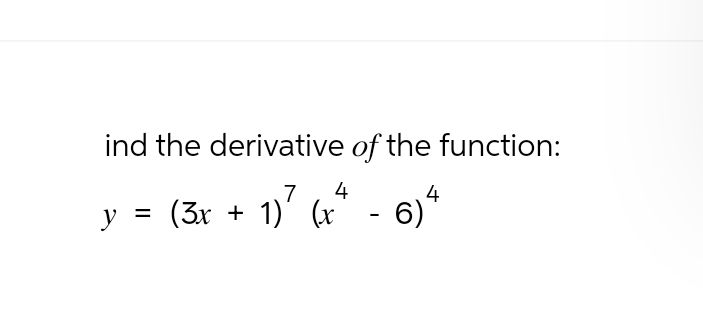 ind the derivative of the function:
4
y=G +) -8)
This is AI generated Response.
Asked by: Rahul
Created at: 2025-12-05 04:10:38
Asked by: Rahul
Created at: 2025-12-05 04:10:38
Final Answer:
Rendered
Raw Text
Did you like this answer?
## Step 1: Identify the Rule to Use
The function is:
\[ y = (3x + 1)^7 \cdot (x^4 - 6)^4 \]
This is a product of two functions, so we use the **product rule**:
\[
\frac{d}{dx}[u \cdot v] = u'v + uv'
\]
Let \( u = (3x+1)^7 \) and \( v = (x^4-6)^4 \).
**Explanation:**
We need to differentiate each part and then apply the product rule.
---
## Step 2: Differentiate Each Part
Differentiate \( u \) and \( v \):
- \( u' = 7(3x+1)^6 \cdot 3 = 21(3x+1)^6 \)
- \( v' = 4(x^4-6)^3 \cdot 4x^3 = 16x^3(x^4-6)^3 \)
Now, apply the product rule:
\[
y' = u'v + uv'
\]
\[
y' = 21(3x+1)^6 \cdot (x^4-6)^4 + (3x+1)^7 \cdot 16x^3 (x^4-6)^3
\]
**Explanation:**
We used the chain rule for each derivative and then substituted into the product rule formula.
---
## Final Answer
\[
\boxed{
y' = 21(3x+1)^6 (x^4-6)^4 + 16x^3 (3x+1)^7 (x^4-6)^3
}
\]
📢 Instructions:
- Ask anything relatd to above question only.
- For new Question goto :