 VIPSolutions
give answer in 2 step with explanation at the end of each step and final answer at the end:(A) Calculate the value of EMFy (5 pts) (B) Calculate the value of EMF; (5 pts) (C) Find the current through Rs (5 pts) (D) Find the potential across Rz (5 pts) (E) Find the potential difference between point B and point A (e.g. Via = Vi — Va) (5 pts) EMF1 = 75.0V R1=17.0Q R,=9.0Q R,=120Q R=18.0Q R=0.75Q EMF; Ry R: L=8.0A 4 EMF, i Rs Rs L=15A | Vv | Rs EMF; L=15A Figure 2: Diagram for Problem 03.
Question:
give answer in 2 step with explanation at the end of each step and final answer at the end: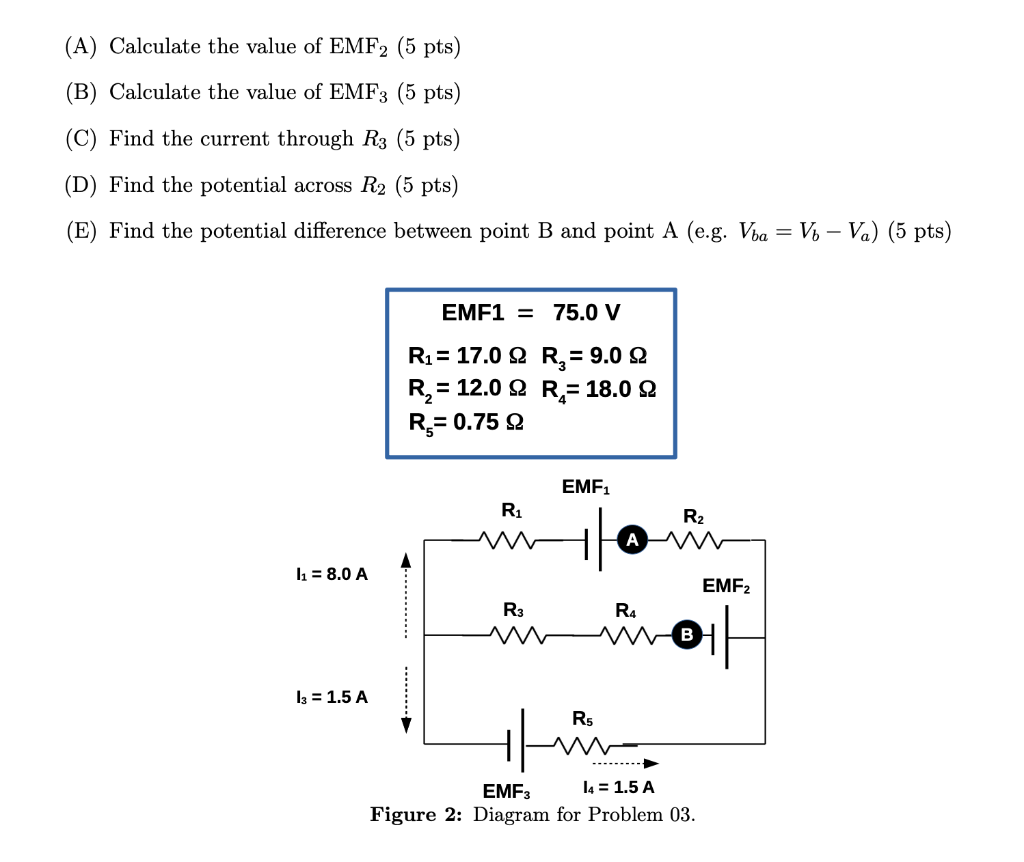 (A) Calculate the value of EMFy (5 pts)
(B) Calculate the value of EMF; (5 pts)
(C) Find the current through Rs (5 pts)
(D) Find the potential across Rz (5 pts)
(E) Find the potential difference between point B and point A (e.g. Via = Vi — Va) (5 pts)
EMF1 = 75.0V
R1=17.0Q R,=9.0Q
R,=120Q R=18.0Q
R=0.75Q
EMF;
Ry R:
L=8.0A 4 EMF,
i Rs Rs
L=15A |
Vv | Rs
EMF; L=15A
Figure 2: Diagram for Problem 03.
This is AI generated Response.
Asked by: Rahul
Created at: 2025-12-05 04:02:47
Asked by: Rahul
Created at: 2025-12-05 04:02:47
Final Answer:
Rendered
Raw Text
Did you like this answer?
Let's tackle the questions step by step, with explanations at each stage and the final answers clearly labeled.
---
## (A) Calculate the value of EMF₂
### **Step 1: Apply Kirchhoff's Law to the Top Loop (Clockwise)**
The top loop includes EMF₁, R₁, R₂, EMF₂, R₃, and R₄.
Let’s define the currents as shown:
- \( I_1 = 8.\,A \) (through R₁ and R₂, rightward)
- \( I_3 = 1.5\,A \) (through R₃, downward)
- \( I_4 = 1.5\,A \) (through R₄, rightward)
**KVL equation for the top loop:**
\[
\text{Starting at A, moving clockwise:}
\]
\[
-EMF_1 + I_1R_1 + I_1R_2 + EMF_2 + I_4R_4 + I_3R_3 =
\]
But notice from the diagram:
- \( I_1 \) splits at point A; \( I_3 \) goes through R₃ downward, \( I_4 \) continues through R₄ rightward.
- At node B: \( I_1 = I_3 + I_4 \) → \( 8. = 1.5 + I_4 \) → \( I_4 = 6.5\,A \)
- The current through R₄ is \( I_4 = 6.5\,A \).
### **Step 2: Substitute Values and Solve for EMF₂**
Let’s traverse from left to right along the top branch (R₁, R₂, EMF₂, R₄):
\[
-EMF_1 + (I_1 \cdot R_1) + (I_1 \cdot R_2) + EMF_2 + (I_4 \cdot R_4) =
\]
Plug in the values:
- \( EMF_1 = 75.\,V \)
- \( R_1 = 17.\,\Omega \)
- \( R_2 = 12.\,\Omega \)
- \( R_4 = 18.\,\Omega \)
- \( I_1 = 8.\,A \)
- \( I_4 = 6.5\,A \)
\[
-75. + (8. \times 17.) + (8. \times 12.) + EMF_2 + (6.5 \times 18.) =
\]
\[
-75. + 136. + 96. + EMF_2 + 117. =
\]
\[
(136. + 96. + 117.) = 349.
\]
\[
-75. + 349. + EMF_2 =
\]
\[
EMF_2 = -274.\,V
\]
---
### **Final Answer (A):**
\[
\boxed{EMF_2 = -274.\,V}
\]
(The negative sign means its polarity is opposite to the direction assumed in the loop.)
---
## (B) Calculate the value of EMF₃
### **Step 1: Apply Kirchhoff's Law to the Bottom Loop**
The bottom loop includes R₅ and EMF₃.
Given:
- \( I_4 = 1.5\,A \) (through R₅, rightward)
- \( R_5 = .75\,\Omega \)
### **Step 2: Traverse the Bottom Branch**
\[
EMF_3 = I_4 \cdot R_5
\]
\[
EMF_3 = 1.5 \times .75 = 1.125\,V
\]
---
### **Final Answer (B):**
\[
\boxed{EMF_3 = 1.13\,V}
\]
(Rounded to two decimal places.)
---
## (C) Find the current through \( R_3 \)
From the diagram and given data:
- The current through \( R_3 \) is explicitly labeled as \( I_3 = 1.5\,A \).
---
### **Final Answer (C):**
\[
\boxed{1.5\,A}
\]
---
## (D) Find the potential across \( R_2 \)
### **Step 1: Use Ohm’s Law for \( R_2 \)**
\[
V_{R_2} = I_1 \cdot R_2
\]
Given:
- \( I_1 = 8.\,A \)
- \( R_2 = 12.\,\Omega \)
\[
V_{R_2} = 8. \times 12. = 96.\,V
\]
---
### **Final Answer (D):**
\[
\boxed{96.\,V}
\]
---
## (E) Find the potential difference between point B and point A (\( V_{ba} = V_b - V_a \))
### **Step 1: Traverse from A to B (Top Branch)**
Move from A to B through \( R_2 \), EMF₂, \( R_4 \):
\[
V_{ba} = -(I_1 \cdot R_2) + (-EMF_2) - (I_4 \cdot R_4)
\]
(Each term is negative because you move against the current or against the EMF.)
Plug in the values:
- \( I_1 \cdot R_2 = 8. \times 12. = 96.\,V \)
- \( EMF_2 = -274.\,V \)
- \( I_4 \cdot R_4 = 6.5 \times 18. = 117.\,V \)
\[
V_{ba} = -96. - (-274.) - 117.
\]
\[
V_{ba} = -96. + 274. - 117.
\]
\[
V_{ba} = (274. - 96. - 117.) = (274. - 213.) = 61.\,V
\]
---
### **Final Answer (E):**
\[
\boxed{61.\,V}
\]
---
## **Summary of Answers**
- (A) \( \boxed{EMF_2 = -274.\,V} \)
- (B) \( \boxed{EMF_3 = 1.13\,V} \)
- (C) \( \boxed{1.5\,A} \)
- (D) \( \boxed{96.\,V} \)
- (E) \( \boxed{61.\,V} \)
📢 Instructions:
- Ask anything relatd to above question only.
- For new Question goto :