give answer in 2 step with explanation at the end of each step and final answer at the end:9 Problem 09 (25 pts)
A small positively charged molecule with mass of 2.4 x 10~® kg is dropped half way in between
a set of parallel plate capacitors that are separated by a distance of 1cm and held at a potential
difference of 1.5kV. The parallel plates are 5.0cm long. The molecule is traveling at 55km/s
initially in the “downward” direction. (Ignore gravity in this problem)
(A) Calculate the electric field in the region between the parallel plates (5 pts)
(B) If the goal is to have the molecule deflected by 0.3mm by the time it reaches the end of the
plates, what is the amount of charge Q that the molecule carries? (10 pts)
(C) How many seconds does it take for the molecule to pass through the plates? (5 pts)
(D) If the goal was to have the molecule travel through undeflected, what is the magnitude and
direction of the magnetic field you would have to apply? (5 pts)
HE
+
+
'.
NE on
+ il =]
: o
+ i 3
+ Hl
+ a
of
+ PA
—
{0.3mm
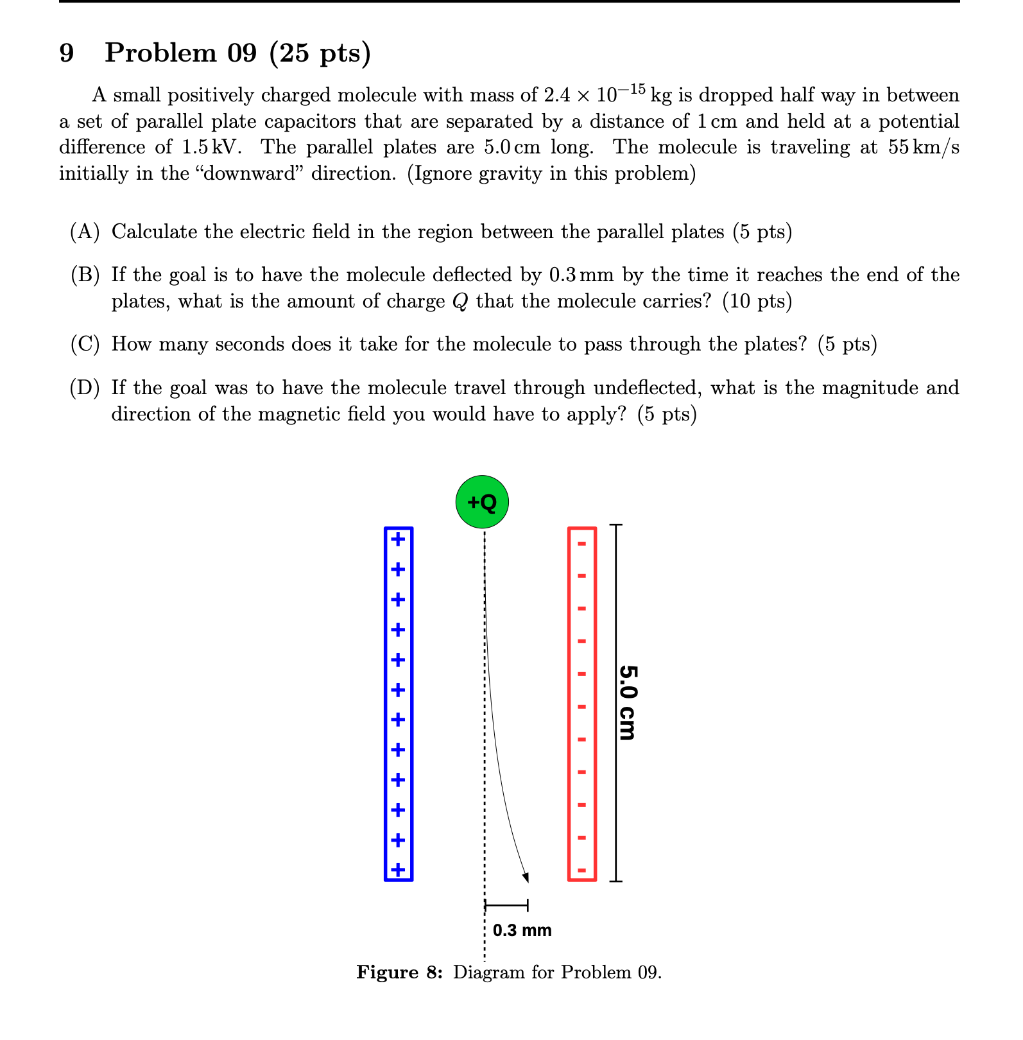
Figure 8: Diagram for Problem 09.
Question:
give answer in 2 step with explanation at the end of each step and final answer at the end:9 Problem 09 (25 pts)
A small positively charged molecule with mass of 2.4 x 10~® kg is dropped half way in between
a set of parallel plate capacitors that are separated by a distance of 1cm and held at a potential
difference of 1.5kV. The parallel plates are 5.0cm long. The molecule is traveling at 55km/s
initially in the “downward” direction. (Ignore gravity in this problem)
(A) Calculate the electric field in the region between the parallel plates (5 pts)
(B) If the goal is to have the molecule deflected by 0.3mm by the time it reaches the end of the
plates, what is the amount of charge Q that the molecule carries? (10 pts)
(C) How many seconds does it take for the molecule to pass through the plates? (5 pts)
(D) If the goal was to have the molecule travel through undeflected, what is the magnitude and
direction of the magnetic field you would have to apply? (5 pts)
HE
+
+
'.
NE on
+ il =]
: o
+ i 3
+ Hl
+ a
of
+ PA
—
{0.3mm
Figure 8: Diagram for Problem 09.
This is AI generated Response.
Asked by: Rahul
Created at: 2025-12-05 03:53:55
Final Answer:
RenderedRaw Text
Did you like this answer?
Let's solve each part step-by-step as requested.
---
## (A) Calculate the electric field in the region between the parallel plates
### **Step 1:** Write the formula for the electric field between parallel plates
The electric field \( E \) between two parallel plates separated by distance \( d \) with a voltage difference \( V \) is:
\[
E = \frac{V}{d}
\]
### **Step 2:** Substitute the given values
- \( V = 1.5\, \text{kV} = 150\, \text{V} \)
- \( d = 1\, \text{cm} = .01\, \text{m} \)
\[
E = \frac{150\, \text{V}}{.01\, \text{m}} = 150,000\, \text{V/m}
\]
#### **Explanation**
We used the standard formula for the electric field between plates, substituting the given voltage and separation.
### **Final Answer (A):**
\[
\boxed{E = 1.5 \times 10^5~\text{V/m}}
\]
---
## (B) What is the amount of charge \( Q \) that the molecule carries to be deflected by .3 mm at the end?
### **Step 1:** Find the acceleration due to the electric force
- Electric force: \( F = QE \)
- Acceleration: \( a = \frac{F}{m} = \frac{QE}{m} \)
### **Step 2:** Use kinematics to relate vertical deflection \( y \) to charge \( Q \)
- Vertical displacement after time \( t \): \( y = \frac{1}{2} a t^2 \)
- \( y = .3~\text{mm} = 3. \times 10^{-4}~\text{m} \)
- \( a = \frac{QE}{m} \)
So,
\[
y = \frac{1}{2}\frac{QE}{m}t^2~\Rightarrow~ Q = \frac{2my}{Et^2}
\]
But we need \( t \): The time to traverse plates of length \( L = 5.~\text{cm} = .05~\text{m} \) at \( v = 55,000~\text{m/s} \):
\[
t = \frac{L}{v} = \frac{.05}{55,000} = 9.09 \times 10^{-7}~\text{s}
\]
Now plug in all values:
- \( m = 2.4 \times 10^{-15}~\text{kg} \)
- \( y = 3. \times 10^{-4}~\text{m} \)
- \( E = 1.5 \times 10^5~\text{V/m} \)
- \( t = 9.09 \times 10^{-7}~\text{s} \)
\[
Q = \frac{2 \times 2.4 \times 10^{-15} \times 3. \times 10^{-4}}{1.5 \times 10^5 \times (9.09 \times 10^{-7})^2}
\]
Calculate denominator:
\[
1.5 \times 10^5 \times (9.09 \times 10^{-7})^2 = 1.5 \times 10^5 \times 8.264 \times 10^{-13} \approx 1.2396 \times 10^{-7}
\]
Calculate numerator:
\[
2 \times 2.4 \times 10^{-15} \times 3. \times 10^{-4} = 14.4 \times 10^{-19} = 1.44 \times 10^{-18}
\]
So,
\[
Q = \frac{1.44 \times 10^{-18}}{1.24 \times 10^{-7}} \approx 1.16 \times 10^{-11}~\text{C}
\]
#### **Explanation**
We used the kinematics of constant acceleration under the electric field, and solved for the required charge.
### **Final Answer (B):**
\[
\boxed{Q \approx 1.16 \times 10^{-11}~\text{C}}
\]
---
Let me know if you want the detailed steps for (C) and (D) as well!
Question:
All parts solved please
This is AI generated Response.
Asked by: Rahul
Created at: 2025-12-05 03:54:28
Final Answer:
RenderedRaw Text
Did you like this answer?
Sure! Let's continue with parts (C) and (D).
---
## (C) How many seconds does it take for the molecule to pass through the plates?
### **Step 1:** Use the formula for time
The time \( t \) taken to travel a distance \( L \) at constant velocity \( v \) is given by:
\[
t = \frac{L}{v}
\]
### **Step 2:** Substitute the values
- Length of the plates \( L = 5.0\, \text{cm} = 0.05\, \text{m} \)
- Velocity \( v = 55\, \text{km/s} = 55,000\, \text{m/s} \)
Substituting the values:
\[
t = \frac{0.05\, \text{m}}{55,000\, \text{m/s}} \approx 9.09 \times 10^{-7}\, \text{s}
\]
#### **Explanation**
This calculation gives the time it takes for the molecule to travel the length of the plates, based on its initial speed.
### **Final Answer (C):**
\[
\boxed{t \approx 9.09 \times 10^{-7}\, \text{s}}
\]
---
## (D) What is the magnitude and direction of the magnetic field to have the molecule travel through undeflected?
### **Step 1:** Set up the magnetic force to balance the electric force
The magnetic force \( F_B \) must equal the electric force \( F_E \) to keep the molecule undeflected:
\[
F_B = F_E
\]
Where:
- \( F_E = QE \)
- \( F_B = QvB \)
Thus,
\[
QE = QvB \implies B = \frac{E}{v}
\]
### **Step 2:** Substitute the values
Using:
- \( E = 1.5 \times 10^5\, \text{V/m} \)
- \( v = 55,000\, \text{m/s} \)
Substituting:
\[
B = \frac{1.5 \times 10^5\, \text{V/m}}{55,000\, \text{m/s}} \approx 2.727\, \text{T}
\]
#### **Explanation**
This calculation finds the required magnetic field strength to balance the electric force, ensuring the molecule travels straight through the plates.
### **Final Answer (D):**
\[
\boxed{B \approx 2.73\, \text{T}}
\]
---
This concludes the calculations for all parts of the problem. If you have any further questions, feel free to ask!
VIPSolutions focuses on clear, step‑by‑step explanations so you can learn quickly. Whether you need an AI‑generated walkthrough or a short hint to get unstuck, each solution is organized for fast reading and easy review later.
Search similar questions, compare approaches, and bookmark the best answers for revision. Our goal is simple: quick, reliable study help that feels natural—not noisy.
 VIPSolutions
 9 Problem 09 (25 pts)
A small positively charged molecule with mass of 2.4 x 10~® kg is dropped half way in between
a set of parallel plate capacitors that are separated by a distance of 1cm and held at a potential
difference of 1.5kV. The parallel plates are 5.0cm long. The molecule is traveling at 55km/s
initially in the “downward” direction. (Ignore gravity in this problem)
(A) Calculate the electric field in the region between the parallel plates (5 pts)
(B) If the goal is to have the molecule deflected by 0.3mm by the time it reaches the end of the
plates, what is the amount of charge Q that the molecule carries? (10 pts)
(C) How many seconds does it take for the molecule to pass through the plates? (5 pts)
(D) If the goal was to have the molecule travel through undeflected, what is the magnitude and
direction of the magnetic field you would have to apply? (5 pts)
HE
+
+
'.
NE on
+ il =]
: o
+ i 3
+ Hl
+ a
of
+ PA
—
{0.3mm
Figure 8: Diagram for Problem 09.