give answer in 2 step with explanation at the end of each step and final answer at the end:Ablockis initially held against a compressed spring on a horizontal track. When the spring is released, it pushes
the block along the track, which is frictionless everywhere except between points B and C. After passing this
region, the track rises into a ramp.
The block has a mass of m=0.20kg, and the spring is initially compressed by 4.0cm. The spring constant is
k=2.5 N/cm. After being released, the block slides up the ramp and reaches a maximum vertical height of
h=10cm, where it momentarily comes to rest before sliding back down.
As the block returns, it passes again through the frictional region between B and C and eventually comes to rest
exactly at point 8. The length of the frictional region is L=20cm. Find the coefficient of kinetic friction for the
region between B and C.
L D
— ig
A B Cc
Question:
give answer in 2 step with explanation at the end of each step and final answer at the end:Ablockis initially held against a compressed spring on a horizontal track. When the spring is released, it pushes
the block along the track, which is frictionless everywhere except between points B and C. After passing this
region, the track rises into a ramp.
The block has a mass of m=0.20kg, and the spring is initially compressed by 4.0cm. The spring constant is
k=2.5 N/cm. After being released, the block slides up the ramp and reaches a maximum vertical height of
h=10cm, where it momentarily comes to rest before sliding back down.
As the block returns, it passes again through the frictional region between B and C and eventually comes to rest
exactly at point 8. The length of the frictional region is L=20cm. Find the coefficient of kinetic friction for the
region between B and C.
L D
— ig
A B Cc
This is AI generated Response.
Asked by: Rahul
Created at: 2025-12-05 03:37:39
Final Answer:
RenderedRaw Text
Did you like this answer?
Let's solve the problem step by step as requested.
---
## **Step 1: Find Initial Energy Stored in the Spring and Energy Needed to Reach Height \( h \)**
**Given:**
- Mass, \( m = .20\, \text{kg} \)
- Spring constant, \( k = 2.5\, \text{N/cm} = 250\, \text{N/m} \)
- Compression, \( x = 4.\, \text{cm} = .040\, \text{m} \)
- Maximum height, \( h = 10\, \text{cm} = .10\, \text{m} \)
**Initial energy stored in spring:**
\[
E_{\text{spring}} = \frac{1}{2} k x^2 = \frac{1}{2} \cdot 250 \cdot (.040)^2 = .2\, \text{J}
\]
**Energy needed to reach height \( h \):**
\[
E_{\text{grav}} = mgh = .20 \times 9.8 \times .10 = .196\, \text{J}
\]
**Explanation:**
The spring stores \( .2\, \text{J} \) of energy. To reach height \( h \), the block needs \( .196\, \text{J} \). The difference must be the energy lost due to friction in region BC.
---
## **Step 2: Calculate Energy Lost to Friction and Find \(\mu\)**
**Energy lost to friction:**
\[
\Delta E = E_{\text{spring}} - E_{\text{grav}} = .2 - .196 = .004\, \text{J}
\]
**Work done by friction (as the block passes through BC twice):**
- Friction force = \( f = \mu m g \)
- Distance covered in BC = \( 2L \) (once on the way up, once on the way back)
- \( L = 20\, \text{cm} = .20\, \text{m} \)
\[
\text{Work by friction} = f \cdot d = \mu m g \cdot 2L
\]
Set equal to energy lost:
\[
\mu m g \cdot 2L = .004
\]
\[
\mu = \frac{.004}{2 \cdot .20 \cdot .20 \cdot 9.8}
\]
\[
\mu = \frac{.004}{.784}
\]
\[
\mu \approx .0051
\]
**Explanation:**
The total energy lost to friction (through BC twice) equals the difference between the spring energy and gravitational energy. Solving for \(\mu\) gives the coefficient of kinetic friction.
---
## **Final Answer**
\[
\boxed{\mu \approx .0051}
\]
This is the coefficient of kinetic friction for the region between B and C.
VIPSolutions focuses on clear, step‑by‑step explanations so you can learn quickly. Whether you need an AI‑generated walkthrough or a short hint to get unstuck, each solution is organized for fast reading and easy review later.
Search similar questions, compare approaches, and bookmark the best answers for revision. Our goal is simple: quick, reliable study help that feels natural—not noisy.
 VIPSolutions
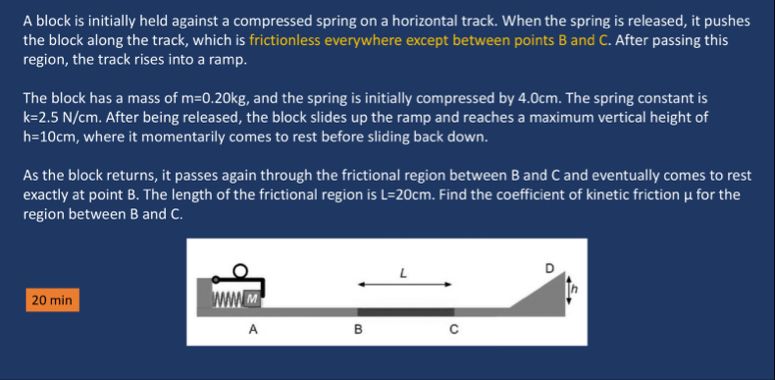 Ablockis initially held against a compressed spring on a horizontal track. When the spring is released, it pushes
the block along the track, which is frictionless everywhere except between points B and C. After passing this
region, the track rises into a ramp.
The block has a mass of m=0.20kg, and the spring is initially compressed by 4.0cm. The spring constant is
k=2.5 N/cm. After being released, the block slides up the ramp and reaches a maximum vertical height of
h=10cm, where it momentarily comes to rest before sliding back down.
As the block returns, it passes again through the frictional region between B and C and eventually comes to rest
exactly at point 8. The length of the frictional region is L=20cm. Find the coefficient of kinetic friction for the
region between B and C.
L D
— ig
A B Cc