 VIPSolutions
give answer in 2 step with explanation at the end of each step and final answer at the end:| Evaluate the indefinite integral. il / secs) tan(8e) do =| +C. < |
Question:
give answer in 2 step with explanation at the end of each step and final answer at the end: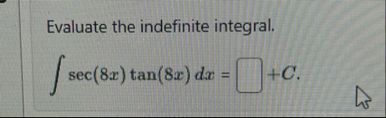 | Evaluate the indefinite integral.
il
/ secs) tan(8e) do =| +C. <
|
This is AI generated Response.
Asked by: Rahul
Created at: 2025-12-05 03:11:12
Asked by: Rahul
Created at: 2025-12-05 03:11:12
Final Answer:
Rendered
Raw Text
Did you like this answer?
## Step 1: Identify the Integral Form
The given integral is:
\[
\int \sec(8x)\tan(8x)\, dx
\]
Recall that the derivative of \(\sec(u)\) with respect to \(u\) is \(\sec(u)\tan(u)\). So if we let \(u = 8x\), then \(du = 8\,dx\).
**Explanation:**
We notice that \(\sec(8x)\tan(8x)\) is the derivative of \(\sec(8x)\), but we need to account for the chain rule since the argument is \(8x\).
---
## Step 2: Substitute and Integrate
Let \(u = 8x\), so \(dx = \frac{du}{8}\):
\[
\int \sec(8x)\tan(8x)\, dx = \int \sec(u)\tan(u) \cdot \frac{du}{8}
\]
\[
= \frac{1}{8} \int \sec(u)\tan(u)\, du
\]
Since \(\int \sec(u)\tan(u)\, du = \sec(u)\), we have:
\[
= \frac{1}{8} \sec(u) + C
\]
\[
= \frac{1}{8} \sec(8x) + C
\]
**Explanation:**
We performed a substitution and integrated, using the fact that the antiderivative of \(\sec(u)\tan(u)\) is \(\sec(u)\).
---
## **Final Answer**
\[
\boxed{\int \sec(8x)\tan(8x)\, dx = \frac{1}{8} \sec(8x) + C}
\]
📢 Instructions:
- Ask anything relatd to above question only.
- For new Question goto :