This is AI generated Response.
Asked by: Rahul
Created at: 2025-12-05 02:10:45
Final Answer:
RenderedRaw Text
Did you like this answer?
Let's solve each part in **2 steps with explanations** and a final answer at the end of each part:
---
## (a) Sketch the Magnetic Field Lines and Describe the Field
### Step 1: Field Lines Inside the Toroid (\(a < r < b\))
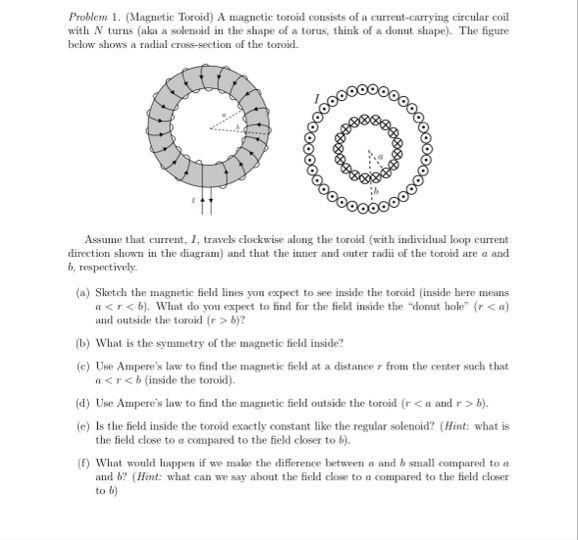
- The current \(I\) flows around the toroid, creating circular magnetic field lines inside the "donut" (the core).
- The field lines are **concentric circles** centered on the axis of the toroid, **tangent** to the path of the current.
**Explanation:**
By the right-hand rule, the magnetic field inside the toroid loops around the central axis, following the current direction.
### Step 2: Field Inside the “Donut Hole” (\(r < a\)) and Outside (\(r > b\))
- **Inside the hole (\(r < a\)):** No current is enclosed, so the field is **zero**.
- **Outside the toroid (\(r > b\)):** Similarly, the net current enclosed is zero, so the field is **zero**.
**Explanation:**
Ampère’s law states that if no net current is enclosed, the magnetic field must be zero.
**Final Answer:**
- Inside the toroid (\(a < r < b\)): Circular, concentric field lines.
- Inside the hole (\(r < a\)) and outside (\(r > b\)): Magnetic field is zero.
---
## (b) Symmetry of the Magnetic Field Inside
### Step 1: Shape and Direction
- The magnetic field inside the toroid is **azimuthal** (circles around the central axis).
**Explanation:**
Due to the toroidal symmetry, the field must be tangent to circles centered on the axis.
### Step 2: Magnitude
- The magnitude depends only on the distance \(r\) from the center, not on the angle.
**Explanation:**
By symmetry, at any point at radius \(r\), the field is the same.
**Final Answer:**
The field inside the toroid is **azimuthally symmetric** (depends only on distance from the center, not angle).
---
## (c) Ampère’s Law for Field Inside (\(a < r < b\))
### Step 1: Apply Ampère’s Law
\[
\oint \vec{B} \cdot d\vec{l} = \mu_ I_{\text{enc}}
\]
Choose a circular path of radius \(r\) (\(a < r < b\)), enclosing all \(N\) turns.
### Step 2: Calculate Enclosed Current
\[
I_{\text{enc}} = N I
\]
\[
B \cdot 2\pi r = \mu_ N I \implies B = \frac{\mu_ N I}{2\pi r}
\]
**Explanation:**
Ampère’s loop encloses all the current \(N I\), giving the result above.
**Final Answer:**
\[
B(r) = \frac{\mu_ N I}{2\pi r}, \quad a < r < b
\]
---
## (d) Ampère’s Law for Field Outside (\(r < a\) and \(r > b\))
### Step 1: For \(r < a\) (inside the hole)
- The Ampère loop encloses **no current**.
\[
I_{\text{enc}} = \implies B =
\]
### Step 2: For \(r > b\) (outside the toroid)
- The total net current passing through the loop is zero (current goes in and returns around the loop).
\[
I_{\text{enc}} = \implies B =
\]
**Explanation:**
By Ampère’s law, no net current enclosed means zero field.
**Final Answer:**
\[
B = \quad \text{for} \quad r < a \quad \text{and} \quad r > b
\]
---
## (e) Is the Toroid Field Constant Like in a Solenoid?
### Step 1: Solenoid Field
- In a long solenoid, the field inside is **constant**.
### Step 2: Toroid Field
- In a toroid, \(B(r) \propto 1/r\), so it **varies** with radius.
**Explanation:**
Since \(r\) changes from \(a\) to \(b\), the field decreases as you move outward.
**Final Answer:**
The field inside a toroid is **not constant**; it decreases with increasing \(r\).
---
## (f) What if \(a\) and \(b\) Are Close Together? (Narrow Toroid)
### Step 1: Narrow Toroid (\(a \approx b\))
- The difference in \(r\) is small, so \(B(r)\) does not change much across the core.
### Step 2: Field Comparison
- The field becomes **almost constant**, similar to a solenoid.
- For \(r\) close to \(a\), \(B\) is slightly higher than for \(r\) close to \(b\).
**Explanation:**
As the width of the toroid shrinks, the \(1/r\) variation diminishes and the field approaches a constant value.
**Final Answer:**
If \(a \approx b\), the field inside the toroid becomes nearly constant, similar to a solenoid.
VIPSolutions focuses on clear, step‑by‑step explanations so you can learn quickly. Whether you need an AI‑generated walkthrough or a short hint to get unstuck, each solution is organized for fast reading and easy review later.
Search similar questions, compare approaches, and bookmark the best answers for revision. Our goal is simple: quick, reliable study help that feels natural—not noisy.
 VIPSolutions
 Problem 1. (Magnetic Toroid) A magnetic toro consists of n currnt-carying cicula cil
with tur (an slew in the shape of a torus, think of & dona shape). The figure
low shows sil cros-section of the toroid
AL oo
po 1%
7 X omen ©
g £28
{ S & Mo
3 & 2 ©
5 y § & ® 3
2 Teeg® §
0 QF
. rey oc
coco
Assume that current, 1, trasels clockwise along the toroid (with individual oop curent
ection sw nthe diagram) ad that. the fer snd oer ods of the toroid ae a asl
bn pectively
(a) Sheth the magnetic field lines you expect 1 see inside the toi inside here means
< 7.< b). What do sou expec to fu for the eld side the “dont bok” (r < a)
nd ouside te toroid (>)?
0) What isthe symmetry of the magnetic fed inside”
6) Uso Ampere Le id the magic feb a a distanoe from the conker wich that
b).
6) 1 the eld inside the toroid exactly const ie the regular solenoid? (Hint: what's
held close 0 a compared tthe ied cher 0 6.
(6) What woul iappen i we make the difference betwen a ae b sal compar 10.0
and b7 (fink what can wo sy about the hl che to compare the ld caer
wh)