 VIPSolutions
give answer in 2 step with explanation at the end of each step and final answer at the end:Experiment 2* Hypothesis: The speed of water circulation is proportional to the rate of temperature increase of an object immersed in liquid Flow meter sme @) il
Question:
give answer in 2 step with explanation at the end of each step and final answer at the end: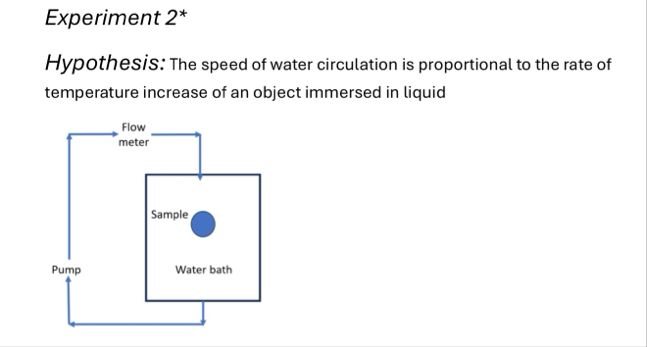 Experiment 2*
Hypothesis: The speed of water circulation is proportional to the rate of
temperature increase of an object immersed in liquid
Flow
meter
sme @)
il
This is AI generated Response.
Asked by: Rahul
Created at: 2025-12-04 12:25:10
Asked by: Rahul
Created at: 2025-12-04 12:25:10
Final Answer:
Rendered
Raw Text
Did you like this answer?
## Step 1: Understanding the Hypothesis
**Explanation:**
The hypothesis states that the speed of water circulation (how fast water moves around the sample) is directly proportional to the rate at which the temperature of an object (the sample) increases when it is placed in the liquid. This means, if you increase the speed of water flow, the sample's temperature should rise faster.
---
## Step 2: Analyzing the Experimental Setup
**Explanation:**
The setup consists of a water bath with a sample inside, connected to a pump that circulates water. A flow meter measures the speed of water movement. As water circulates, it transfers heat to the sample. Faster water movement means more frequent transfer of heated water to the sample, increasing the rate at which the sample's temperature rises.
---
## Final Answer
**The experiment is designed to test whether increasing the speed of water circulation (measured by the flow meter) causes the sample to heat up faster, supporting the hypothesis that these two variables are proportional.**
Question:
Solve correct answer
This is AI generated Response.
Asked by: Rahul
Created at: 2025-12-04 12:25:27
Asked by: Rahul
Created at: 2025-12-04 12:25:27
Final Answer:
Rendered
Raw Text
Did you like this answer?
## Step 1: Understanding the Hypothesis
**Explanation:**
The hypothesis states that the speed of water circulation is directly proportional to the rate of temperature increase of an object immersed in the liquid. This implies that as the speed of water flow increases, the temperature of the object should rise more rapidly. In mathematical terms, if \( v \) is the speed of water circulation and \( T \) is the temperature increase rate, the hypothesis can be expressed as:
\[
T \propto v
\]
This means that \( T = k \cdot v \) for some constant \( k \).
---
## Step 2: Analyzing the Experimental Setup
**Explanation:**
The experiment involves a water bath where a sample is immersed. A pump circulates water around the sample, and a flow meter measures the speed of water flow. As water circulates, it transfers heat to the sample. If the flow meter indicates a higher speed, the water brings more heat to the sample per unit time, leading to a quicker temperature rise. This relationship can be observed by recording temperature changes at different flow rates.
---
## Final Answer
**The experiment aims to verify that increasing the speed of water circulation leads to a faster temperature increase in the sample, thus supporting the hypothesis that water circulation speed and temperature increase rate are proportional.**
📢 Instructions:
- Ask anything relatd to above question only.
- For new Question goto :