 VIPSolutions
give answer in 2 step with explanation at the end of each step and final answer at the end:Question 2 pes pe dey em Sr es Aa Sb ey ET me QQ. — Fim ik eh Bante rr fee oe eh = rs A es
Question:
give answer in 2 step with explanation at the end of each step and final answer at the end: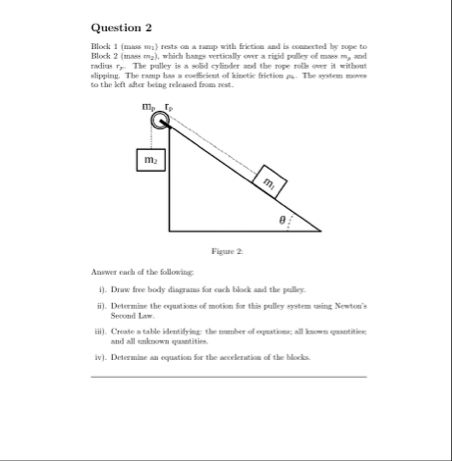 Question 2
pes pe dey
em
Sr es Aa Sb ey
ET
me
QQ.
—
Fim ik eh
Bante rr fee oe eh
=
rs
A es
This is AI generated Response.
Asked by: Rahul
Created at: 2025-12-04 04:53:52
Asked by: Rahul
Created at: 2025-12-04 04:53:52
Final Answer:
Rendered
Raw Text
Did you like this answer?
Certainly! We'll proceed step-by-step as requested.
---
## **Step 1: Draw Free Body Diagrams & Identify Forces**
### For Block 1 (\(m_1\)) on the Ramp
- **Forces acting on \(m_1\):**
- Gravity (\(m_1g\)): Acts vertically downward.
- Normal force (\(N\)): Perpendicular to the ramp surface.
- Friction (\(f_k\)): Opposes the motion, acts up the ramp. \(f_k = \mu_k N\)
- Tension (\(T\)): Acts up the ramp, along the direction of the rope.
**Decompose gravity into components:**
- Parallel to ramp: \(m_1g \sin\theta\) (down the ramp)
- Perpendicular to ramp: \(m_1g \cos\theta\) (into the ramp)
**Explanation:**
Here, we've identified all the forces acting on block \(m_1\) and decomposed gravity to make equations easier to set up later.
---
### For Block 2 (\(m_2\)) (Hanging)
- **Forces acting on \(m_2\):**
- Gravity (\(m_2g\)): Acts downward.
- Tension (\(T\)): Acts upward (through the rope).
**Explanation:**
Block \(m_2\) is only affected by gravity pulling it down and tension pulling it up.
---
### For Pulley (\(m_p\))
- **Forces/Torques acting on pulley:**
- Tensions on either side of rope: \(T_1\) (side of block 1), \(T_2\) (side of block 2)
- Rotational inertia: The pulley is a solid cylinder, so \(I = \frac{1}{2}m_pr^2\)
- Friction in the bearing is neglected.
**Explanation:**
The difference in tensions on either side of the pulley causes it to rotate, contributing to the system's dynamics.
---
## **Step 2: Write Equations of Motion (Newton’s Second Law)**
### For Block 1 on Ramp:
\[
m_1 a = T - m_1g\sin\theta - f_k
\]
Where \(f_k = \mu_k N = \mu_k m_1 g \cos\theta\)
### For Block 2 (Hanging):
\[
m_2 a = m_2 g - T_2
\]
### For Pulley (Rotational):
\[
\tau = I \alpha \implies (T_1 - T_2) r = I \frac{a}{r}
\]
Where \(I = \frac{1}{2}m_p r^2\) and the rope doesn't slip, so \(a = r\alpha\).
**Explanation:**
We have set up Newton's second law for each mass and the pulley, relating forces and torques to accelerations. \(T_1\) and \(T_2\) are not necessarily equal because the pulley has mass and rotational inertia.
---
## **Final Answer: (Equation for Acceleration)**
Now, solve for acceleration \(a\):
1. For block 1:
\[
m_1 a = T_1 - m_1g\sin\theta - \mu_k m_1 g \cos\theta
\]
\[
T_1 = m_1 a + m_1g\sin\theta + \mu_k m_1 g \cos\theta
\]
2. For block 2:
\[
m_2 a = m_2 g - T_2
\]
\[
T_2 = m_2 g - m_2 a
\]
3. For pulley:
\[
(T_1 - T_2) r = \frac{1}{2} m_p r^2 \frac{a}{r}
\implies T_1 - T_2 = \frac{1}{2} m_p a
\]
**Substitute for \(T_1\) and \(T_2\):**
\[
\left[m_1 a + m_1g\sin\theta + \mu_k m_1 g \cos\theta\right] - [m_2 g - m_2 a] = \frac{1}{2} m_p a
\]
\[
m_1 a + m_1g\sin\theta + \mu_k m_1 g \cos\theta - m_2 g + m_2 a = \frac{1}{2} m_p a
\]
\[
(m_1 + m_2) a - \frac{1}{2} m_p a = m_2 g - m_1g\sin\theta - \mu_k m_1 g \cos\theta
\]
\[
\left(m_1 + m_2 + \frac{1}{2} m_p\right) a = m_2 g - m_1g\sin\theta - \mu_k m_1 g \cos\theta
\]
\[
a = \frac{m_2 g - m_1g\sin\theta - \mu_k m_1 g \cos\theta}{m_1 + m_2 + \frac{1}{2} m_p}
\]
---
## **Final Answer:**
\[
\boxed{
a = \frac{m_2 g - m_1g\sin\theta - \mu_k m_1 g \cos\theta}{m_1 + m_2 + \frac{1}{2} m_p}
}
\]
**This equation gives the acceleration of the blocks, considering the effects of friction, the angle of the ramp, and the inertia of the pulley.**
Question:
Solve all parts
This is AI generated Response.
Asked by: Rahul
Created at: 2025-12-04 04:54:45
Asked by: Rahul
Created at: 2025-12-04 04:54:45
Final Answer:
Rendered
Raw Text
Did you like this answer?
## Step-by-Step Solution
### **Step 1: Analyze the System and Identify Forces**
#### For Block 1 (\(m_1\)) on the Ramp
- **Forces acting on \(m_1\):**
- Weight: \(m_1g\) (downward)
- Normal Force: \(N\) (perpendicular to the ramp)
- Frictional Force: \(f_k = \mu_k N\) (up the ramp)
- Tension: \(T\) (up the ramp)
**Gravity Components:**
- Parallel to ramp: \(m_1g \sin\theta\)
- Perpendicular to ramp: \(m_1g \cos\theta\)
**Explanation:**
We define the forces acting on block \(m_1\), breaking down the gravitational force into components to simplify calculations later.
---
#### For Block 2 (\(m_2\)) (Hanging)
- **Forces acting on \(m_2\):**
- Weight: \(m_2g\) (downward)
- Tension: \(T\) (upward)
**Explanation:**
Block \(m_2\) experiences only gravitational force and tension, which helps us set up the equations of motion.
---
#### For the Pulley
- **Forces/Torques acting on the pulley:**
- Tension on either side: \(T_1\) (block 1) and \(T_2\) (block 2)
- Moment of Inertia: \(I = \frac{1}{2}m_p r^2\)
**Explanation:**
The difference in tensions creates a torque that affects the pulley’s rotation, which is crucial for understanding the entire system's dynamics.
---
### **Step 2: Write Equations of Motion**
#### For Block 1 on Ramp:
Using Newton's second law:
\[
m_1 a = T_1 - m_1g \sin\theta - f_k
\]
Substituting friction:
\[
f_k = \mu_k m_1 g \cos\theta \implies m_1 a = T_1 - m_1g \sin\theta - \mu_k m_1 g \cos\theta
\]
#### For Block 2 (Hanging):
\[
m_2 a = m_2 g - T_2
\]
#### For Pulley (Rotational Motion):
Using torque:
\[
\tau = I \alpha \implies (T_1 - T_2) r = \frac{1}{2} m_p r^2 \frac{a}{r}
\]
Thus:
\[
T_1 - T_2 = \frac{1}{2} m_p a
\]
**Explanation:**
We formulated the equations of motion for both blocks and the pulley, establishing relationships between tension, acceleration, and forces acting on them.
---
### **Final Equation for Acceleration**
1. From the equation for block 1:
\[
T_1 = m_1 a + m_1g \sin\theta + \mu_k m_1 g \cos\theta
\]
2. From the equation for block 2:
\[
T_2 = m_2 g - m_2 a
\]
3. Substitute \(T_1\) and \(T_2\) into the pulley equation:
\[
\left(m_1 a + m_1g \sin\theta + \mu_k m_1 g \cos\theta\right) - \left(m_2 g - m_2 a\right) = \frac{1}{2} m_p a
\]
Rearranging gives:
\[
(m_1 + m_2) a + m_1g \sin\theta + \mu_k m_1 g \cos\theta - m_2 g = \frac{1}{2} m_p a
\]
4. Combine terms:
\[
\left(m_1 + m_2 + \frac{1}{2} m_p\right) a = m_2 g - m_1g \sin\theta - \mu_k m_1 g \cos\theta
\]
5. Solve for \(a\):
\[
a = \frac{m_2 g - m_1g\sin\theta - \mu_k m_1 g \cos\theta}{m_1 + m_2 + \frac{1}{2} m_p}
\]
---
## **Final Answer:**
\[
\boxed{
a = \frac{m_2 g - m_1g\sin\theta - \mu_k m_1 g \cos\theta}{m_1 + m_2 + \frac{1}{2} m_p}
}
\]
**This equation provides the acceleration of the blocks, taking into account the effects of friction, the ramp angle, and the mass of the pulley.**
📢 Instructions:
- Ask anything relatd to above question only.
- For new Question goto :