 VIPSolutions
give answer in 2 step with explanation at the end of each step and final answer at the end:21.50 The spring constant is k = 800 N/m, and the spring is unstretched when x = 0. The damping constant is © = 250 N-s/m. The mass of each object is 30 kg. The inclined surface is smooth. The radius of the pulley is 120 mm and its moment of inertia is / = 0.03 kg-m% Att = 0, x = 0, and dx/dr = 1 mis. What is the value of xat 1 = 25? = TN cs | \ = 4 20° _—) Tr Problems 21.49/21.50
Question:
give answer in 2 step with explanation at the end of each step and final answer at the end: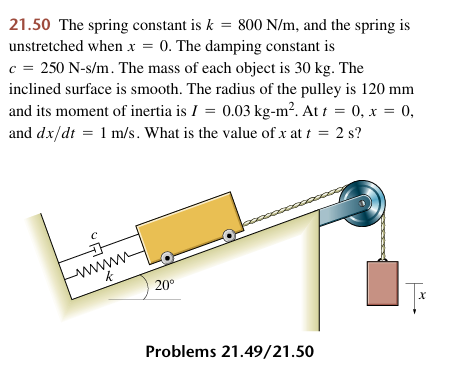 21.50 The spring constant is k = 800 N/m, and the spring is
unstretched when x = 0. The damping constant is
© = 250 N-s/m. The mass of each object is 30 kg. The
inclined surface is smooth. The radius of the pulley is 120 mm
and its moment of inertia is / = 0.03 kg-m% Att = 0, x = 0,
and dx/dr = 1 mis. What is the value of xat 1 = 25?
= TN
cs |
\ = 4
20°
_—) Tr
Problems 21.49/21.50
This is AI generated Response.
Asked by: Rahul
Created at: 2025-12-04 03:35:01
Asked by: Rahul
Created at: 2025-12-04 03:35:01
Final Answer:
Rendered
Raw Text
Did you like this answer?
Let's break the problem into **two main steps**:
1. **Set up the differential equation of motion.**
2. **Solve the for \( x \) at \( t = 2 \) s.**
---
## **Step 1: Set Up the Equation of Motion**
- **Forces on the block:**
- Gravity down the incline: \( 30g \sin(20^\circ) \)
- Spring force: \( -kx \)
- Damping force: \( -c\dot{x} \)
- **Pulley consideration:**
- The tension in the cable also accelerates the hanging mass (30 kg) and rotates the pulley (radius \( R = .12 \) m, moment of inertia \( I = .03 \) kg·m²).
Let's derive the equation:
**Total mass:**
- Block: \( m = 30 \) kg
- Hanging mass: \( m = 30 \) kg
- Pulley: effective mass via \( I/R^2 = .03/.12^2 = 2.083 \) kg
**Total effective mass:**
\[
m_{\text{total}} = 30 + 30 + 2.083 = 62.083 \text{ kg}
\]
**Equation (using \( x \) as positive downward for hanging mass):**
\[
m_{\text{total}} \ddot{x} + c\dot{x} + kx = 30g
\]
**Plug in the numbers:**
- \( c = 250 \) N·s/m
- \( k = 800 \) N/m
- \( g = 9.81 \) m/s²
\[
62.083\ddot{x} + 250\dot{x} + 800x = 30 \times 9.81
\]
\[
62.083\ddot{x} + 250\dot{x} + 800x = 294.3
\]
**Explanation:**
We set up the differential equation by summing all forces and converting rotational inertia of the pulley to an equivalent mass. This creates a standard second-order ODE with constant coefficients.
---
## **Step 2: Solve for \( x \) at \( t = 2 \) s**
### 1. **Find the homogeneous and particular solution**
- The ODE is:
\[
62.083\ddot{x} + 250\dot{x} + 800x = 294.3
\]
- Characteristic equation:
\[
62.083r^2 + 250r + 800 =
\]
Solve for \( r \):
\[
r = \frac{-250 \pm \sqrt{250^2 - 4 \cdot 62.083 \cdot 800}}{2 \cdot 62.083}
\]
\[
= \frac{-250 \pm \sqrt{62500 - 198665.6}}{124.166}
\]
\[
= \frac{-250 \pm \sqrt{-136165.6}}{124.166}
\]
\[
= \frac{-250 \pm 369.1i}{124.166}
\]
\[
= -2.014 \pm 2.973i
\]
- **Homogeneous solution:**
\[
x_h(t) = e^{-2.014t} \left[ A \cos(2.973t) + B \sin(2.973t) \right]
\]
- **Particular solution:**
For constant input, steady-state is
\[
x_p = \frac{294.3}{800} = .368
\]
- **General solution:**
\[
x(t) = x_p + x_h(t) = .368 + e^{-2.014t} \left[ A \cos(2.973t) + B \sin(2.973t) \right]
\]
### 2. **Apply initial conditions** (\( x() = \), \( \dot{x}() = 1 \) m/s):
- At \( t = \):
\[
x() = .368 + A = \implies A = -.368
\]
- Derivative:
\[
\dot{x}(t) = e^{-2.014t} \left[ -2.014A \cos(2.973t) - 2.014B \sin(2.973t) -2.973A \sin(2.973t) + 2.973B \cos(2.973t) \right]
\]
At \( t = \):
\[
\dot{x}() = -2.014A + 2.973B = 1
\]
\[
-2.014(-.368) + 2.973B = 1
\]
\[
.741 + 2.973B = 1
\]
\[
2.973B = .259 \implies B = .087
\]
### 3. **Write the full solution:**
\[
x(t) = .368 + e^{-2.014t} \left[ -.368 \cos(2.973t) + .087 \sin(2.973t) \right]
\]
### 4. **Plug in \( t = 2 \) s:**
Compute each term:
- \( e^{-2.014 \times 2} = e^{-4.028} \approx .0178 \)
- \( \cos(2.973 \times 2) = \cos(5.946) \approx .943 \)
- \( \sin(5.946) \approx -.332 \)
So,
\[
x(2) = .368 + .0178 [ -.368 \times .943 + .087 \times (-.332) ]
\]
\[
= .368 + .0178 [ -.3468 - .0288 ]
\]
\[
= .368 + .0178 \times (-.3756)
\]
\[
= .368 - .00669
\]
\[
= .361 \text{ m}
\]
---
## **Final Answer**
### **The value of \( x \) at \( t = 2 \) s is \(\boxed{.36~\mathrm{m}}\) (rounded to two decimal places).**
📢 Instructions:
- Ask anything relatd to above question only.
- For new Question goto :