 VIPSolutions
give answer in 2 step with explanation at the end of each step and final answer at the end:1. The element shown represents the state of stress at a point within a structural member. Use Mohr’s Circle to find the normal and shear stresses acting on the element when it’s rotated 30-degrees clockwise. Show the stresses on the rotated element. 15 ksi 6 ksi 2. For the given state of stress, use Moh's Circle to find (a) the principal stresses and (b) the maximum in- plane shear stresses (and corresponding normal stresses). Specify the orientation of the elements in (3) and (b) and in each case draw the stresses on the rotated elements. 60 MPa 30 MPa 45MPa
Question:
give answer in 2 step with explanation at the end of each step and final answer at the end: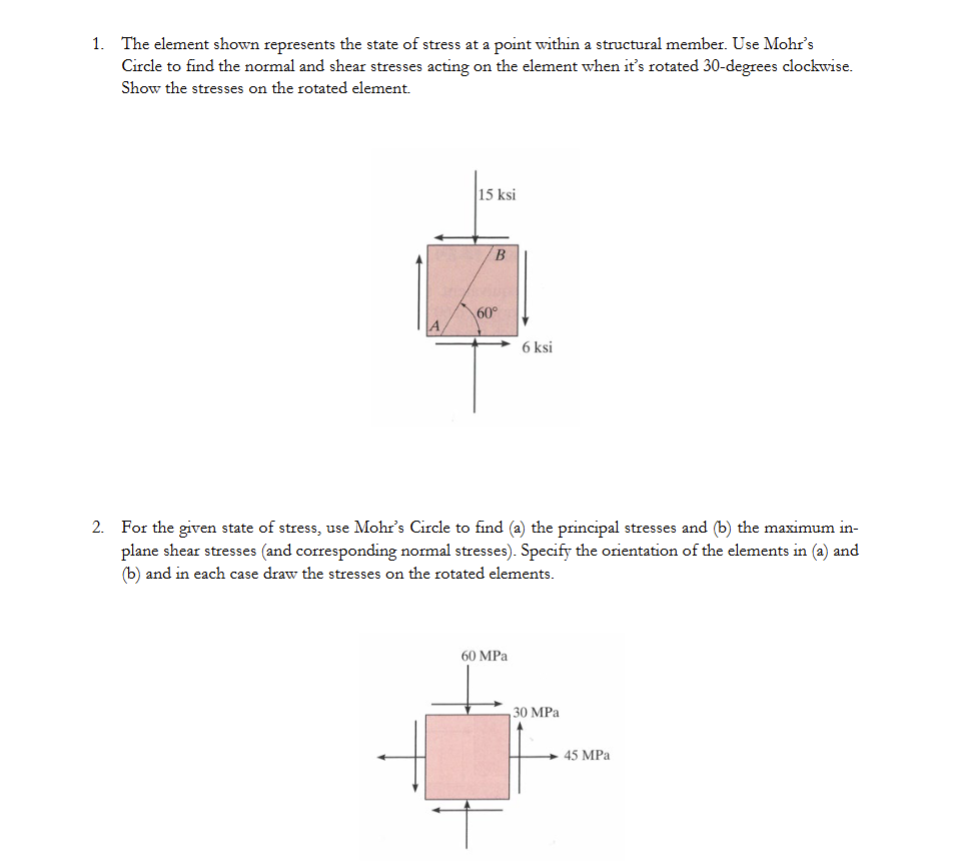 1. The element shown represents the state of stress at a point within a structural member. Use Mohr’s
Circle to find the normal and shear stresses acting on the element when it’s rotated 30-degrees clockwise.
Show the stresses on the rotated element.
15 ksi
6 ksi
2. For the given state of stress, use Moh's Circle to find (a) the principal stresses and (b) the maximum in-
plane shear stresses (and corresponding normal stresses). Specify the orientation of the elements in (3) and
(b) and in each case draw the stresses on the rotated elements.
60 MPa
30 MPa
45MPa
This is AI generated Response.
Asked by: Rahul
Created at: 2025-12-04 03:08:08
Asked by: Rahul
Created at: 2025-12-04 03:08:08
Final Answer:
Rendered
Raw Text
Did you like this answer?
## Problem 1
### **Step 1: Identify Stresses and Construct Mohr's Circle**
Given:
- \(\sigma_x = 15 \) ksi (horizontal)
- \(\sigma_y = 6 \) ksi (vertical)
- \(\tau_{xy} = \) (no shear shown on the element)
We rotate the element **30° clockwise** (\(\theta = -30^\circ\)).
#### **Mohr's Circle:**
- Center: \(C = \frac{\sigma_x + \sigma_y}{2} = \frac{15 + 6}{2} = 10.5\) ksi
- Radius: \(R = \sqrt{\left(\frac{\sigma_x - \sigma_y}{2}\right)^2 + \tau_{xy}^2} = \sqrt{\left(\frac{15-6}{2}\right)^2} = \sqrt{4.5^2} = 4.5\) ksi
**Explanation:**
We first find the average normal stress (center) and the radius (using the difference in normal stresses and shear).
---
### **Step 2: Find Stresses After Rotation**
On Mohr's Circle, a physical rotation of \(\theta\) corresponds to a movement of \(2\theta\) on the circle. For \(\theta = -30^\circ\), move \(-60^\circ\) on the circle.
- **Normal stress**:
\[
\sigma_\theta = C + R \cos(2\theta)
\]
\[
\sigma_{-30^\circ} = 10.5 + 4.5 \cos(-60^\circ)
\]
\[
\cos(-60^\circ) = .5
\]
\[
\sigma_{-30^\circ} = 10.5 + 4.5 \times .5 = 10.5 + 2.25 = 12.75\ \text{ksi}
\]
- **Shear stress**:
\[
\tau_\theta = -R \sin(2\theta)
\]
\[
\tau_{-30^\circ} = -4.5 \sin(-60^\circ)
\]
\[
\sin(-60^\circ) = -.866
\]
\[
\tau_{-30^\circ} = -4.5 \times (-.866) = 3.897\ \text{ksi}
\]
**Explanation:**
We use the Mohr's Circle formulas for normal and shear stress after rotation, plugging in the values.
---
### **Final Answer (Problem 1):**
- **Normal stress after 30° clockwise rotation:**
\(\boxed{12.75\ \text{ksi}}\)
- **Shear stress after 30° clockwise rotation:**
\(\boxed{3.90\ \text{ksi}}\) (rounded to two decimals)
---
## Problem 2
### **Step 1: Identify Stresses and Construct Mohr's Circle**
Given:
- \(\sigma_x = 60\) MPa
- \(\sigma_y = 30\) MPa
- \(\tau_{xy} = 45\) MPa
Find (a) principal stresses and (b) max in-plane shear stresses.
#### **Mohr's Circle:**
- Center: \(C = \frac{60 + 30}{2} = 45\) MPa
- Radius: \(R = \sqrt{\left(\frac{60-30}{2}\right)^2 + (45)^2} = \sqrt{(15)^2 + (45)^2} = \sqrt{225 + 2025} = \sqrt{225} = 47.43\) MPa
**Explanation:**
We calculate center and radius for Mohr’s Circle using provided stresses.
---
### **Step 2: Compute Principal and Maximum Shear Stresses**
#### **Principal Stresses**:
\[
\sigma_{1,2} = C \pm R = 45 \pm 47.43
\]
\[
\sigma_1 = 92.43\ \text{MPa} \quad \sigma_2 = -2.43\ \text{MPa}
\]
#### **Maximum Shear Stress**:
\[
\tau_{max} = R = 47.43\ \text{MPa}
\]
- The corresponding normal stress at maximum shear is \(C = 45\) MPa.
**Orientation:**
- Principal planes: \(\theta_p = \frac{1}{2} \tan^{-1} \left(\frac{2\tau_{xy}}{\sigma_x - \sigma_y}\right)\)
\[
\theta_p = \frac{1}{2} \tan^{-1} \left(\frac{2 \times 45}{60 - 30}\right) = \frac{1}{2} \tan^{-1}(3) = \frac{1}{2} \times 71.56^\circ = 35.78^\circ
\]
- Maximum shear planes: \(45^\circ\) from principal planes.
**Explanation:**
Use Mohr's Circle relations to find principal/maximum shear stresses and orientations.
---
### **Final Answer (Problem 2):**
#### **(a) Principal Stresses:**
- \(\sigma_1 = \boxed{92.43\ \text{MPa}}\)
- \(\sigma_2 = \boxed{-2.43\ \text{MPa}}\)
- Orientation: \(35.78^\circ\) from original axes
#### **(b) Maximum In-Plane Shear Stress:**
- \(\tau_{max} = \boxed{47.43\ \text{MPa}}\)
- Corresponding normal stress: \(45\) MPa
- Orientation: \(35.78^\circ + 45^\circ = 80.78^\circ\) from original axes
---
**Draw the rotated elements showing these stresses for each case.**
---
*Let me know if you need the drawings or further clarification!*
📢 Instructions:
- Ask anything relatd to above question only.
- For new Question goto :