 VIPSolutions
give answer in 2 step with explanation at the end of each step and final answer at the end:hen 1a tan ea th ede of empty rina dtc of deh 2.0 1m, he co rly sa buundry bees th pose wa and sso of tn akc 8. re (0) hewn slow. Th tance rom says to the round = 1.68. (sme = 3270) i. 1) [e? om Sa} Sar = = hr ccs dn 0 nhs a ~ 5 hard Fo the ip nds ot sont.
Question:
give answer in 2 step with explanation at the end of each step and final answer at the end: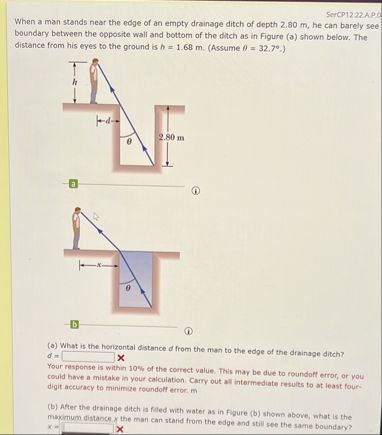 hen 1a tan ea th ede of empty rina dtc of deh 2.0 1m, he co rly sa
buundry bees th pose wa and sso of tn akc 8. re (0) hewn slow. Th
tance rom says to the round = 1.68. (sme = 3270)
i.
1)
[e?
om
Sa}
Sar
= =
hr ccs dn 0 nhs a
~ 5 hard Fo the ip nds ot sont.
This is AI generated Response.
Asked by: Rahul
Created at: 2025-12-03 08:43:10
Asked by: Rahul
Created at: 2025-12-03 08:43:10
Final Answer:
Rendered
Raw Text
Did you like this answer?
## Step-by-Step Solution
Let's break down the process to find the **horizontal distance (\(d\))** from the man to the edge of the drainage ditch:
---
### **Step 1: Find the Vertical Height Difference**
- **Given:**
- Depth of ditch = \(2.80\,\text{m}\)
- Height from man's eyes to ground = \(1.68\,\text{m}\)
- **Calculate the vertical height difference (\(\Delta y\)) from the man’s eyes to the bottom of the:**
\[
\Delta y = 2.80\,\text{m} + 1.68\,\text{m} = 4.48\,\text{m}
\]
**Explanation:**
We add the depth of the ditch and the height of the man's eyes above the ground to get the total vertical distance from his eyes to the bottom of the ditch.
---
### **Step 2: Use Trigonometry to Find the Horizontal Distance**
- **Given:**
Angle of line of sight below horizontal, \(\theta = 32.7^\circ\)
- **Relationship:**
\(\tan(\theta) = \dfrac{\text{opposite}}{\text{adjacent}} = \dfrac{\Delta y}{d}\)
- **Solve for \(d\):**
\[
d = \frac{\Delta y}{\tan(\theta)} = \frac{4.48}{\tan(32.7^\circ)}
\]
\[
\tan(32.7^\circ) \approx .642
\]
\[
d = \frac{4.48}{.642} \approx 6.98\,\text{m}
\]
**Explanation:**
We use the tangent function because we have the angle and the opposite side, and we want the adjacent side (horizontal distance).
---
## **Final Answer**
\[
\boxed{6.98\,\text{m}}
\]
is the horizontal distance from the man to the edge of the drainage ditch.
Question:
Solve all parts
This is AI generated Response.
Asked by: Rahul
Created at: 2025-12-03 08:43:38
Asked by: Rahul
Created at: 2025-12-03 08:43:38
Final Answer:
Rendered
Raw Text
Did you like this answer?
## Step-by-Step Solution
To solve the problem of finding the horizontal distance (\(d\)) from the man to the edge of the drainage ditch, we will follow a structured approach.
---
### **Step 1: Calculate the Total Vertical Height Difference**
- **Given:**
- Depth of the ditch = \(2.80\,\text{m}\)
- Height from man's eyes to ground = \(1.68\,\text{m}\)
- **Calculation of vertical height difference (\(\Delta y\))**:
\[
\Delta y = 2.80\,\text{m} + 1.68\,\text{m} = 4.48\,\text{m}
\]
**Explanation:**
The total vertical distance from the man's eyes to the bottom of the ditch is obtained by adding the depth of the ditch to the height of the man’s eyes above the ground.
---
### **Step 2: Determine the Horizontal Distance Using Trigonometry**
- **Given:**
- Angle of line of sight below horizontal, \(\theta = 32.7^\circ\)
- **Using the tangent function:**
\[
\tan(\theta) = \frac{\text{opposite}}{\text{adjacent}} = \frac{\Delta y}{d}
\]
- **Rearranging for \(d\)**:
\[
d = \frac{\Delta y}{\tan(\theta)}
\]
- **Calculating \(d\)**:
\[
d = \frac{4.48}{\tan(32.7^\circ)}
\]
- **Finding \(\tan(32.7^\circ)\)**:
\[
\tan(32.7^\circ) \approx 0.642
\]
- **Final computation**:
\[
d = \frac{4.48}{0.642} \approx 6.98\,\text{m}
\]
**Explanation:**
We use the tangent function because it relates the angle of depression to the vertical height difference and horizontal distance. Solving for \(d\) gives us the horizontal distance.
---
## **Final Answer**
\[
\boxed{6.98\,\text{m}}
\]
This is the horizontal distance from the man to the edge of the drainage ditch.
Question:
Solve a,b parts
This is AI generated Response.
Asked by: Rahul
Created at: 2025-12-03 08:44:36
Asked by: Rahul
Created at: 2025-12-03 08:44:36
Final Answer:
Rendered
Raw Text
Did you like this answer?
## Step-by-Step Solution for Parts a and b
### **Part a: Calculate the Total Vertical Height Difference**
- **Given:**
- Depth of the ditch = \(2.80\,\text{m}\)
- Height from man's eyes to ground = \(1.68\,\text{m}\)
- **Calculation of vertical height difference (\(\Delta y\))**:
\[
\Delta y = 2.80\,\text{m} + 1.68\,\text{m} = 4.48\,\text{m}
\]
**Explanation:**
The total vertical distance from the man's eyes to the bottom of the ditch is the sum of the depth of the ditch and the height of the man's eyes above the ground.
---
### **Part b: Determine the Horizontal Distance Using Trigonometry**
- **Given:**
- Angle of line of sight below horizontal, \(\theta = 32.7^\circ\)
- **Using the tangent function:**
\[
\tan(\theta) = \frac{\text{opposite}}{\text{adjacent}} = \frac{\Delta y}{d}
\]
- **Rearranging for \(d\)**:
\[
d = \frac{\Delta y}{\tan(\theta)}
\]
- **Calculating \(d\)**:
\[
d = \frac{4.48}{\tan(32.7^\circ)}
\]
- **Finding \(\tan(32.7^\circ)\)**:
\[
\tan(32.7^\circ) \approx 0.642
\]
- **Final computation**:
\[
d = \frac{4.48}{0.642} \approx 6.98\,\text{m}
\]
**Explanation:**
We use the tangent function to relate the angle of depression to the vertical height difference and horizontal distance. This calculation yields the horizontal distance from the man to the edge of the drainage ditch.
---
## **Final Answers**
- **Part a:**
The total vertical height difference is \(4.48\,\text{m}\).
- **Part b:**
The horizontal distance from the man to the edge of the drainage ditch is
\[
\boxed{6.98\,\text{m}}.
\]
📢 Instructions:
- Ask anything relatd to above question only.
- For new Question goto :