 VIPSolutions
give answer in 2 step with explanation at the end of each step and final answer at the end:Synthesis / Retrosynthetic Analysis 6. Using the carbon containing starting material(s) provided, propose a synthetic scheme for the following target molecule. Provide structures for all intermediates. The carbon atoms in the product must originate from the starting material(s), but you may use as many equivalents of each starting material as you would like. and any reagent/reaction you know. (note: no mechanisms are required). I'S ON —> = On Page 13
Question:
give answer in 2 step with explanation at the end of each step and final answer at the end: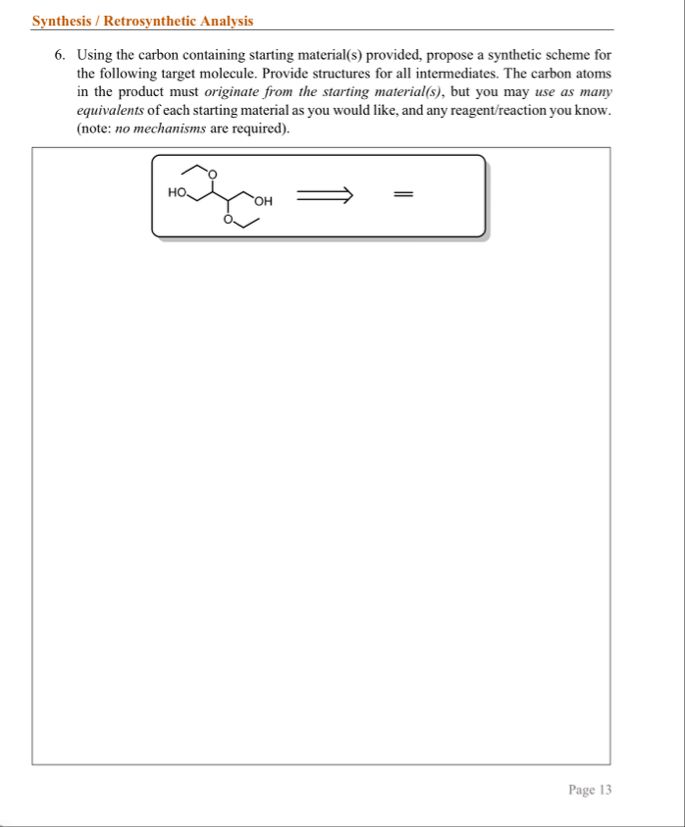 Synthesis / Retrosynthetic Analysis
6. Using the carbon containing starting material(s) provided, propose a synthetic scheme for
the following target molecule. Provide structures for all intermediates. The carbon atoms
in the product must originate from the starting material(s), but you may use as many
equivalents of each starting material as you would like. and any reagent/reaction you know.
(note: no mechanisms are required).
I'S ON —> =
On
Page 13
This is AI generated Response.
Asked by: Rahul
Created at: 2025-12-02 15:35:38
Asked by: Rahul
Created at: 2025-12-02 15:35:38
Final Answer:
Rendered
Raw Text
Did you like this answer?
## Step 1: Oxidation of Alcohols to Carbonyls
**Explanation:**
The starting material contains two primary alcohol groups. To convert these to a compound where a double bond (alkene) is present, we first need to oxidize both alcohols to carbonyls (aldehyde or ketone).
- Use **PCC** or **Jones reagent** (CrO₃/H₂SO₄) to oxidize both alcohols to aldehydes.
**Intermediate Structure:**
```
O O
|| ||
HO–CH₂–C–CH₂–C–OH
```
Now we have a 1,4-dialdehyde.
---
## Step 2: Double Aldol Condensation (or Intramolecular Aldol Reaction)
**Explanation:**
When a 1,4-dialdehyde undergoes a base-catalyzed aldol condensation, it can cyclize to form a five-membered ring with a double bond (α,β-unsaturated carbonyl, or alkene after dehydration).
- Use **NaOH/H₂O, heat** for intramolecular aldol condensation.
- This results in cyclopentenone after dehydration.
**Final Product:**
```
O
||
/ \
| |
\ = /
```
This is **2-cyclopentenone**.
---
## **Final Answer**
**Step 1:** Oxidize both primary alcohols to aldehydes to get a 1,4-dialdehyde.
**Step 2:** Subject the dialdehyde to base (NaOH) and heat to induce intramolecular aldol condensation, forming cyclopentenone (a five-membered ring with a double bond and a ketone).
**Target molecule:** **Cyclopentenone** (2-cyclopentenone).
Question:
Solve correct answer
This is AI generated Response.
Asked by: Rahul
Created at: 2025-12-02 15:39:27
Asked by: Rahul
Created at: 2025-12-02 15:39:27
Final Answer:
Rendered
Raw Text
Did you like this answer?
# Synthesis Retrosynthetic Analysis
## Step 1: Oxidation of Alcohols to Carbonyls
**Explanation:**
The synthesis begins with the oxidation of the two primary alcohol groups present in the starting material. To achieve the desired target molecule, we first convert these alcohols into carbonyls (aldehydes).
- **Reagents:** Use **PCC** (Pyridinium chlorochromate) or **Jones reagent** (CrO₃/H₂SO₄) to oxidize both alcohols.
**Intermediate Structure:**
```
O O
|| ||
HO–CH₂–C–CH₂–C–OH
```
After oxidation, we obtain a **1,4-dialdehyde**.
---
## Step 2: Double Aldol Condensation (or Intramolecular Aldol Reaction)
**Explanation:**
Next, the 1,4-dialdehyde can undergo a base-catalyzed aldol condensation to form an α,β-unsaturated carbonyl compound by cyclizing into a five-membered ring.
- **Reagents:** Use **NaOH** and **heat** for the intramolecular aldol condensation. This reaction leads to the formation of a cyclopentenone after dehydration.
**Final Product:**
```
O
||
/ \
| |
\ = /
```
This structure represents **2-cyclopentenone**, which is the target molecule.
---
## Final Answer
1. **Step 1:** Oxidize both primary alcohols to aldehydes to form a **1,4-dialdehyde**.
2. **Step 2:** Perform intramolecular aldol condensation using **NaOH** and heat to yield **2-cyclopentenone**.
**Target molecule:** **Cyclopentenone (2-cyclopentenone)**.
📢 Instructions:
- Ask anything relatd to above question only.
- For new Question goto :