 VIPSolutions
give answer in 2 step with explanation at the end of each step and final answer at the end:1) Starting from rest, a penny (mass nm, and radius rp), a nickel (mass 71, and radius ry), and a marble (mass mn and radius rm) each roll without slipping down a ramp of height 40 cm. a. At the bottom of the ramp, how will their final speeds compare? Make a conceptual argument; no equations are necessary for this part. b. Now, solve for the final speed of each object. (You will get a numerical value.) c. Was your answer to part a correct? If not, explain.
Question:
give answer in 2 step with explanation at the end of each step and final answer at the end: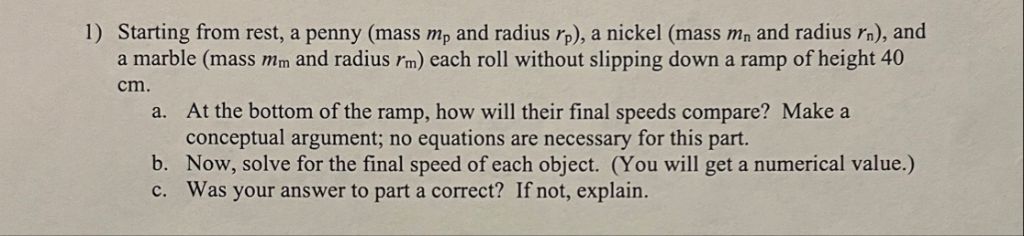 1) Starting from rest, a penny (mass nm, and radius rp), a nickel (mass 71, and radius ry), and
a marble (mass mn and radius rm) each roll without slipping down a ramp of height 40
cm.
a. At the bottom of the ramp, how will their final speeds compare? Make a
conceptual argument; no equations are necessary for this part.
b. Now, solve for the final speed of each object. (You will get a numerical value.)
c. Was your answer to part a correct? If not, explain.
This is AI generated Response.
Asked by: Rahul
Created at: 2025-12-02 09:34:10
Asked by: Rahul
Created at: 2025-12-02 09:34:10
Final Answer:
Rendered
Raw Text
Did you like this answer?
### Step 1: **Conceptual Argument (Part a)**
**Explanation:**
All objects start from rest and roll **without slipping** down the same ramp. When rolling without slipping, both translational and rotational kinetic energy must be considered. The final speed at the bottom depends not just on mass, but on the **moment of inertia** of each object. Generally:
- **Penny and nickel** are modeled as solid disks (moment of inertia: \(I = \frac{1}{2} m r^2\))
- **Marble** is a solid sphere (moment of inertia: \(I = \frac{2}{5} m r^2\))
**Conceptual conclusion:**
The final speed will **not** be the same for all three objects. The object with the **smallest moment of inertia relative to its mass** will have the largest final speed. The solid sphere (marble) will reach the bottom with a higher speed than the disks (penny and nickel).
---
### Step 2: **Numerical Calculation (Part b)**
**Explanation:**
Use **energy conservation**. The potential energy at the top (\(mgh\)) is converted into translational (\(\frac{1}{2}mv^2\)) and rotational (\(\frac{1}{2}I\omega^2\)) kinetic energy at the bottom.
For rolling without slipping: \(v = \omega r\)
**Energy equation:**
\[
mgh = \frac{1}{2}mv^2 + \frac{1}{2}I\omega^2
\]
Substitute \(I\) and \(\omega\):
- For disks: \(I = \frac{1}{2}mr^2\), so \(\frac{1}{2}I\omega^2 = \frac{1}{4}mv^2\)
- For sphere: \(I = \frac{2}{5}mr^2\), so \(\frac{1}{2}I\omega^2 = \frac{1}{5}mv^2\)
**Solve for \(v\):**
- For disk:
\[
mgh = \frac{1}{2}mv^2 + \frac{1}{4}mv^2 = \frac{3}{4}mv^2 \implies v_{disk} = \sqrt{\frac{4gh}{3}}
\]
- For sphere:
\[
mgh = \frac{1}{2}mv^2 + \frac{1}{5}mv^2 = \frac{7}{10}mv^2 \implies v_{sphere} = \sqrt{\frac{10gh}{7}}
\]
Given \(h = .40\) m, \(g = 9.8\) m/s²:
- \(v_{disk} = \sqrt{\frac{4 \times 9.8 \times .40}{3}} = \sqrt{\frac{15.68}{3}} = \sqrt{5.23} \approx 2.29\) m/s
- \(v_{sphere} = \sqrt{\frac{10 \times 9.8 \times .40}{7}} = \sqrt{\frac{39.2}{7}} = \sqrt{5.6} \approx 2.37\) m/s
---
### Step 3: **Check with Part a (Part c)**
**Explanation:**
The calculation confirms the conceptual argument:
- The **marble (sphere)**, with a smaller moment of inertia ratio, ends up with a **slightly higher speed** than the disks (penny and nickel).
- The penny and nickel (both disks) have the **same final speed**, which is lower than that of the marble.
---
## **Final Answers**
- **a.** The marble will reach the bottom with the highest speed; the penny and nickel will have the same (lower) speed.
- **b.** Penny/Nickel: \(v \approx 2.29\) m/s; Marble: \(v \approx 2.37\) m/s.
- **c.** Yes, the conceptual answer in (a) is confirmed by the calculations in (b).
📢 Instructions:
- Ask anything relatd to above question only.
- For new Question goto :