 VIPSolutions
give answer in 2 step with explanation at the end of each step and final answer at the end:1) Starting from rest, a penny (mass nm, and radius rp), a nickel (mass 71, and radius ry), and a marble (mass mn and radius rm) each roll without slipping down a ramp of height 40 cm. a. At the bottom of the ramp, how will their final speeds compare? Make a conceptual argument; no equations are necessary for this part. b. Now, solve for the final speed of each object. (You will get a numerical value.) c. Was your answer to part a correct? If not, explain.
Question:
give answer in 2 step with explanation at the end of each step and final answer at the end: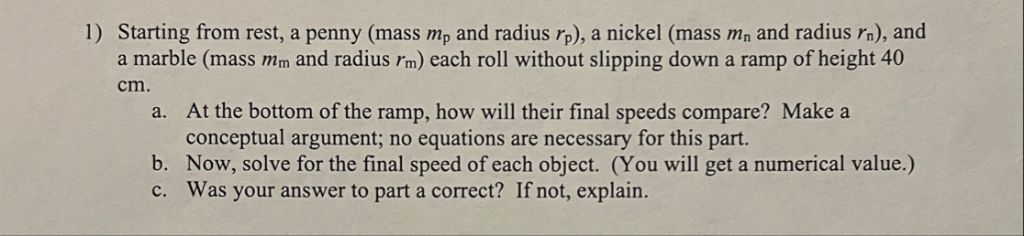 1) Starting from rest, a penny (mass nm, and radius rp), a nickel (mass 71, and radius ry), and
a marble (mass mn and radius rm) each roll without slipping down a ramp of height 40
cm.
a. At the bottom of the ramp, how will their final speeds compare? Make a
conceptual argument; no equations are necessary for this part.
b. Now, solve for the final speed of each object. (You will get a numerical value.)
c. Was your answer to part a correct? If not, explain.
This is AI generated Response.
Asked by: Rahul
Created at: 2025-12-02 09:33:32
Asked by: Rahul
Created at: 2025-12-02 09:33:32
Final Answer:
Rendered
Raw Text
Did you like this answer?
## Step 1: **Conceptual Argument (Part a)**
**Explanation:**
All objects are **rolling without slipping** down the same ramp of height 40 cm, starting from rest. The **final speed at the bottom** depends on how the initial potential energy is split between translational and rotational kinetic energy. For rolling without slipping, the distribution depends on the shape (moment of inertia), **not on mass or radius**.
- A **penny and a nickel** are both solid disks (same type of object).
- A **marble** is a solid sphere.
**Solid spheres** have a smaller moment of inertia relative to their mass than solid disks, so more energy goes into translation (linear speed). Thus, the **marble will have the highest final speed**, and the penny and nickel will have the same (but lower) final speeds.
**Conclusion for Step 1:**
- Marble > Penny = Nickel (in terms of final speed)
---
## Step 2: **Numerical Calculation (Part b)**
### **Energy Conservation:**
Total mechanical energy is conserved:
\[
mgh = \frac{1}{2}mv^2 + \frac{1}{2}I\omega^2
\]
For rolling without slipping, \( v = \omega r \).
### **Moment of Inertia:**
- **Solid disk (penny, nickel):** \( I = \frac{1}{2}mr^2 \)
- **Solid sphere (marble):** \( I = \frac{2}{5}mr^2 \)
### **Plug in for each shape:**
#### **Solid Disk:**
\[
mgh = \frac{1}{2}mv^2 + \frac{1}{2} \left(\frac{1}{2}mr^2\right)\left(\frac{v^2}{r^2}\right)
\]
\[
mgh = \frac{1}{2}mv^2 + \frac{1}{4}mv^2 = \frac{3}{4}mv^2
\]
\[
gh = \frac{3}{4}v^2 \implies v = \sqrt{\frac{4}{3}gh}
\]
#### **Solid Sphere:**
\[
mgh = \frac{1}{2}mv^2 + \frac{1}{2} \left(\frac{2}{5}mr^2\right)\left(\frac{v^2}{r^2}\right)
\]
\[
mgh = \frac{1}{2}mv^2 + \frac{1}{5}mv^2 = \frac{7}{10}mv^2
\]
\[
gh = \frac{7}{10}v^2 \implies v = \sqrt{\frac{10}{7}gh}
\]
### **Plug in \( h = .40 \) m, \( g = 9.8 \) m/s²:**
- **Solid disks (penny, nickel):**
\[
v_{\text{disk}} = \sqrt{\frac{4}{3} \cdot 9.8 \cdot .40} = \sqrt{\frac{4}{3} \cdot 3.92} = \sqrt{5.227} \approx 2.29\, \text{m/s}
\]
- **Solid sphere (marble):**
\[
v_{\text{sphere}} = \sqrt{\frac{10}{7} \cdot 9.8 \cdot .40} = \sqrt{\frac{10}{7} \cdot 3.92} = \sqrt{5.6} \approx 2.37\, \text{m/s}
\]
**Conclusion for Step 2:**
- **Marble:** ~2.37 m/s
- **Penny:** ~2.29 m/s
- **Nickel:** ~2.29 m/s
---
## Step 3: **Check (Part c)**
**Was the conceptual answer correct?**
Yes. The marble (solid sphere) moves fastest, and the penny and nickel (both solid disks) have the same, but slightly lower, speed.
---
## **Final Answers**
- **(a)** The marble will be fastest; penny and nickel will be equally fast but slower than the marble.
- **(b)** Marble: **2.37 m/s**; Penny/Nickel: **2.29 m/s**
- **(c)** Yes, the conceptual answer was correct.
📢 Instructions:
- Ask anything relatd to above question only.
- For new Question goto :