 VIPSolutions
give answer in 2 step with explanation at the end of each step and final answer at the end:Assume J is given by the graph below. SUppose J 1s continuous and that (5) = 0. 7 3 2 o—_0 o—0 1 1 2 3 4 5 6 7 -1 -2 = Oo—0 Sketch, on a sheet of work paper, an accurate graph of £, and use it to find each of 10 [0] and 1-1) Then find the value of the integral: 2 0 (Note that you can do this in two different ways)
Question:
give answer in 2 step with explanation at the end of each step and final answer at the end: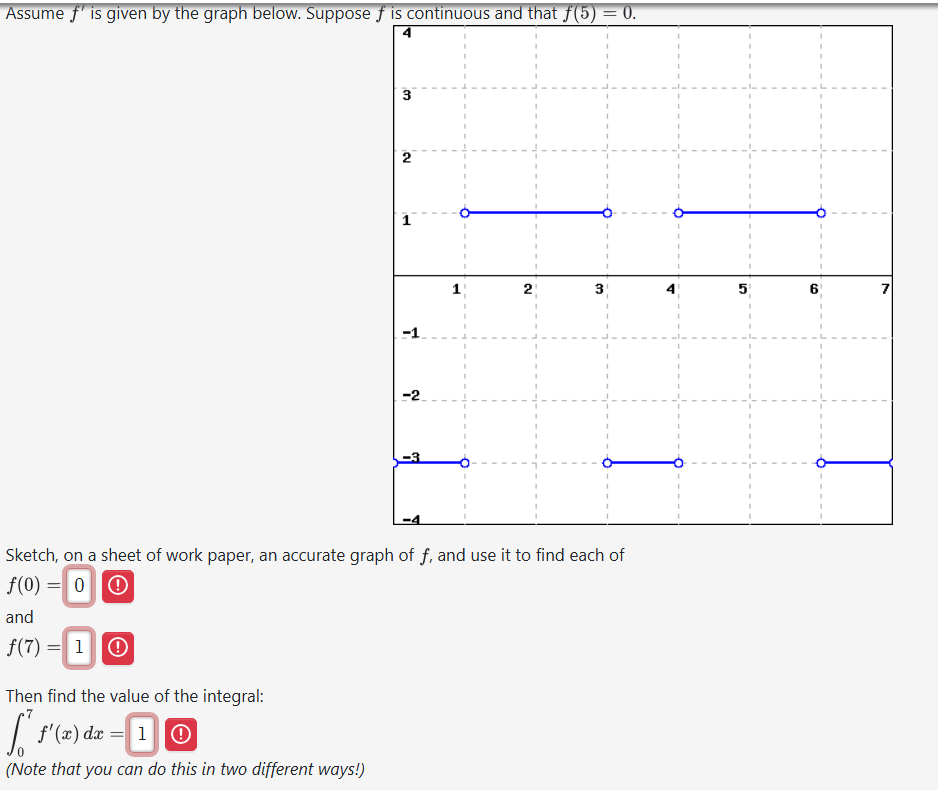 Assume J is given by the graph below. SUppose J 1s continuous and that (5) = 0.
7
3
2
o—_0 o—0
1
1 2 3 4 5 6 7
-1
-2
= Oo—0
Sketch, on a sheet of work paper, an accurate graph of £, and use it to find each of
10 [0]
and
1-1)
Then find the value of the integral:
2
0
(Note that you can do this in two different ways)
This is AI generated Response.
Asked by: Rahul
Created at: 2025-12-02 05:12:26
Asked by: Rahul
Created at: 2025-12-02 05:12:26
Final Answer:
Rendered
Raw Text
Did you like this answer?
Let's break down the problem into two steps as requested.
---
## **Step 1: Find \( f() \) and \( f(7) \) Using the Graph of \( f'(x) \)**
### Explanation:
- The graph shows \('(x) \) is **piecewise constant**:
- From \( x = \) to \( x = 2 \), \( f'(x) = -3 \)
- From \( x = 2 \) to \( x = 5 \), \( f'(x) = 1 \)
- From \( x = 5 \) to \( x = 7 \), \( f'(x) = 1 \)
- We know **\( f(5) = \)**.
- To find \( f() \) and \( f(7) \), use the Fundamental Theorem of Calculus:
\[
f(b) = f(a) + \int_a^b f'(x) \, dx
\]
#### **Finding \( f() \):**
We know \( f(5) = \), want to find \( f() \):
\[
f(5) = f() + \int_^5 f'(x) \, dx
\]
So,
\[
f() = f(5) - \int_^5 f'(x) \, dx
\]
Calculate the integral:
- From to 2: \( f'(x) = -3 \) ⇒ Area = \( -3 \times 2 = -6 \)
- From 2 to 5: \( f'(x) = 1 \) ⇒ Area = \( 1 \times 3 = 3 \)
- Total: \( -6 + 3 = -3 \)
So:
\[
f() = - (-3) = 3
\]
**Explanation:**
We found \( f() \) by integrating \( f'(x) \) from to 5 and subtracting from \( f(5) \).
---
#### **Finding \( f(7) \):**
Similarly,
\[
f(7) = f(5) + \int_5^7 f'(x) \, dx
\]
From 5 to 7: \( f'(x) = 1 \) ⇒ Area = \( 1 \times 2 = 2 \)
So:
\[
f(7) = + 2 = 2
\]
**Explanation:**
We found \( f(7) \) by integrating \( f'(x) \) from 5 to 7 and adding to \( f(5) \).
---
## **Step 2: Calculate \( \int_^7 f'(x) \, dx \)**
### Explanation:
The total integral is the sum of areas under \( f'(x) \) from to 7:
- From to 2: \( -3 \times 2 = -6 \)
- From 2 to 5: \( 1 \times 3 = 3 \)
- From 5 to 7: \( 1 \times 2 = 2 \)
Sum: \( -6 + 3 + 2 = -1 \)
Alternatively, by the Fundamental Theorem:
\[
\int_^7 f'(x) dx = f(7) - f() = 2 - 3 = -1
\]
**Explanation:**
The value of the integral is the net area under the graph between \( x = \) and \( x = 7 \), or simply \( f(7) - f() \).
---
## **Final Answers**
- \( f() = \boxed{3} \)
- \( f(7) = \boxed{2} \)
- \( \int_^7 f'(x) dx = \boxed{-1} \)
📢 Instructions:
- Ask anything relatd to above question only.
- For new Question goto :