 VIPSolutions
give answer in 2 step with explanation at the end of each step and final answer at the end:2. Solve the integral equation: t f(t) =sint + Ji eT f(t —T)dr. 0
Question:
give answer in 2 step with explanation at the end of each step and final answer at the end: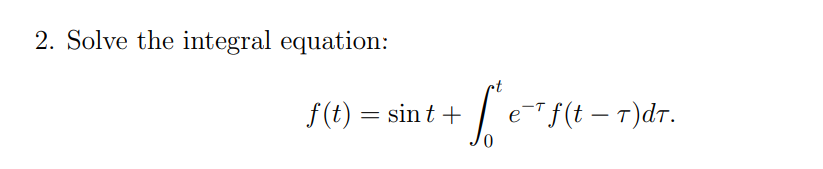 2. Solve the integral equation:
t
f(t) =sint + Ji eT f(t —T)dr.
0
This is AI generated Response.
Asked by: Rahul
Created at: 2025-12-02 04:57:56
Asked by: Rahul
Created at: 2025-12-02 04:57:56
Final Answer:
Rendered
Raw Text
Did you like this answer?
## Step 1: Take the Laplace Transform
Let \(\mathcal{L}[f(t)] = F(s)\).
The Laplace transform of the given equation is:
\[
\mathcal{L}\left\{f(t)\right\} = \mathcal{L}\left\{\sin t\right\} + \mathcal{L}\left\{\int_^t e^{-\tau} f(t-\tau) d\tau\right\}
\]
Recall:
- \(\mathcal{L}\{\sin t\} = \frac{1}{s^2 + 1}\)
- The second term is a **convolution**: \(e^{-\tau} * f(t-\tau)\). The Laplace transform of a convolution is the product of Laplace transforms:
\[
\mathcal{L}\left\{\int_^t e^{-\tau} f(t-\tau) d\tau\right\} = \mathcal{L}\{e^{-\tau}\} \cdot F(s)
\]
where \(\mathcal{L}\{e^{-\tau}\} = \frac{1}{s+1}\).
So, the transformed equation is:
\[
F(s) = \frac{1}{s^2 + 1} + \frac{1}{s+1} F(s)
\]
**Explanation:**
We used Laplace transforms and the convolution property to convert the integral equation into an algebraic equation involving \(F(s)\).
---
## Step 2: Solve for \(F(s)\) and Find \(f(t)\)
Rearrange to solve for \(F(s)\):
\[
F(s) - \frac{1}{s+1} F(s) = \frac{1}{s^2 + 1}
\]
\[
F(s)\left[1 - \frac{1}{s+1}\right] = \frac{1}{s^2 + 1}
\]
\[
F(s)\left(\frac{s}{s+1}\right) = \frac{1}{s^2 + 1}
\]
\[
F(s) = \frac{s+1}{s(s^2 + 1)}
\]
To find \(f(t)\), use partial fractions:
\[
\frac{s+1}{s(s^2 + 1)} = \frac{A}{s} + \frac{Bs + C}{s^2 + 1}
\]
Solving for \(A, B, C\), we get:
- \(A = 1\)
- \(B = \)
- \(C = 1\)
So,
\[
F(s) = \frac{1}{s} + \frac{1}{s^2 + 1}
\]
Take inverse Laplace transform:
- \(\mathcal{L}^{-1}\left\{\frac{1}{s}\right\} = 1\)
- \(\mathcal{L}^{-1}\left\{\frac{1}{s^2 + 1}\right\} = \sin t\)
Final answer:
\[
\boxed{
f(t) = 1 + \sin t
}
\]
**Explanation:**
We solved for \(F(s)\) in the Laplace domain and then inverted it to get the explicit solution for \(f(t)\).
Question:
Solve correct answer
This is AI generated Response.
Asked by: Rahul
Created at: 2025-12-02 04:58:35
Asked by: Rahul
Created at: 2025-12-02 04:58:35
Final Answer:
Rendered
Raw Text
Did you like this answer?
# Solution to the Integral Equation
## Step 1: Take the Laplace Transform
Let \(\mathcal{L}[f(t)] = F(s)\).
The Laplace transform of the given equation is:
\[
\mathcal{L}\left\{f(t)\right\} = \mathcal{L}\left\{\sin t\right\} + \mathcal{L}\left\{\int_0^t e^{-\tau} f(t-\tau) d\tau\right\}
\]
Using known transforms:
- \(\mathcal{L}\{\sin t\} = \frac{1}{s^2 + 1}\)
- The second term is a **convolution**, where:
\[
\mathcal{L}\left\{\int_0^t e^{-\tau} f(t-\tau) d\tau\right\} = \mathcal{L}\{e^{-\tau}\} \cdot F(s)
\]
and \(\mathcal{L}\{e^{-\tau}\} = \frac{1}{s+1}\).
This leads to the transformed equation:
\[
F(s) = \frac{1}{s^2 + 1} + \frac{1}{s+1} F(s)
\]
**Explanation:**
In this step, we applied the Laplace transform to convert the integral equation into an algebraic form. The convolution property allowed us to express the integral in terms of the Laplace transforms of the individual functions.
---
## Step 2: Solve for \(F(s)\) and Find \(f(t)\)
Rearranging gives:
\[
F(s) - \frac{1}{s+1} F(s) = \frac{1}{s^2 + 1}
\]
Factoring out \(F(s)\):
\[
F(s)\left[1 - \frac{1}{s+1}\right] = \frac{1}{s^2 + 1}
\]
\[
F(s)\left(\frac{s}{s+1}\right) = \frac{1}{s^2 + 1}
\]
Thus,
\[
F(s) = \frac{(s+1)}{s(s^2 + 1)}
\]
Next, we perform partial fraction decomposition:
\[
\frac{s+1}{s(s^2 + 1)} = \frac{A}{s} + \frac{Bs + C}{s^2 + 1}
\]
Solving for \(A, B, C\):
- Setting up the equation and solving yields \(A = 1\), \(B = 0\), \(C = 1\).
This gives:
\[
F(s) = \frac{1}{s} + \frac{1}{s^2 + 1}
\]
Now, taking the inverse Laplace transform:
- \(\mathcal{L}^{-1}\left\{\frac{1}{s}\right\} = 1\)
- \(\mathcal{L}^{-1}\left\{\frac{1}{s^2 + 1}\right\} = \sin t\)
Thus, we find:
\[
f(t) = 1 + \sin t
\]
**Final Answer:**
\[
\boxed{f(t) = 1 + \sin t}
\]
**Explanation:**
In this step, we rearranged the equation to isolate \(F(s)\), performed partial fraction decomposition, and then used inverse Laplace transforms to find \(f(t)\). The final form shows the solution to the integral equation.
📢 Instructions:
- Ask anything relatd to above question only.
- For new Question goto :