 VIPSolutions
give answer in 2 step with explanation at the end of each step and final answer at the end:i : a 5 E § x : a & & ° tl
Question:
give answer in 2 step with explanation at the end of each step and final answer at the end: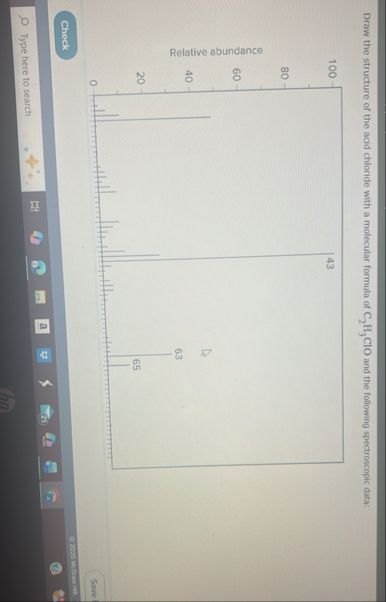 i
:
a 5
E §
x :
a &
& °
tl
This is AI generated Response.
Asked by: Rahul
Created at: 2025-12-01 22:06:08
Asked by: Rahul
Created at: 2025-12-01 22:06:08
Final Answer:
Rendered
Raw Text
Did you like this answer?
## Step : Analyzing the Mass Spectrum
The spectrum shows two notable peaks at **m/z = 63** and **m/z = 65**.
The molecular formula given is **C₂H₃ClO** (acid chloride).
- **Chlorine isotopes**: Cl has two common isotopes, ³⁵Cl and ³⁷Cl, with a natural abundance ratio of about 3:1.
- The two peaks (63 and 65) are separated by 2 mass units, matching the presence of these isotopes.
**Explanation:**
The presence of two major peaks separated by 2 and a ~3:1 intensity ratio is a signature for a molecule containing one chlorine atom.
---
## Step 2: Proposing the Structure
Given: **C₂H₃ClO** and the functional group is acid chloride.
- Acid chloride functional group: **-COCl**
- The remaining atoms: 1 more carbon, 3 hydrogens
Combine the pieces:
- Attach the -COCl group to a methyl group (CH₃).
- Structure: **CH₃COCl** (acetyl chloride)
**Explanation:**
This structure uses all atoms in the formula and fits the acid chloride functional group requirement. The mass spectrum's isotopic pattern supports the presence of a single Cl atom.
---
## **Final Answer**
### **Structure: Acetyl chloride (CH₃COCl)**
- **Molecular formula:** C₂H₃ClO
- **Structure:**
```
H O
| ||
H—C—C—Cl
|
H
```
- **Mass spectrum:** Matches the expected isotopic pattern for one Cl atom in the molecule.
📢 Instructions:
- Ask anything relatd to above question only.
- For new Question goto :