 VIPSolutions
give answer in 2 step with explanation at the end of each step and final answer at the end:Given the following graph of the function y = f(x) and n = 6, answer the following questions about the area under the curve from x = 0 tox = 6. (Click on a graph to enlargeit.) (Round your answer fo within two decimal places if necessary, but do not round until your final computation.) a. Use the Trapezoidal Rule fo estimate the area. Estimate: Ty = b. Use Simpson's Rule fo estimate the area. Estimate: Ss = ilo { | | =i] SE
Question:
give answer in 2 step with explanation at the end of each step and final answer at the end: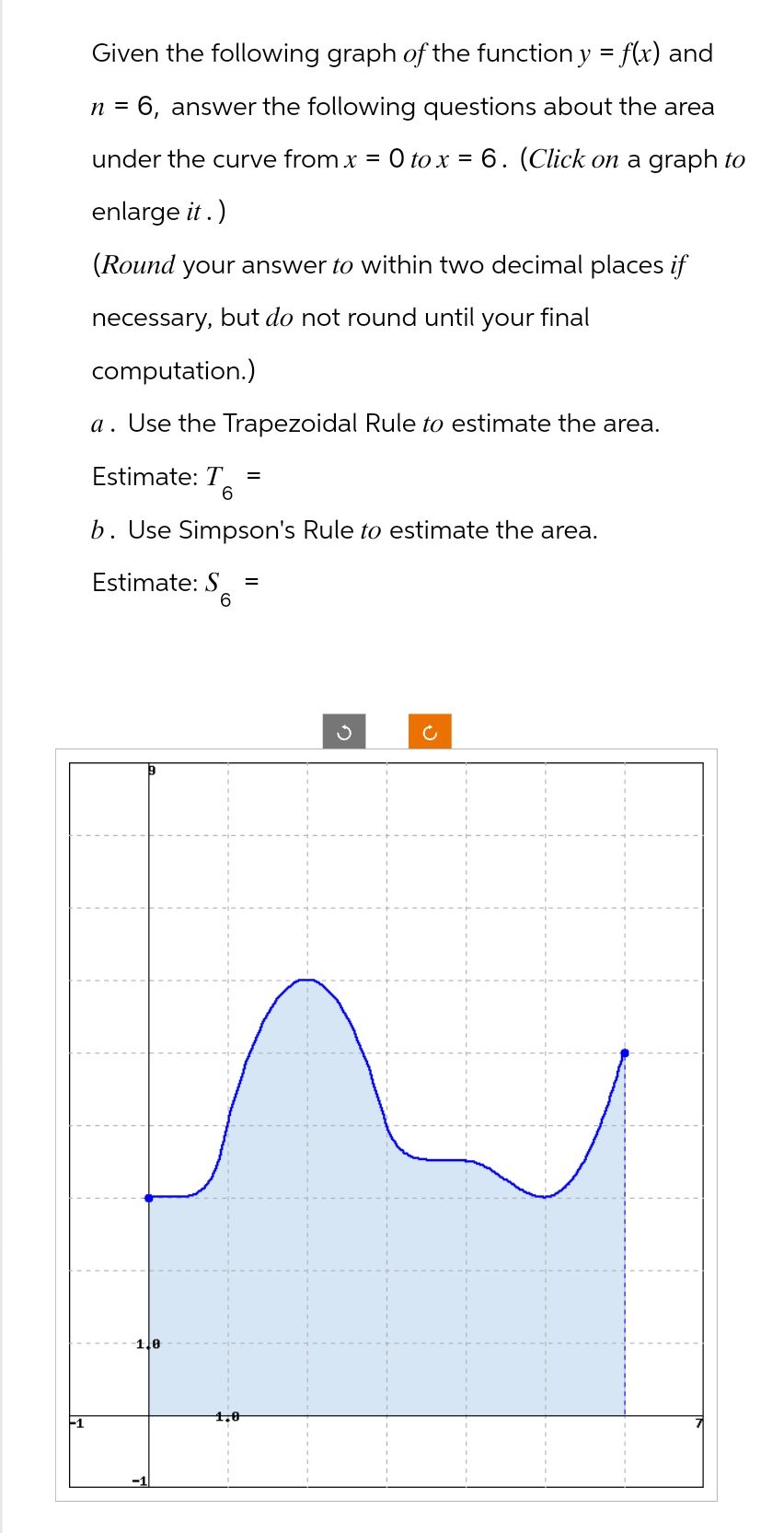 Given the following graph of the function y = f(x) and
n = 6, answer the following questions about the area
under the curve from x = 0 tox = 6. (Click on a graph to
enlargeit.)
(Round your answer fo within two decimal places if
necessary, but do not round until your final
computation.)
a. Use the Trapezoidal Rule fo estimate the area.
Estimate: Ty =
b. Use Simpson's Rule fo estimate the area.
Estimate: Ss =
ilo {
| |
=i] SE
This is AI generated Response.
Asked by: Rahul
Created at: 2025-12-01 07:01:50
Asked by: Rahul
Created at: 2025-12-01 07:01:50
Final Answer:
Rendered
Raw Text
Did you like this answer?
Let's solve the step by step both the **apezoidal Rule** and **Simpson's Rule**, using the graph and \( n = 6 \) (which means 7 points).
### **Step 1: Extract the y-values from the graph**
have \( x \) values at \( , 1, 2, 3, 4, 5, 6 \).
Approximate \( y \) values from the graph at each \( x \):
- \( f() = 1 \)
- \( f(1) = 3 \)
- \( f(2) = 5 \)
- \( f(3) = 3 \)
- \( f(4) = 1 \)
- \( f(5) = \)
- \( f(6) = 2 \)
**Explanation:**
These \( y \)-values are visually estimated based on the graph's intersection with each vertical grid line.
---
### **Step 2a: Trapezoidal Rule Calculation**
The Trapezoidal Rule formula:
\[
T_n = \frac{h}{2} [f(x_) + 2f(x_1) + 2f(x_2) + 2f(x_3) + 2f(x_4) + 2f(x_5) + f(x_6)]
\]
Where \( h = \frac{b - a}{n} = \frac{6 - }{6} = 1 \).
Plug in values:
\[
T_6 = \frac{1}{2} [1 + 2(3) + 2(5) + 2(3) + 2(1) + 2() + 2]
\]
\[
= \frac{1}{2} [1 + 6 + 10 + 6 + 2 + + 2]
\]
\[
= \frac{1}{2} [27]
\]
\[
= 13.5
\]
**Explanation**:
Each interior point is multiplied by 2, endpoints by 1, sum, then multiply by \( \frac{h}{2} \).
---
### **Step 2b: Simpson's Rule Calculation**
Simpson's Rule formula (for even \( n \)):
\[
S_n = \frac{h}{3} [f(x_) + 4f(x_1) + 2f(x_2) + 4f(x_3) + 2f(x_4) + 4f(x_5) + f(x_6)]
\]
With \( h = 1 \):
Plug in values:
\[
S_6 = \frac{1}{3} [1 + 4(3) + 2(5) + 4(3) + 2(1) + 4() + 2]
\]
\[
= \frac{1}{3} [1 + 12 + 10 + 12 + 2 + + 2]
\]
\[
= \frac{1}{3} [39]
\]
\[
= 13
\]
**Explanation:**
Alternate coefficients 4 and 2 for interior points, endpoints by 1, sum, then multiply by \( \frac{h}{3} \).
---
## **Final Answers**
- **Trapezoidal Rule estimate (\(T_6\))**: **13.5**
- **Simpson's Rule estimate (\(S_6\))**: **13**
These are rounded as needed and based on the values visually estimated from the graph.
📢 Instructions:
- Ask anything relatd to above question only.
- For new Question goto :