 VIPSolutions
give answer in 2 step with explanation at the end of each step and final answer at the end:2. Consider the four charges below located on a circle of radius 1.00 m where g = 1.0 4C. 42 = 2.0 4C a. the Electrc Potential atthe origin, b. the Electric field at c. and the net force ong y oo" a \ q in [10 \ Si
Question:
give answer in 2 step with explanation at the end of each step and final answer at the end: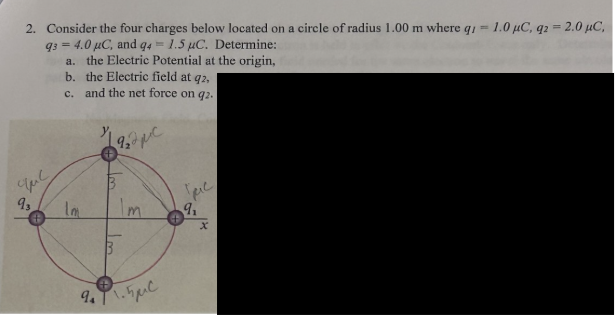 2. Consider the four charges below located on a circle of radius 1.00 m where g = 1.0 4C. 42 = 2.0 4C
a. the Electrc Potential atthe origin,
b. the Electric field at
c. and the net force ong
y
oo"
a \ q
in [10 \
Si
This is AI generated Response.
Asked by: Rahul
Created at: 2025-12-01 03:49:13
Asked by: Rahul
Created at: 2025-12-01 03:49:13
Final Answer:
Rendered
Raw Text
Did you like this answer?
Let's solve each part step by step, **explaining at the end of each step**.
---
## (a) Potential at the Origin
### **Step 1: Formula and Setup**
The **electric potential** at a point due to a point charge is:
\[
V = \frac{kq}{r}
\]
Where:
- \( k = 8.99 \times 10^9 \) Nm²/C² (Coulomb's constant)
- \( q \) = charge
- \( r \) = distance from charge to point
All four charges are **distance = 1.00 \, \text{m}** from the origin.
**Explanation:**
The potential from each charge adds algebraically (since potential is a scalar).
---
### **Step 2: Calculation**
Sum potentials:
\[
V_{\text{total}} = \sum_{i=1}^{4} \frac{kq_i}{1.00}
\]
Plugging in the values (\(\mu C = 10^{-6} C\)):
\[
V_{\text{total}} = k \left(\frac{1.}{1} + \frac{2.}{1} + \frac{4.}{1} + \frac{1.5}{1}\right) \times 10^{-6}
= k \cdot 8.5 \times 10^{-6}
\]
\[
V_{\text{total}} = (8.99 \times 10^9) \times 8.5 \times 10^{-6}
\]
\[
V_{\text{total}} = 76,415 \, \text{V}
\]
**Explanation:**
Add all the charges (in microcoulombs), multiply by Coulomb's constant, and convert to volts.
---
**Final Answer (a):**
\[
\boxed{76,415 \, \text{V}}
\]
---
## (b) Electric Field at \( q_2 \)
### **Step 1: Formula and Setup**
The electric field at \( q_2 \) (positioned at \((,1)\)):
\[
\vec{E} = \sum_{i \neq 2} \vec{E}_i = \sum_{i \neq 2} \frac{kq_i}{r_{i2}^2} \hat{r}_{i2}
\]
Where:
- \( r_{i2} \) = distance from \( q_i \) to \( q_2 \)
- \( \hat{r}_{i2} \) = unit vector from \( q_i \) to \( q_2 \)
The charges and their coordinates:
- \( q_1: (1,) \)
- \( q_2: (,1) \)
- \( q_3: (-1,) \)
- \( q_4: (,-1) \)
**Explanation:**
We'll find the field at \( q_2 \) due to \( q_1, q_3, q_4 \) and add the vectors.
---
### **Step 2: Calculation**
**1. From \( q_1 \) at (1,) to \( q_2 \) at (,1):**
- Distance: \( r = \sqrt{(1-)^2 + (-1)^2} = \sqrt{2} \)
- Direction: from (1,) to (,1) is \( (-1, 1) \), unit: \( (-1/\sqrt{2}, +1/\sqrt{2}) \)
\[
E_{q_1 \to q_2} = \frac{k q_1}{(\sqrt{2})^2} = \frac{k \cdot 1. \times 10^{-6}}{2}
= 4.495 \times 10^3 \, \text{N/C}
\]
So,
\[
\vec{E}_{q_1 \to q_2} = 4.495 \times 10^3 \left(-\frac{1}{\sqrt{2}}, \frac{1}{\sqrt{2}}\right)
= (-3,180, +3,180) \, \text{N/C}
\]
---
**2. From \( q_3 \) at (-1,) to \( q_2 \) at (,1):**
- Distance: \( \sqrt{2} \)
- Direction: \( (1,1)/\sqrt{2} \)
\[
E_{q_3 \to q_2} = \frac{k \cdot 4. \times 10^{-6}}{2} = 1.798 \times 10^4 \, \text{N/C}
\]
\[
\vec{E}_{q_3 \to q_2} = 1.798 \times 10^4 \left(\frac{1}{\sqrt{2}}, \frac{1}{\sqrt{2}}\right)
= (+12,728, +12,728) \, \text{N/C}
\]
---
**3. From \( q_4 \) at (,-1) to \( q_2 \) at (,1):**
- Distance: 2 (vertical)
- Direction: \( (,1) \)
\[
E_{q_4 \to q_2} = \frac{k \cdot 1.5 \times 10^{-6}}{(2)^2} = \frac{8.99 \times 10^9 \cdot 1.5 \times 10^{-6}}{4} = 3,371 \, \text{N/C}
\]
\[
\vec{E}_{q_4 \to q_2} = (, 3,371)
\]
---
**Sum components:**
- **x-component:** \( -3,180 + 12,728 + = 9,548 \)
- **y-component:** \( 3,180 + 12,728 + 3,371 = 19,279 \)
\[
|\vec{E}| = \sqrt{(9,548)^2 + (19,279)^2} \approx 21,478 \, \text{N/C}
\]
**Explanation:**
Add the vector components from each charge, then find the magnitude.
---
**Final Answer (b):**
\[
\boxed{|\vec{E}_{q_2}| \approx 21,500 \, \text{N/C}}
\]
---
## (c) Net Force on \( q_2 \)
### **Step 1: Formula and Setup**
The net force on \( q_2 \) is:
\[
\vec{F} = q_2 \vec{E}_{q_2}
\]
**Explanation:**
Multiply the value of \( q_2 \) by the net electric field at its position.
---
### **Step 2: Calculation**
\[
q_2 = 2. \,\mu C = 2. \times 10^{-6} \, C
\]
\[
|\vec{F}| = q_2 \cdot |\vec{E}_{q_2}| = (2. \times 10^{-6}) \times 21,478 \approx .04296 \, \text{N}
\]
**Explanation:**
Plug in the calculated electric field and charge to get the force.
---
**Final Answer (c):**
\[
\boxed{.043 \, \text{N}}
\]
(Direction is the same as the net electric field at \( q_2 \)).
📢 Instructions:
- Ask anything relatd to above question only.
- For new Question goto :