 VIPSolutions
give answer in 2 step with explanation at the end of each step and final answer at the end:intervals on which 4 '1" increasing or decresung and use 2 ils torg derivifine to bind airelative evirema r(x) = —-— x -4 (A. noints)
Question:
give answer in 2 step with explanation at the end of each step and final answer at the end: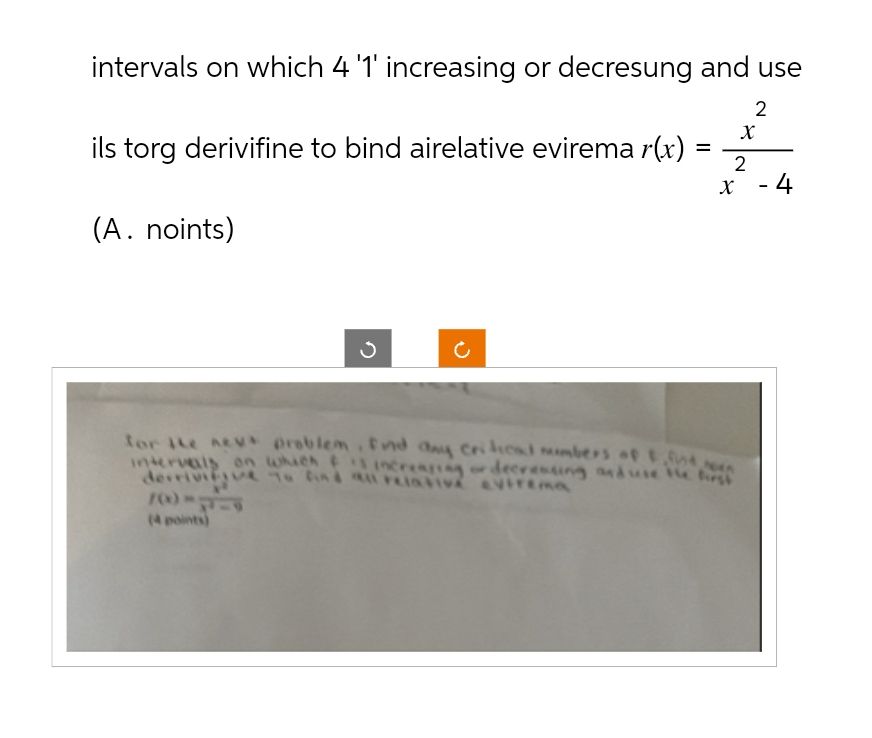 intervals on which 4 '1" increasing or decresung and use
2
ils torg derivifine to bind airelative evirema r(x) = —-—
x -4
(A. noints)
This is AI generated Response.
Asked by: Rahul
Created at: 2025-11-30 21:09:39
Asked by: Rahul
Created at: 2025-11-30 21:09:39
Final Answer:
Rendered
Raw Text
Did you like this answer?
## Step 1: Find the Derivative and Critical Points
Given:
\[
r(x) = \frac{x^2}{x^2 - 4}
\]
First, find the **first derivative** using the quotient rule:
\[
r'(x) = \frac{(x^2-4)(2x) - x^2(2x)}{(x^2-4)^2}
\]
\[
= \frac{2x(x^2 - 4) - 2x x^2}{(x^2-4)^2}
\]
\[
= \frac{2x(x^2 - 4 - x^2)}{(x^2-4)^2}
\]
\[
= \frac{2x(-4)}{(x^2-4)^2}
\]
\[
= \frac{-8x}{(x^2-4)^2}
\]
Set the numerator to **zero** to find critical points:
\[
-8x = \implies x =
\]
Also, the denominator is zero at \( x = 2 \) and \( x = -2 \), but these are **not in the domain** of \( r(x) \).
**Explanation:**
We found the critical point at \( x = \). The function is not defined at \( x = 2 \) and \( x = -2 \).
---
## Step 2: Test Intervals for Increasing/Decreasing
Pick test points in the intervals: \( (-\infty, -2) \), \( (-2, ) \), \( (, 2) \), \( (2, \infty) \).
\[
r'(x) = \frac{-8x}{(x^2-4)^2}
\]
- **For \( x < -2 \):** Pick \( x = -3 \):
\[
r'(-3) = \frac{-8(-3)}{((-3)^2-4)^2} = \frac{24}{(9-4)^2} = \frac{24}{25} >
\]
So, **increasing**.
- **For \( -2 < x < \):** Pick \( x = -1 \):
\[
r'(-1) = \frac{-8(-1)}{((-1)^2-4)^2} = \frac{8}{(1-4)^2} = \frac{8}{9} >
\]
So, **increasing**.
- **For \( < x < 2 \):** Pick \( x = 1 \):
\[
r'(1) = \frac{-8(1)}{(1-4)^2} = \frac{-8}{9} <
\]
So, **decreasing**.
- **For \( x > 2 \):** Pick \( x = 3 \):
\[
r'(3) = \frac{-8(3)}{(9-4)^2} = \frac{-24}{25} <
\]
So, **decreasing**.
**Explanation:**
Function increases on \( (-\infty, -2) \) and \( (-2, ) \), decreases on \( (, 2) \) and \( (2, \infty) \).
---
## **Final Answer**
- **Increasing on:** \( (-\infty, -2) \) and \( (-2, ) \)
- **Decreasing on:** \( (, 2) \) and \( (2, \infty) \)
- **Relative maximum at:** \( x = \), since the function changes from increasing to decreasing at this point. There are no relative minima in the domain.
📢 Instructions:
- Ask anything relatd to above question only.
- For new Question goto :