 VIPSolutions
give answer in 2 step with explanation at the end of each step and final answer at the end:Ld
Question:
give answer in 2 step with explanation at the end of each step and final answer at the end: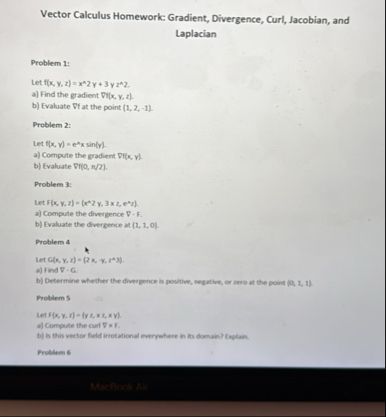 Ld
This is AI generated Response.
Asked by: Rahul
Created at: 2025-11-30 06:38:00
Asked by: Rahul
Created at: 2025-11-30 06:38:00
Final Answer:
Rendered
Raw Text
Did you like this answer?
Let's solve **Problem 1** step by step, as requested:
---
## Problem 1
Let \( f(x, y, z) = x^2 y + 3y + y^2 z \).
### a) Find the gradient, ∇f(x, y, z).
**Step 1: Compute Partial Derivatives**
- \( \frac{\partial f}{\partial x} = 2xy \) (since \( x^2y \) is the only term with \( x \))
- \( \frac{\partial f}{\partial y} = x^2 + 3 + 2yz \) (derivative of each term with respect to \( y \))
- \( \frac{\partial f}{\partial z} = y^2 \) (only \( y^2z \) has \( z \))
**Gradient:**
\[
\boxed{
\nabla f(x, y, z) = (2xy,\, x^2 + 3 + 2yz,\, y^2)
}
\]
**Explanation:**
The gradient is found by taking the partial derivative of \( f \) with respect to each variable.
---
### b) Evaluate ∇f at the point (1, 2, -1).
**Step 2: Substitute \( x = 1, y = 2, z = -1 \) into the gradient**
- \( 2xy = 2 \times 1 \times 2 = 4 \)
- \( x^2 + 3 + 2yz = 1^2 + 3 + 2 \times 2 \times (-1) = 1 + 3 - 4 = \)
- \( y^2 = 2^2 = 4 \)
So,
\[
\boxed{
\nabla f(1, 2, -1) = (4,\, ,\, 4)
}
\]
**Explanation:**
Substituting the values into each component gives the gradient at the specific point.
---
## **Final Answer:**
- **Gradient:** \( \nabla f(x, y, z) = (2xy,\, x^2 + 3 + 2yz,\, y^2) \)
- **At (1, 2, -1):** \( \nabla f(1, 2, -1) = (4,\, ,\, 4) \)
📢 Instructions:
- Ask anything relatd to above question only.
- For new Question goto :