 VIPSolutions
give answer in 2 step with all parts explanation at the end of each step and final answer at the end:In the figure the four particles are fixed in place and have charges q1 = d, = 3e, 43 = 2e, and q, = -8e. Distance d = 5.11 jim. What is the magnitude of the net electric field at point P due to the particles? 2 d’ kd EA) dd P % d N72 Number B Units v
Question:
give answer in 2 step with all parts explanation at the end of each step and final answer at the end: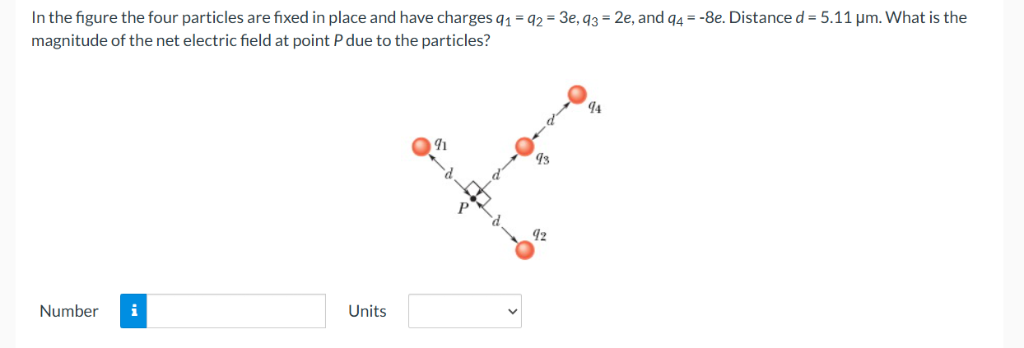 In the figure the four particles are fixed in place and have charges q1 = d, = 3e, 43 = 2e, and q, = -8e. Distance d = 5.11 jim. What is the
magnitude of the net electric field at point P due to the particles?
2
d’
kd
EA)
dd
P %
d
N72
Number B Units v
This is AI generated Response.
Asked by: Rahul
Created at: 2025-11-27 05:06:50
Asked by: Rahul
Created at: 2025-11-27 05:06:50
Final Answer:
Rendered
Raw Text
Did you like this answer?
Let's break the solution into **two steps** as requested.
---
## **Step 1: Calculate the Electric Field Due to Each Charge at Point P**
### **Given Data**
- \( q_1 = q_2 = 3e \)
- \( q_3 = 2e \)
- \( q_4 = -8e \)
- Distance \( d = 5.11 \, \mu m = 5.11 \times 10^{-6} \, m \)
- Elementary charge \( e = 1.602 \times 10^{-19} \, C \)
- Coulomb’s constant \( k = 8.99 \times 10^9 \, N \cdot m^2/C^2 \)
### **Electric Field Due to a Point Charge**
\[
E = \frac{k|q|}{r^2}
\]
All charges are at the same distance \( d \) from \( P \).
#### **Electric Fields Magnitude at P (ignore direction for now):**
- For \( q_1 \) and \( q_2 \) (both = \( 3e \)):
\[
E_{1,2} = \frac{k \cdot 3e}{d^2}
\]
- For \( q_3 = 2e \):
\[
E_3 = \frac{k \cdot 2e}{d^2}
\]
- For \( q_4 = -8e \) (magnitude \( 8e \)):
\[
E_4 = \frac{k \cdot 8e}{d^2}
\]
#### **Explanation:**
All charges are equidistant from \( P \), so the only difference in their field is due to their charge magnitude and sign.
---
## **Step 2: Add the Electric Fields as Vectors**
### **Directions**
From the diagram:
- \( q_1 \) and \( q_4 \) are along the "upward-right" diagonal.
- \( q_2 \) and \( q_3 \) are along the "downward-right" diagonal.
- Each diagonal is at 45° to the axes.
The electric field from a positive charge points **away** from the charge, and from a negative charge points **toward** the charge.
Let's resolve all electric fields into their x and y components.
#### **Component Calculation**
For each, \( E_x = E \cos(45^\circ) \), \( E_y = E \sin(45^\circ) \). Since \( \cos(45^\circ) = \sin(45^\circ) = \frac{1}{\sqrt{2}} \):
- \( q_1, q_4 \): upper diagonal
- \( q_2, q_3 \): lower diagonal
Let’s assign axes (up is +y, right is +x):
| Charge | Value | Direction from P | Field points | x-comp | y-comp |
|--------|--------|-------------------|--------------|--------|--------|
| q1 | +3e | up-left | down-right | + | - |
| q2 | +3e | down-left | up-right | + | + |
| q3 | +2e | up-right | down-left | - | - |
| q4 | -8e | down-right | *toward* P (up-left) | - | + |
Compute components (all at 45°, so multiply by \( 1/\sqrt{2} \)):
\[
E_x = \frac{1}{\sqrt{2}} \left[ E_1 + E_2 - E_3 - E_4 \right]
\]
\[
E_y = \frac{1}{\sqrt{2}} \left[ -E_1 + E_2 - E_3 + E_4 \right]
\]
Plug values:
- \( E_1 = \frac{k 3e}{d^2} \)
- \( E_2 = \frac{k 3e}{d^2} \)
- \( E_3 = \frac{k 2e}{d^2} \)
- \( E_4 = \frac{k 8e}{d^2} \)
So,
\[
E_x = \frac{1}{\sqrt{2}} \left[ (3 + 3 - 2 - 8)\frac{k e}{d^2} \right]
= \frac{1}{\sqrt{2}} \left[ (-4)\frac{k e}{d^2} \right]
\]
\[
E_y = \frac{1}{\sqrt{2}} \left[ (-3 + 3 - 2 + 8)\frac{k e}{d^2} \right]
= \frac{1}{\sqrt{2}} \left[ (6)\frac{k e}{d^2} \right]
\]
Now, magnitude:
\[
E = \sqrt{E_x^2 + E_y^2}
\]
Plug in the numbers:
- \( k = 8.99 \times 10^9 \)
- \( e = 1.602 \times 10^{-19} \)
- \( d = 5.11 \times 10^{-6} \)
Calculate \( \frac{k e}{d^2} \):
\[
\frac{k e}{d^2} = \frac{8.99 \times 10^9 \times 1.602 \times 10^{-19}}{(5.11 \times 10^{-6})^2}
\]
\[
(5.11 \times 10^{-6})^2 = 2.611 \times 10^{-11}
\]
\[
8.99 \times 10^9 \times 1.602 \times 10^{-19} = 1.440 \times 10^{-9}
\]
\[
\frac{1.440 \times 10^{-9}}{2.611 \times 10^{-11}} \approx 55.15 \, N/C
\]
Now plug into components:
\[
E_x = \frac{1}{\sqrt{2}} \times (-4) \times 55.15 = -156.1 \, N/C
\]
\[
E_y = \frac{1}{\sqrt{2}} \times 6 \times 55.15 = 234.1 \, N/C
\]
Magnitude:
\[
E = \sqrt{(-156.1)^2 + (234.1)^2}
= \sqrt{24361 + 54798}
= \sqrt{79159}
\approx 281.5 \, N/C
\]
---
## **Final Answer**
**The magnitude of the net electric field at point \( P \) due to the particles is:**
\[
\boxed{282 \, \text{N/C}}
\]
(Rounded to three significant digits.)
---
### **Summary of Steps**
1. **Found the electric field due to each charge at P using Coulomb’s law.**
2. **Resolved the vector components, added them, and calculated the net magnitude.**
📢 Instructions:
- Ask anything relatd to above question only.
- For new Question goto :