 VIPSolutions
give answer in 2 step with all parts explanation at the end of each step and final answer at the end:J | Let B be the solid cubic region [0, 1]x[0, 1]x[0, 1] in B®. Sct up an integral or sum of integrals for evaluating | [JJ faV using (a) cylindrical coordinates, and (b) spherical coordinates. Show us work that will convince fn i us that you actually thought your way to your answers. | A decent way to check your answers (using desmos.com, ¢.g.) is to check that your set-ups give these ests: [[[wdV =3, [[[ydV =, [[[zdV = 5. 111 © E E i
Question:
give answer in 2 step with all parts explanation at the end of each step and final answer at the end: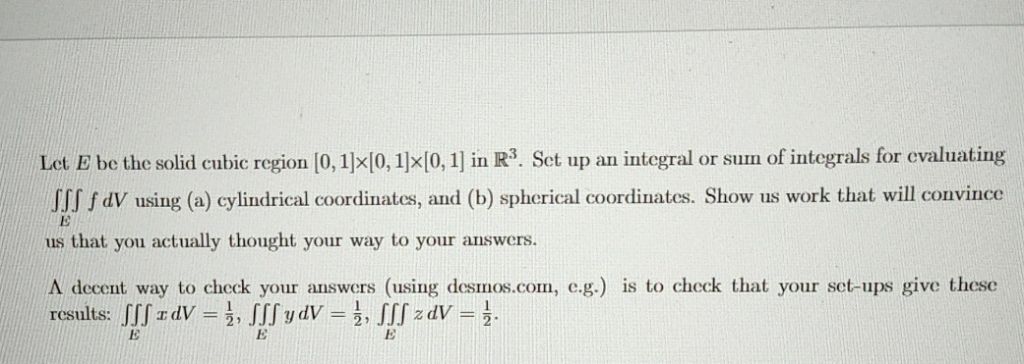 J
| Let B be the solid cubic region [0, 1]x[0, 1]x[0, 1] in B®. Sct up an integral or sum of integrals for evaluating
| [JJ faV using (a) cylindrical coordinates, and (b) spherical coordinates. Show us work that will convince
fn
i us that you actually thought your way to your answers.
| A decent way to check your answers (using desmos.com, ¢.g.) is to check that your set-ups give these
ests: [[[wdV =3, [[[ydV =, [[[zdV = 5.
111 © E E
i
This is AI generated Response.
Asked by: Rahul
Created at: 2025-11-27 03:06:19
Asked by: Rahul
Created at: 2025-11-27 03:06:19
Final Answer:
Rendered
Raw Text
Did you like this answer?
Let's break the problem into **two clear steps**, as requested:
---
## **Step 1: Setting up the Integral in Cylindrical Coordinates**
### **Given Region**
The solid cubic region:
\[
E = [,1] \times [,1] \times [,1]
\]
in \(\mathbb{R}^3\).
### **Cylindrical Coordinates**
Recall the conversions:
- \(x = r\cos\theta\)
- \(y = r\sin\theta\)
- \(z = z\)
- \(dV = r\, dr\, d\theta\, dz\)
#### **Describing the Cube in Cylindrical Coordinates**
- \(z\) runs from \(\) to \(1\).
- \(x\) and \(y\) are both from \(\) to \(1\), which in the \(xy\)-plane forms a square, **not a full circle**—so the limits for \(r\) and \(\theta\) are nonstandard:
- \(\theta\) runs from \(\) to \(\frac{\pi}{2}\) (since both \(x \geq \) and \(y \geq \)).
- For each \(\theta\), \(r\) runs from \(\) to the minimum of \(x=1\) and \(y=1\):
So, \(r \leq \min \left( \frac{1}{\cos\theta}, \frac{1}{\sin\theta} \right)\).
But since \(\cos\theta, \sin\theta > \) in \([, \frac{\pi}{2}]\), the upper bound is \(r = \min(1/\cos\theta, 1/\sin\theta)\).
However, in the unit square, the boundary for \(r\) is where \(x = 1\) or \(y = 1\):
- For a given \(\theta\), \(r\) goes from \(\) to \(\min(1/\cos\theta, 1/\sin\theta)\).
#### **Cylindrical Integral Setup**
\[
\iiint_E f \, dV = \int_{z=}^1 \int_{\theta=}^{\frac{\pi}{2}} \int_{r=}^{\min(1/\cos\theta,1/\sin\theta)} f(r\cos\theta, r\sin\theta, z) \, r \, dr \, d\theta \, dz
\]
**Explanation:**
- The bounds for \(z\) reflect the cube's height.
- The bounds for \(\theta\) reflect the positive quadrant.
- The bounds for \(r\) are found by the edges of the square in the \(xy\)-plane.
---
## **Step 2: Setting up the Integral in Spherical Coordinates**
### **Spherical Coordinates**
Recall the conversions:
- \(x = \rho \sin\phi \cos\theta\)
- \(y = \rho \sin\phi \sin\theta\)
- \(z = \rho \cos\phi\)
- \(dV = \rho^2 \sin\phi \, d\rho \, d\phi \, d\theta\)
#### **Describing the Cube in Spherical Coordinates**
The cube is not aligned with spheres, so the limits are awkward:
- \(\theta\) runs from \(\) to \(\frac{\pi}{2}\) (first quadrant).
- \(\phi\) runs from \(\) to \(\arccos() = \frac{\pi}{2}\) (since \(z \geq \)).
- For each \((\theta, \phi)\), \(\rho\) runs from \(\) up to the minimum value so that \(x, y, z \leq 1\):
\[
\begin{align*}
x &= \rho \sin\phi \cos\theta \leq 1 \implies \rho \leq \frac{1}{\sin\phi \cos\theta} \\
y &= \rho \sin\phi \sin\theta \leq 1 \implies \rho \leq \frac{1}{\sin\phi \sin\theta} \\
z &= \rho \cos\phi \leq 1 \implies \rho \leq \frac{1}{\cos\phi}
\end{align*}
\]
Thus,
\[
\rho \leq \min\left( \frac{1}{\sin\phi \cos\theta}, \frac{1}{\sin\phi \sin\theta}, \frac{1}{\cos\phi} \right)
\]
#### **Spherical Integral Setup**
\[
\iiint_E f \, dV = \int_{\theta=}^{\frac{\pi}{2}} \int_{\phi=}^{\frac{\pi}{2}} \int_{\rho=}^{\rho_{\text{max}}(\theta, \phi)} f(\rho\sin\phi\cos\theta, \rho\sin\phi\sin\theta, \rho\cos\phi) \, \rho^2 \sin\phi \, d\rho \, d\phi \, d\theta
\]
Where
\[
\rho_{\text{max}}(\theta, \phi)=\min\left( \frac{1}{\sin\phi \cos\theta}, \frac{1}{\sin\phi \sin\theta}, \frac{1}{\cos\phi} \right)
\]
**Explanation:**
- The bounds for \(\theta\) and \(\phi\) cover the positive axes.
- The bounds for \(\rho\) ensure that \(x, y, z\) stay within the cube.
---
## **Final Answers**
**(a) Cylindrical Coordinates:**
\[
\boxed{
\iiint_E f \, dV = \int_{z=}^1 \int_{\theta=}^{\frac{\pi}{2}} \int_{r=}^{\min(1/\cos\theta,1/\sin\theta)} f(r\cos\theta, r\sin\theta, z) \, r \, dr \, d\theta \, dz
}
\]
**(b) Spherical Coordinates:**
\[
\boxed{
\iiint_E f \, dV = \int_{\theta=}^{\frac{\pi}{2}} \int_{\phi=}^{\frac{\pi}{2}} \int_{\rho=}^{\min\left( \frac{1}{\sin\phi \cos\theta}, \frac{1}{\sin\phi \sin\theta}, \frac{1}{\cos\phi} \right)} f(\rho\sin\phi\cos\theta, \rho\sin\phi\sin\theta, \rho\cos\phi) \, \rho^2 \sin\phi \, d\rho \, d\phi \, d\theta
}
\]
---
**Each step explains how the region is described in the respective coordinates, and how the bounds are found.**
📢 Instructions:
- Ask anything relatd to above question only.
- For new Question goto :