VIPSolutions logo ✨ VIPSolutions

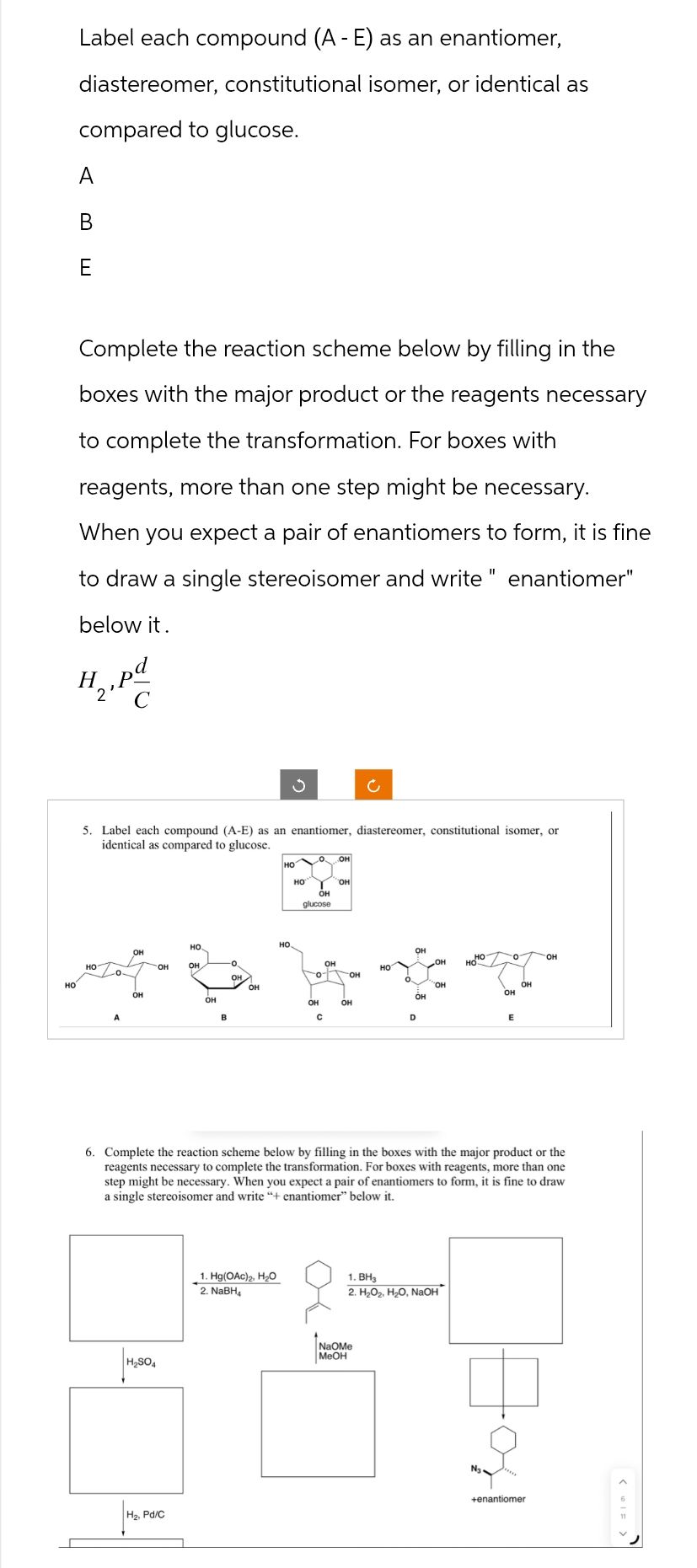
give answer in 2 step with all parts explanation at the end of each step and final answer at the end: ALabel each compound (A - E) as an enantiomer, diastereomer, constitutional isomer, or identical as compared to glucose. A B E Complete the reaction scheme below by filling in the boxes with the major product or the reagents necessary to complete the transformation. For boxes with reagents, more than one step might be necessary. When you expect a pair of enantiomers to form, it is fine to draw a single stereoisomer and write " enantiomer" below it. d H_,P— 2c 5. Label each compound (A-E) as an enantiomer, diastereomer, constitutional isomer, or identical as compared to glucose. —— Hoy om 4 pon on il aN » Jo oT on Lon wo | or BO peal ar WE Meo oll or on ) | on on x s c ° : 6. Complete the reaction scheme below by filling in the boxes with the major product or the reagents necessary to complete the transformation. For boxes with reagents, more than one step might be necessary. When you expect a pair of enantiomers to form, it is fine to draw a single stercoisomer and write “+ enantiomer” below it. 1. Hg(OAc),, HO BH f Nowe [sso Veo [17 { ] || 2 sonanomer [peree )
Question:

give answer in 2 step with all parts explanation at the end of each step and final answer at the end: AUploaded ImageLabel each compound (A - E) as an enantiomer, diastereomer, constitutional isomer, or identical as compared to glucose. A B E Complete the reaction scheme below by filling in the boxes with the major product or the reagents necessary to complete the transformation. For boxes with reagents, more than one step might be necessary. When you expect a pair of enantiomers to form, it is fine to draw a single stereoisomer and write " enantiomer" below it. d H_,P— 2c 5. Label each compound (A-E) as an enantiomer, diastereomer, constitutional isomer, or identical as compared to glucose. —— Hoy om 4 pon on il aN » Jo oT on Lon wo | or BO peal ar WE Meo oll or on ) | on on x s c ° : 6. Complete the reaction scheme below by filling in the boxes with the major product or the reagents necessary to complete the transformation. For boxes with reagents, more than one step might be necessary. When you expect a pair of enantiomers to form, it is fine to draw a single stercoisomer and write “+ enantiomer” below it. 1. Hg(OAc),, HO BH f Nowe [sso Veo [17 { ] || 2 sonanomer [peree )

This is AI generated Response.
Asked by: Rahul
Created at: 2025-11-26 15:38:22

Final Answer:

Rendered Raw Text
Did you like this answer?
Let's break your question into **two steps** as requested: --- ## **Step 1: Label each compound (A-E) compared to glucose** Let's analyze the structures: ### **Glucose Reference Structure** - D-Glucose is shown in the pyranose (6-membered ring) form. ### **A** - Structure: Pyranose ring, but the orientation of the OH groups is different from D-glucose. Compare each chiral center. - **Label:** **Enantiomer** (all chiral centers are inverted compared to glucose; this is L-glucose). ### **B** - Structure: Furanose (5-membered ring) form instead of pyranose. - **Label:** **Constitutional isomer** (different connectivity, ring size is different). ### **E** - Structure: Pyranose ring, but only some OH groups are inverted compared to glucose. - **Label:** **Diastereomer** (not all, but some chiral centers are inverted). #### **Summary Table:** | Compound | Relation to Glucose | |----------|----------------------| | A | Enantiomer | | B | Constitutional isomer| | E | Diastereomer | --- ### **Step 1 Explanation** - **Enantiomers**: Mirror images, all chiral centers inverted. - **Diastereomers**: Some, but not all, chiral centers are inverted. - **Constitutional isomers**: Different connectivity (different ring size). --- ## **Step 2: Complete the Reaction Scheme** Let's walk through the reaction scheme: ### **Middle Compound:** 1-methylcyclohexene #### **Left Path (Oxymercuration-Demercuration)** 1. **Reagents:** - 1. Hg(OAc)₂, H₂O - 2. NaBH₄ 2. **Product:** Markovnikov addition of water (OH to more substituted carbon). - Product: 1-methylcyclohexanol #### **Bottom Left (Acid)** - **Reagent:** H₂SO₄ (acid-catalyzed dehydration) - **Product:** Elimination of water to regenerate the alkene (1-methylcyclohexene). #### **Bottom (Hydrogenation)** - **Reagent:** H₂, Pd/C - **Product:** Complete reduction of alkene to **1-methylcyclohexane**. --- #### **Right Path (Hydroboration-Oxidation)** 1. **Reagents:** - 1. BH₃ - 2. H₂O₂, H₂O, NaOH 2. **Product:** Anti-Markovnikov addition of water (OH to less substituted carbon). - Product: 2-methylcyclohexanol #### **Right (Methoxide)** - **Reagent:** NaOMe, MeOH (Williamson ether synthesis, but here for elimination) - **Product:** E2 elimination to form a double bond (**2-methylcyclohexene**). #### **Bottom Right (SN2 with azide)** - **Reagent:** NaN₃ (azide ion) - **Substrate:** 2-methylcyclohexyl tosylate/halide (from previous steps) - **Product:** **2-azido-2-methylcyclohexane** (with inversion of configuration, so enantiomers possible). --- ### **Step 2 Explanation** - **Oxymercuration-Demercuration** gives Markovnikov alcohol. - **Hydroboration-Oxidation** gives anti-Markovnikov alcohol. - **Acid (H₂SO₄)** causes elimination (alkene formation). - **H₂, Pd/C** reduces alkene to alkane. - **NaOMe/MeOH** causes elimination (E2). - **NaN₃** substitutes leaving group (SN2, inversion, forms enantiomers). --- ## **Final Answers** ### **Isomer Identifications** - **A:** Enantiomer of glucose - **B:** Constitutional isomer of glucose - **E:** Diastereomer of glucose ### **Reaction Scheme Products/Reagents** 1. **Left Path:** - 1-methylcyclohexene → (Hg(OAc)₂, H₂O / NaBH₄) → 1-methylcyclohexanol → (H₂SO₄) → 1-methylcyclohexene → (H₂, Pd/C) → 1-methylcyclohexane 2. **Right Path:** - 1-methylcyclohexene → (BH₃ / H₂O₂, H₂O, NaOH) → 2-methylcyclohexanol → (NaOMe, MeOH) → 2-methylcyclohexene → (NaN₃) → 2-azido-2-methylcyclohexane (+ enantiomer) --- **If you need to see the completed reaction scheme boxes as diagrams, let me know!**

📢 Instructions:

  • Ask anything relatd to above question only.
  • For new Question goto :

Study Help, Fast Answers

VIPSolutions focuses on clear, step‑by‑step explanations so you can learn quickly. Whether you need an AI‑generated walkthrough or a short hint to get unstuck, each solution is organized for fast reading and easy review later.

Search similar questions, compare approaches, and bookmark the best answers for revision. Our goal is simple: quick, reliable study help that feels natural—not noisy.