give answer in 2 step with all parts explanation at the end of each step and final answer at the end: AFinding the velocity of sound based on resonance of standing waves
Video: Speed of Sound Lab
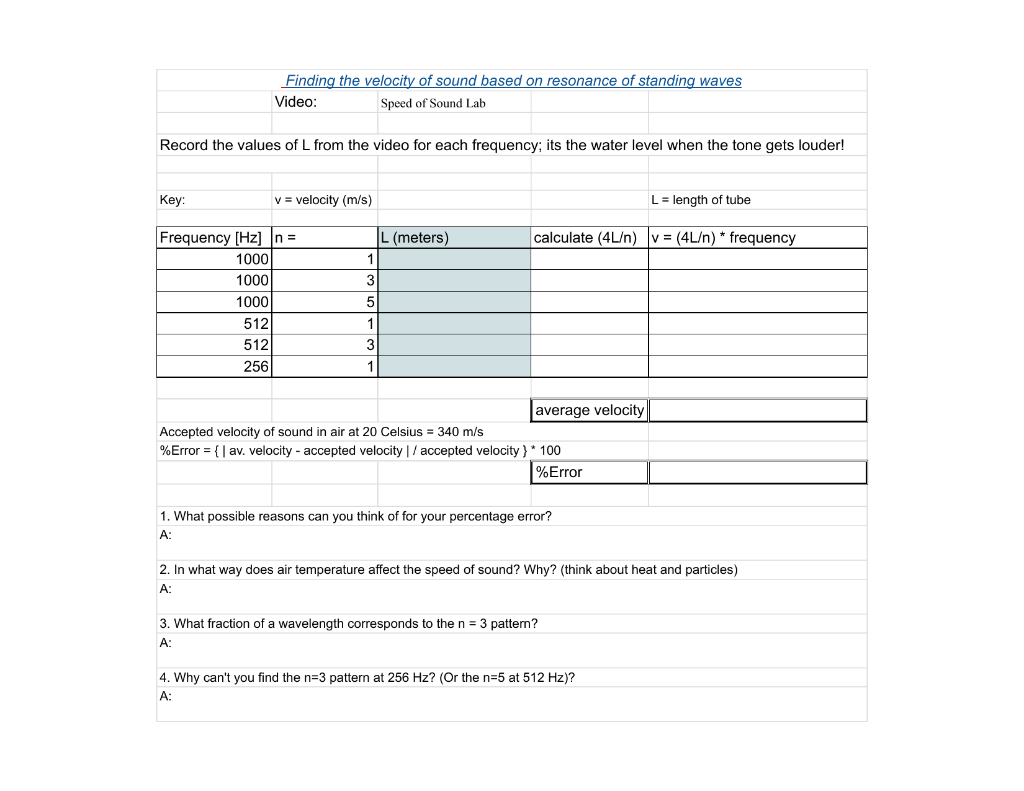
Record the values of L from the video for each frequency; its the water level when the tone gets louder!
Key: v= velocity (mis) L = length of tube
Frequency [Hz] L (meters) calculate (4Ln) |v = (4L/n) * frequency
oof of
oof sf
oof Sf Cr]
BE ] E—
512 E —
ese a 7 |
[oversgoveiosy| |
Accepted velocity of sound in ai at 20 Celsius = 340 mis
%Error = { | av. velocity - accepted velocity | / accepted velocity } * 100
por [|
1. What possible reasons can you think of for your percentage error?
n
2. In what way does air temperature affect the speed of sound? Why? (think about heat and particles)
n
3. What fraction of a wavelength corresponds to the n = 3 pattem?
a
4. Why can't you find the n=3 pattern at 256 Hz? (Or the n=5 at 512 Hz)?
A:
Question:
give answer in 2 step with all parts explanation at the end of each step and final answer at the end: AFinding the velocity of sound based on resonance of standing waves
Video: Speed of Sound Lab
Record the values of L from the video for each frequency; its the water level when the tone gets louder!
Key: v= velocity (mis) L = length of tube
Frequency [Hz] L (meters) calculate (4Ln) |v = (4L/n) * frequency
oof of
oof sf
oof Sf Cr]
BE ] E—
512 E —
ese a 7 |
[oversgoveiosy| |
Accepted velocity of sound in ai at 20 Celsius = 340 mis
%Error = { | av. velocity - accepted velocity | / accepted velocity } * 100
por [|
1. What possible reasons can you think of for your percentage error?
n
2. In what way does air temperature affect the speed of sound? Why? (think about heat and particles)
n
3. What fraction of a wavelength corresponds to the n = 3 pattem?
a
4. Why can't you find the n=3 pattern at 256 Hz? (Or the n=5 at 512 Hz)?
A:
This is AI generated Response.
Asked by: Rahul
Created at: 2025-11-26 05:39:26
Final Answer:
RenderedRaw Text
Did you like this answer?
# Step 1: Explanation of Table Calculations
### **Table Calculations (Columns Explained):**
1. **Frequency [Hz]**: The frequency of the sound used in the experiment.
2. **n**: The harmonic number (1st, 3rd, 5th...).
3. **L (meters)**: The measured length of the air column where resonance occurs (from the experiment/video).
4. **Calculate (4L/n)**: This calculates four times the length divided by the harmonic number.
5. **Velocity (v = (4L/n) * frequency)**: This formula gives the velocity of sound for each measurement.
#### **Explanation for Each Column:**
- The formula comes from the resonance condition for a tube closed at one end: \( L = \frac{n\lambda}{4} \) where \( n \) is an odd integer.
- Rearranged, \( \lambda = \frac{4L}{n} \).
- Velocity, \( v = f\lambda = f \times \frac{4L}{n} \).
**You will fill in the table for each frequency and harmonic using your measured values of \( L \) from the video.**
---
# Step 2: Explanation of Analysis Questions
### **1. Possible Reasons for Percentage Error**
- **Instrumental error** (imprecise measurement of L).
- **Parallax error** (reading the ruler at an angle).
- **Room temperature variation** (actual temperature might differ from 20°C).
- **Humidity and air pressure** (not accounted for).
- **Assumption of perfect resonance** (may not be exact).
### **2. Effect of Air Temperature on Speed of Sound**
- **Higher temperature** → air molecules move faster → sound travels faster.
- **Lower temperature** → molecules move slower → sound travels slower.
- **Reason**: Speed of sound depends on the kinetic energy (temperature) of air molecules.
### **3. Fraction of a Wavelength for n = 3 Pattern**
- For n = 3, \( L = \frac{3\lambda}{4} \).
**So, the length is 3/4 of a wavelength.**
### **4. Why n = 3 at 256 Hz (or n = 5 at 512 Hz) Can't Be Found**
- **Tube may be too short** to accommodate higher harmonics at low frequencies (wavelength too long).
- **Physical limitation**: The required resonance length exceeds the possible tube length.
---
## **Final Answer**
**Step 1:**
- The table uses the formula \( v = (4L/n) \times \text{frequency} \) to find experimental sound velocities.
- You fill in each row with your measured \( L \), calculate \( 4L/n \), then multiply by frequency for velocity.
**Step 2:**
1. Possible errors: measurement, parallax, temperature, humidity, resonance.
2. Higher temperature increases speed; lower decreases it, due to molecular motion.
3. n = 3 pattern is 3/4 of a wavelength.
4. n = 3 at 256 Hz (or n = 5 at 512 Hz) can't be found if the tube can't fit that harmonic's length.
---
**If you provide the measured values of L, I can help fill out the table and calculate the average velocity and % error!**
VIPSolutions focuses on clear, step‑by‑step explanations so you can learn quickly. Whether you need an AI‑generated walkthrough or a short hint to get unstuck, each solution is organized for fast reading and easy review later.
Search similar questions, compare approaches, and bookmark the best answers for revision. Our goal is simple: quick, reliable study help that feels natural—not noisy.
 VIPSolutions
 Finding the velocity of sound based on resonance of standing waves
Video: Speed of Sound Lab
Record the values of L from the video for each frequency; its the water level when the tone gets louder!
Key: v= velocity (mis) L = length of tube
Frequency [Hz] L (meters) calculate (4Ln) |v = (4L/n) * frequency
oof of
oof sf
oof Sf Cr]
BE ] E—
512 E —
ese a 7 |
[oversgoveiosy| |
Accepted velocity of sound in ai at 20 Celsius = 340 mis
%Error = { | av. velocity - accepted velocity | / accepted velocity } * 100
por [|
1. What possible reasons can you think of for your percentage error?
n
2. In what way does air temperature affect the speed of sound? Why? (think about heat and particles)
n
3. What fraction of a wavelength corresponds to the n = 3 pattem?
a
4. Why can't you find the n=3 pattern at 256 Hz? (Or the n=5 at 512 Hz)?
A: