 VIPSolutions
give answer in 2 step with all parts explanation at the end of each step and final answer at the end:Be A Fo 5)-Glutamic acid 5 one of the 20 amino acid busing blocks of polypeptides and proteins. Slob b ee bli hk ry ie SUGUEE IUG Ry wo leg pin tr Baro ii di ST Ai a ee ST rhea me idan CRETE © >
Question:
give answer in 2 step with all parts explanation at the end of each step and final answer at the end: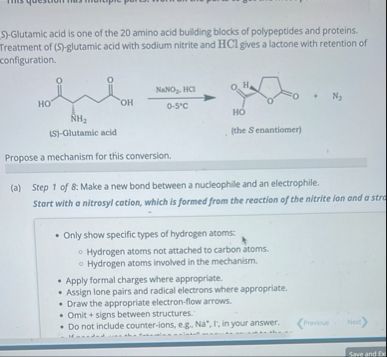 Be A Fo
5)-Glutamic acid 5 one of the 20 amino acid busing blocks of polypeptides and proteins.
Slob b ee bli
hk
ry
ie
SUGUEE IUG
Ry wo
leg pin
tr
Baro ii di ST
Ai
a ee
ST
rhea
me
idan
CRETE
© >
This is AI generated Response.
Asked by: Rahul
Created at: 2025-11-25 14:12:35
Asked by: Rahul
Created at: 2025-11-25 14:12:35
Final Answer:
Rendered
Raw Text
Did you like this answer?
## Step 1: Formation of Nitrosyl Cation (NO⁺)
**Explanation:**
When sodium nitrite (NaNO₂) and hydrochloric acid (HCl) are mixed, they react to produce nitrous acid (HNO₂), which then forms the **nitrosyl cation (NO⁺)**. This cation acts as an electrophile in the reaction with the amine group of (S)-glutamic acid.
**Mechanism Details:**
1. **NaNO₂ + HCl → HNO₂ + NaCl**
Sodium nitrite reacts with hydrochloric acid to form nitrous acid.
2. **HNO₂ + HCl → NO⁺ + 2H₂O + Cl⁻**
Nitrous acid reacts further with HCl to generate the nitrosyl cation (NO⁺), water, and chloride ion.
**Summary:**
- **Electrophile generated:** Nitrosyl cation (NO⁺)
- **Nucleophile in next step:** Amino group of glutamic acid (NH₂)
---
## Step 2: Reaction of Amino Group with Nitrosyl Cation
**Explanation:**
The amino group (–NH₂) on (S)-glutamic acid acts as a nucleophile and attacks the nitrosyl cation (NO⁺), resulting in the formation of an N-nitrosamine intermediate.
**Mechanism Details:**
1. **Nucleophilic Attack:**
The lone pair of electrons on the nitrogen atom of the –NH₂ group attacks the nitrogen atom in NO⁺.
2. **Intermediate Formed:**
This leads to the formation of an N-nitrosamine, where the amino group now has an –N=NO group attached.
**Arrow-Pushing:**
- Arrow from the lone pair on the amino nitrogen to the electrophilic nitrogen of NO⁺.
- This creates a bond between the amine nitrogen and the nitrosyl group.
---
## Final Mechanism (so far):
1. **Generation of NO⁺:**
NaNO₂ + HCl → HNO₂ → NO⁺ (active electrophile)
2. **Amination Reaction:**
(S)-Glutamic acid –NH₂ + NO⁺ → N-nitrosamine intermediate
---
### **Final Answer (for these 2 steps):**
- Step 1: **NO⁺ (nitrosyl cation) is generated from NaNO₂ and HCl.**
- Step 2: **The amino group of (S)-glutamic acid reacts with NO⁺, forming an N-nitrosamine intermediate.**
Let me know if you need the next steps!
📢 Instructions:
- Ask anything relatd to above question only.
- For new Question goto :