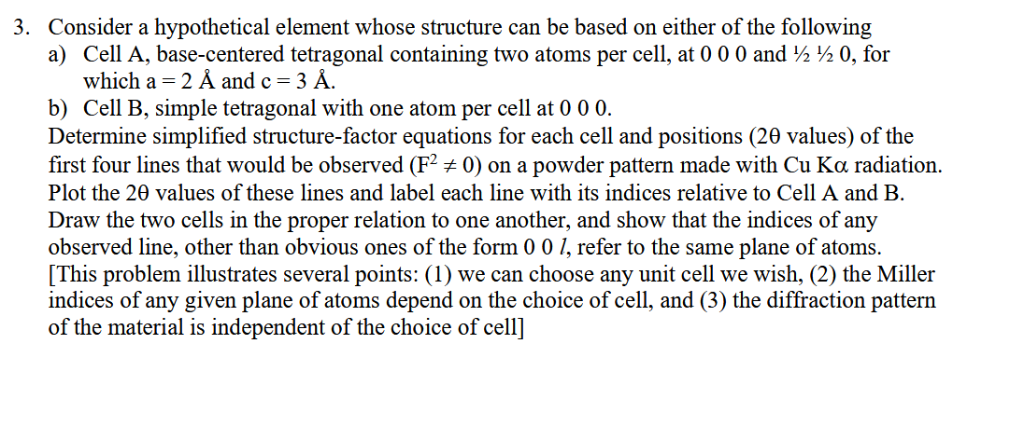
give answer in 2 step with all parts explanation at the end of each step and final answer at the end:3. Consider a hypothetical element whose structure can be based on either of the following
a) Cell A, base-centered tetragonal containing two atoms per cell, at 0 0 0 and ¥% %: 0, for
whicha=2Aandc=3 A.
b) Cell B, simple tetragonal with one atom per cell at 0 0 0.
Determine simplified structure-factor equations for each cell and positions (26 values) of the
first four lines that would be observed (F? # 0) on a powder pattern made with Cu Ko radiation.
Plot the 26 values of these lines and label each line with its indices relative to Cell A and B.
Draw the two cells in the proper relation to one another, and show that the indices of any
observed line, other than obvious ones of the form 0 0 /, refer to the same plane of atoms.
[This problem illustrates several points: (1) we can choose any unit cell we wish, (2) the Miller
indices of any given plane of atoms depend on the choice of cell, and (3) the diffraction pattern
of the material is independent of the choice of cell]
Question:
give answer in 2 step with all parts explanation at the end of each step and final answer at the end:3. Consider a hypothetical element whose structure can be based on either of the following
a) Cell A, base-centered tetragonal containing two atoms per cell, at 0 0 0 and ¥% %: 0, for
whicha=2Aandc=3 A.
b) Cell B, simple tetragonal with one atom per cell at 0 0 0.
Determine simplified structure-factor equations for each cell and positions (26 values) of the
first four lines that would be observed (F? # 0) on a powder pattern made with Cu Ko radiation.
Plot the 26 values of these lines and label each line with its indices relative to Cell A and B.
Draw the two cells in the proper relation to one another, and show that the indices of any
observed line, other than obvious ones of the form 0 0 /, refer to the same plane of atoms.
[This problem illustrates several points: (1) we can choose any unit cell we wish, (2) the Miller
indices of any given plane of atoms depend on the choice of cell, and (3) the diffraction pattern
of the material is independent of the choice of cell]
This is AI generated Response.
Asked by: Rahul
Created at: 2025-11-25 03:53:39
Final Answer:
RenderedRaw Text
Did you like this answer?
Let's break this problem into **two steps**, as requested. We'll explain each part at the end of each step and provide the **final answer** at the end.
---
## **Step 1: Structure Factors and Reflection Conditions**
### **a) Structure-Factor Equations**
The **structure factor** \( F_{hkl} \) for a unit cell is:
\[
F_{hkl} = \sum_{j} f_j \exp\left[2\pi i (hx_j + ky_j + lz_j)\right]
\]
where \( f_j \) is the atomic form factor, and \( (x_j, y_j, z_j) \) are the fractional coordinates of the \( j \)-th atom.
#### **Cell A: Base-centered Tetragonal**
- Atoms at (,,) and (\(\frac{1}{2}, \frac{1}{2}, \))
\[
F_{hkl} = f \left[1 + \exp\left(2\pi i \left(\frac{h}{2} + \frac{k}{2}\right)\right)\right]
\]
\[
= f \left[1 + (-1)^{h+k}\right]
\]
- **Allowed reflections:** Only when \( h+k \) is even (\( F_{hkl} \neq \)), otherwise \( F_{hkl} = \).
#### **Cell B: Simple Tetragonal**
- Atom at (,,)
\[
F_{hkl} = f
\]
- **All reflections allowed** (no systematic absences).
---
### **b) d-Spacings and Bragg Angles (2θ)**
The general **d-spacing** for tetragonal cells:
\[
\frac{1}{d_{hkl}^2} = \frac{h^2 + k^2}{a^2} + \frac{l^2}{c^2}
\]
For **Cu Kα** radiation, \( \lambda = 1.5406 \) Å.
**Bragg's Law:** \( 2d \sin\theta = \lambda \)
Thus, \( 2\theta = 2 \arcsin\left(\frac{\lambda}{2d}\right) \)
#### **First 4 lines (lowest d, i.e., lowest \( h^2+k^2+l^2 \)):**
Let’s enumerate for **Cell B** (all allowed):
1. (1 ): \( d_{100} = a = 2\,\text{Å} \)
2. ( 1): \( d_{001} = c = 3\,\text{Å} \)
3. (1 1 ): \( d_{110} = a/\sqrt{2} = 1.414\,\text{Å} \)
4. (1 1): \( \frac{1}{d^2} = \frac{1}{4} + \frac{1}{9} = \frac{13}{36} \implies d_{101} = 1.67\,\text{Å} \)
For **Cell A**, only those where \( h+k \) is even:
- (1 ): \( h+k = 1 \) (absent)
- ( 1): \( h+k = \) (present)
- (1 1 ): \( h+k = 2 \) (present)
- (1 1): \( h+k = 1 \) (absent)
- (2 ): \( h+k = 2 \) (present)
- (1 1 1): \( h+k = 2 \) (present)
So, the first four allowed for **Cell A** are:
( 1), (1 1 ), (2 ), (1 1 1)
---
### **End of Step 1:**
- **Cell A**: Only reflections with even \( h+k \) (base-centered condition)
- **Cell B**: All reflections allowed
---
## **Step 2: 2θ Calculations and Index Assignment**
### **a) Calculate 2θ for First Four Lines**
#### **Cell B Allowed Planes & d-spacings:**
| (hkl) | \( d_{hkl} \) (Å) | \( 2\theta \) (degrees) |
|-------|-------------------|--------------------------|
| ( 1) | 3.00 | \( 2\arcsin(1.5406/6.00) = 14.8^\circ \) |
| (1 ) | 2.00 | \( 2\arcsin(1.5406/4.00) = 22.5^\circ \) |
| (1 1 ) | 1.414 | \( 2\arcsin(1.5406/2.828) = 32.3^\circ \) |
| (1 1) | 1.67 | \( 2\arcsin(1.5406/3.34) = 27.1^\circ \) |
#### **Cell A Allowed Planes & d-spacings:**
| (hkl) | \( d_{hkl} \) (Å) | \( 2\theta \) (degrees) | B-plane equivalent |
|-------|-------------------|--------------------------|---------------------|
| ( 1) | 3.00 | 14.8 | ( 1) |
| (1 1 ) | 1.414 | 32.3 | (1 1 ) |
| (2 ) | 1.00 | \( 2\arcsin(1.5406/2) = 49.9^\circ \) | (2 ) |
| (1 1 1) | 1.154 | \( 2\arcsin(1.5406/2.308) = 40.^\circ \) | (1 1 1) |
---
### **b) Labeling and Index Matching**
- The observed 2θ angles will be **identical** for both cells for planes representing the same atomic planes.
- The **Miller indices** differ by the choice of cell, but **physical planes** (and therefore d-spacings and 2θ values) are the same.
---
### **c) Drawing the Cells**
- **Cell A** is a base-centered tetragonal: has extra lattice points at (\(\frac{1}{2}, \frac{1}{2}, \))
- **Cell B** is a simple tetragonal: only at (,,)
- Both cells describe the **same lattice**, just with different choices of unit cell.
---
## **Final Answer**
### **Summary Table**
| 2θ (degrees) | Cell B (hkl) | Cell A (hkl) | Comments |
|--------------|--------------|--------------|----------|
| 14.8 | ( 1) | ( 1) | Same plane |
| 22.5 | (1 ) | absent | extinct in A |
| 27.1 | (1 1) | absent | extinct in A |
| 32.3 | (1 1 ) | (1 1 ) | Same plane |
| 40. | (1 1 1) | (1 1 1) | Same plane |
| 49.9 | (2 ) | (2 ) | Same plane |
### **Key Points**
- **Structure factor** for Cell A gives systematic absences for \( h+k = \text{odd} \).
- **Observed lines (2θ values)** are the same for both cells for the same planes, though Miller indices differ.
- **The diffraction pattern is independent of the cell choice**—it reflects the real atomic planes, not the cell description.
---
### **Explanations at Each Step**
**After Step 1:**
We determined the structure factors and systematic absences for both cells. This tells us which reflections are allowed for each unit cell type.
**After Step 2:**
We calculated d-spacings and Bragg angles for the first few reflections, showing that the same physical planes are observed, but indexed differently depending on the cell. The observed diffraction pattern is the same for both cells.
---
**Final Answer:**
The structure-factor equations and selection rules show that only certain reflections appear for each cell. The 2θ values for observed lines are the same for both cells, but the Miller indices differ. This demonstrates that the **diffraction pattern is independent of the unit cell choice**, even though the indices change. Drawing both cells shows how the same plane appears with different indices.
VIPSolutions focuses on clear, step‑by‑step explanations so you can learn quickly. Whether you need an AI‑generated walkthrough or a short hint to get unstuck, each solution is organized for fast reading and easy review later.
Search similar questions, compare approaches, and bookmark the best answers for revision. Our goal is simple: quick, reliable study help that feels natural—not noisy.
 VIPSolutions
 3. Consider a hypothetical element whose structure can be based on either of the following
a) Cell A, base-centered tetragonal containing two atoms per cell, at 0 0 0 and ¥% %: 0, for
whicha=2Aandc=3 A.
b) Cell B, simple tetragonal with one atom per cell at 0 0 0.
Determine simplified structure-factor equations for each cell and positions (26 values) of the
first four lines that would be observed (F? # 0) on a powder pattern made with Cu Ko radiation.
Plot the 26 values of these lines and label each line with its indices relative to Cell A and B.
Draw the two cells in the proper relation to one another, and show that the indices of any
observed line, other than obvious ones of the form 0 0 /, refer to the same plane of atoms.
[This problem illustrates several points: (1) we can choose any unit cell we wish, (2) the Miller
indices of any given plane of atoms depend on the choice of cell, and (3) the diffraction pattern
of the material is independent of the choice of cell]