 VIPSolutions
give answer in 2 step with all parts explanation at the end of each step and final answer at the end:‘Problem 1. Let zy € Rand let f € C(R). The Taylor series of f centered at 7 is the power series. wii i | PE w Let R be the radius of convergence, and bet 1 = (2g — Roxy + RB). (n) Suppose for cach compact K 1 there is a constant € such that fo all k > 0 and r € K, we have 10) < ee 1 Prove the the Tyr wre) comers 0 0) bal [ry — i. £5 Sa ante) = 300 gy oe ele) = 0 ry (€) Let a = 1% Prove CR), amd 10) = 0 forall . Th, the To seri ff comers on al of, br | Apsimm inditi rly Supp
Question:
give answer in 2 step with all parts explanation at the end of each step and final answer at the end: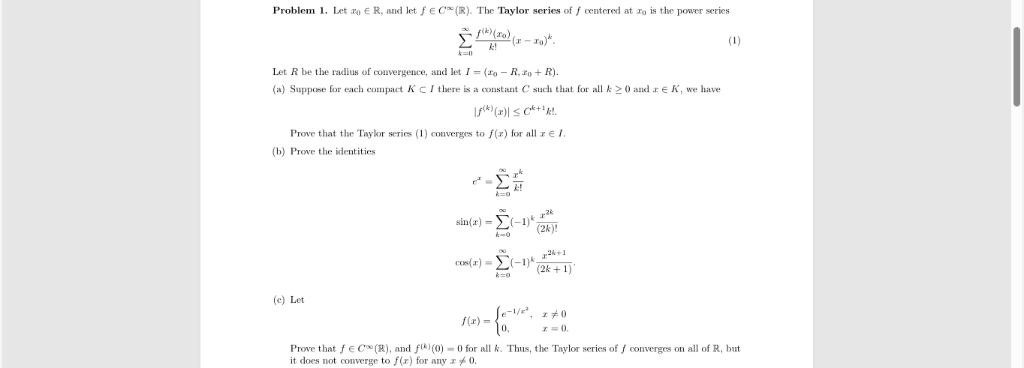 ‘Problem 1. Let zy € Rand let f € C(R). The Taylor series of f centered at 7 is the power series.
wii i |
PE w
Let R be the radius of convergence, and bet 1 = (2g — Roxy + RB).
(n) Suppose for cach compact K 1 there is a constant € such that fo all k > 0 and r € K, we have
10) < ee 1
Prove the the Tyr wre) comers 0 0) bal
[ry —
i.
£5
Sa
ante) = 300 gy
oe
ele) = 0 ry
(€) Let
a
= 1%
Prove CR), amd 10) = 0 forall . Th, the To seri ff comers on al of, br
| Apsimm inditi rly Supp
This is AI generated Response.
Asked by: Rahul
Created at: 2025-11-25 03:25:06
Asked by: Rahul
Created at: 2025-11-25 03:25:06
Final Answer:
Rendered
Raw Text
Did you like this answer?
Certainly! Let’s break down the solution into **2 steps**, with explanations at the end of each step, and a final answer at the end.
---
## **Step 1: Understanding the Taylor Series and Part (a)**
### **Given:**
- \(x_ \in \mathbb{R}\), \(f \in C^\infty(\mathbb{R})\)
- The Taylor series centered at \(x_\):
\[
\sum_{k=1}^{\infty} \frac{f^{(k)}(x_)}{k!}(x - x_)^k
\]
- \(R\) = radius of convergence, \(I = (x_ - R, x_ + R)\)
- For each compact \(K \subset I\), there exists \(C\) such that for all \(k \geq \) and \(x \in K\):
\[
|f^{(k)}(x)| \leq C^{k+1}k!
\]
### **To Prove (a):**
- The Taylor series converges to \(f(x)\) for all \(x \in I\).
#### **Explanation:**
- The bound \( |f^{(k)}(x)| \leq C^{k+1} k! \) ensures rapid growth is controlled.
- By Taylor's theorem with remainder, for any \(x\) in a compact subset of \(I\), the remainder term goes to as \(n \to \infty\).
- Thus, the Taylor series converges **uniformly** to \(f(x)\) on compact subsets of \(I\), and hence pointwise for all \(x \in I\).
---
## **Step 2: Parts (b) and (c) and Their Implications**
### **(b) Prove the identities:**
- \( e^x = \sum_{k=}^\infty \frac{x^k}{k!} \)
- \( \sin(x) = \sum_{k=}^\infty \frac{(-1)^k}{(2k+1)!}x^{2k+1} \)
- \( \cos(x) = \sum_{k=}^\infty \frac{(-1)^k}{(2k)!}x^{2k} \)
#### **Explanation:**
- These are the Maclaurin series for the exponential, sine, and cosine functions.
- All three functions are analytic on \(\mathbb{R}\), and their Taylor series converge to the function everywhere due to their infinite radius of convergence.
---
### **(c) Function \( f(x) = \begin{cases} e^{-1/x^2}, & x \neq \\ , & x = \end{cases} \)**
#### **To Prove:**
- \( f \in C^\infty(\mathbb{R}) \), all derivatives at \(\) are \(\), so the Taylor series at \(\) is identically \(\).
- For \(x \neq \), \(f(x) \neq \).
- Thus, the Taylor series converges everywhere but only equals \(f(x)\) at \(x = \).
#### **Explanation:**
- \(f\) is smooth everywhere; at \(x = \), all derivatives vanish, so its Taylor series is zero everywhere.
- However, for \(x \neq \), \(f(x) > \), showing Taylor series need not equal the function even if it converges.
---
## **Final Answer**
### **Summary:**
1. **(a)** If the derivatives are bounded as \( |f^{(k)}(x)| \leq C^{k+1} k! \) on compact subsets, the Taylor series converges to \(f(x)\) on the interval of convergence.
2. **(b)** The Taylor series for \(e^x\), \(\sin(x)\), and \(\cos(x)\) converge to their respective functions everywhere on \(\mathbb{R}\).
3. **(c)** The function \(f(x) = e^{-1/x^2}\) (for \(x \neq \)), \(\) (for \(x = \)), is smooth but its Taylor series at \(\) is zero everywhere, so the series converges everywhere but does not equal \(f(x)\) except at \(x = \).
---
**In conclusion:**
The Taylor series converges to the function within its interval of convergence if the derivatives are controlled as above, but there exist smooth functions (like in part (c)) where the Taylor series converges everywhere but does not represent the function except at a single point.
📢 Instructions:
- Ask anything relatd to above question only.
- For new Question goto :