 VIPSolutions
give answer in 2 step with all parts explanation at the end of each step and final answer at the end:1.) What are the products of the following reactions? HO" HO on —_— ? TOY YY N nN ° ° Q Q 2 J el) — 7 wor NN — 7? a al PT + a _ ?
Question:
give answer in 2 step with all parts explanation at the end of each step and final answer at the end: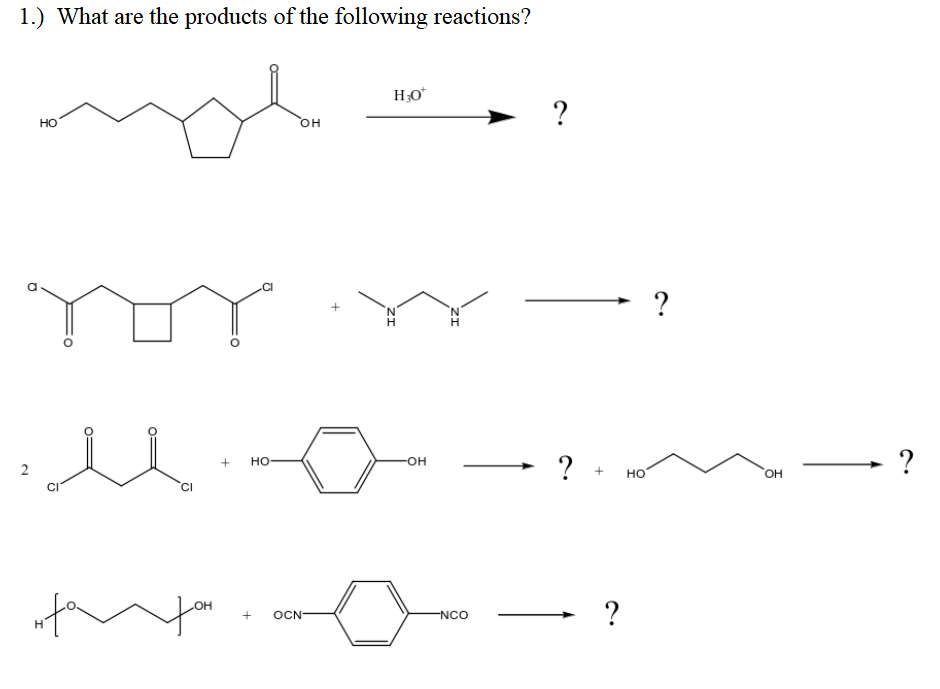 1.) What are the products of the following reactions?
HO"
HO on —_— ?
TOY YY
N nN
° °
Q Q
2 J el) — 7 wor NN — 7?
a al
PT + a _ ?
This is AI generated Response.
Asked by: Rahul
Created at: 2025-11-29 21:41:13
Asked by: Rahul
Created at: 2025-11-29 21:41:13
Final Answer:
Rendered
Raw Text
Did you like this answer?
Let's solve each reaction in **2 steps** and explain each step.
---
## **1. Reaction 1: Cyclopentane-1,1-dicarboxylic acid in acidic conditions**
### **Step 1: Identify the Functional Groups and Reagent**
- The molecule has two carboxylic acid groups (one is a hydroxy acid).
- The reagent is acid (**H₃O⁺**), which suggests a **decarboxylation** reaction, especially if a β-keto acid or β-hydroxy acid is present.
**Explanation:**
Under acidic conditions, β-hydroxy acids readily decarboxylate to give a ketone or aldehyde and CO₂.
---
### **Step 2: Predict the Product**
- The β-hydroxy group (relative to the carboxylic acid) facilitates decarboxylation.
- Removal of CO₂ from the carboxyl group adjacent to the hydroxy yields **cyclopentanone**.
**Explanation:**
The carboxyl group is lost as CO₂, and the remaining molecule is cyclopentanone.
**Final Answer:**
**Cyclopentanone + CO₂**
---
## **2. Reaction 2: Cyclopentane-1,1-dicarbonyl dichloride + Ethylenediamine**
### **Step 1: Identify the Functional Groups and Reagent**
- Dicarbonyl dichloride (diacid chloride) reacts with a diamine (ethylenediamine).
- This is a classic **polyamide (nylon-type) formation** reaction.
**Explanation:**
Acid chlorides react with amines to form amides, releasing HCl.
---
### **Step 2: Predict the Product**
- Each acid chloride reacts with an amine group, forming a cyclic **imide** if intramolecular, or a diamide if only one equivalent is used.
**Explanation:**
Since there are two acid chlorides and a diamine, you will get a **bicyclic diamide** (a cyclopentane ring with two amide linkages to the ethylene bridge).
**Final Answer:**
**Bicyclic diamide (with cyclopentane core and ethylene bridges via amide bonds) + 2 HCl**
---
## **3. Reaction 3: Phthaloyl chloride + Hydroquinone and 1,2-ethanediol**
### **Step 1: First Reaction—Phthaloyl Chloride + Hydroquinone**
- Both are di-functional: phthaloyl chloride (diacid chloride), hydroquinone (diol).
- They form a **polyester** (polyarylate) via condensation, releasing HCl.
**Explanation:**
Each -Cl reacts with an -OH, forming ester bonds.
---
### **Step 2: Second Reaction—Polyester + 1,2-Ethanediol**
- The polyester can further react with more diol (glycolysis), **breaking ester bonds** and forming bis(hydroxyethyl) phthalate.
**Explanation:**
Transesterification with ethylene glycol yields **bis(hydroxyethyl) phthalate**.
**Final Answer:**
**Bis(hydroxyethyl) phthalate + Hydroquinone (if complete transesterification)**
---
## **4. Reaction 4: Polyethylene Glycol + Terephthaloyl Diisocyanate**
### **Step 1: Identify the Functional Groups and Reagent**
- Polyethylene glycol (polyol) reacts with diisocyanate.
- This forms a **polyurethane**.
**Explanation:**
Isocyanate reacts with alcohol to form a **urethane (carbamate) linkage**.
---
### **Step 2: Predict the Product**
- The repeating unit will join via urethane bonds between the glycol and terephthaloyl units.
**Explanation:**
You get a **polyurethane** chain with alternating polyethylene glycol and terephthaloyl units.
**Final Answer:**
**Polyurethane (from polyethylene glycol and terephthaloyl diisocyanate)**
---
## **Summary Table**
| Reaction | Step 1 (Explanation) | Step 2 (Product) | Final Answer |
|----------|---------------------|------------------|--------------|
| 1 | Acidic decarboxylation of β-hydroxy acid | Cyclopentanone + CO₂ | Cyclopentanone + CO₂ |
| 2 | Diamine + diacid chloride → diamide | Bicyclic diamide + 2 HCl | Bicyclic diamide + 2 HCl |
| 3 | Diacid chloride + diol → polyester | Transesterification with glycol | Bis(hydroxyethyl) phthalate + hydroquinone |
| 4 | Polyol + diisocyanate → polyurethane | Polyurethane formation | Polyurethane |
📢 Instructions:
- Ask anything relatd to above question only.
- For new Question goto :