 VIPSolutions
give answer in 2 step with all parts explanation at the end of each step and final answer at the end:Problem 10 What is the ratio of the velocity of a 5.00-MeV B ray to that ofan a particle with the same kinetic energy? This should confirm that B’s travel much faster than a’s even when relativity is taken into consideration (5pt) Va Up
Question:
give answer in 2 step with all parts explanation at the end of each step and final answer at the end: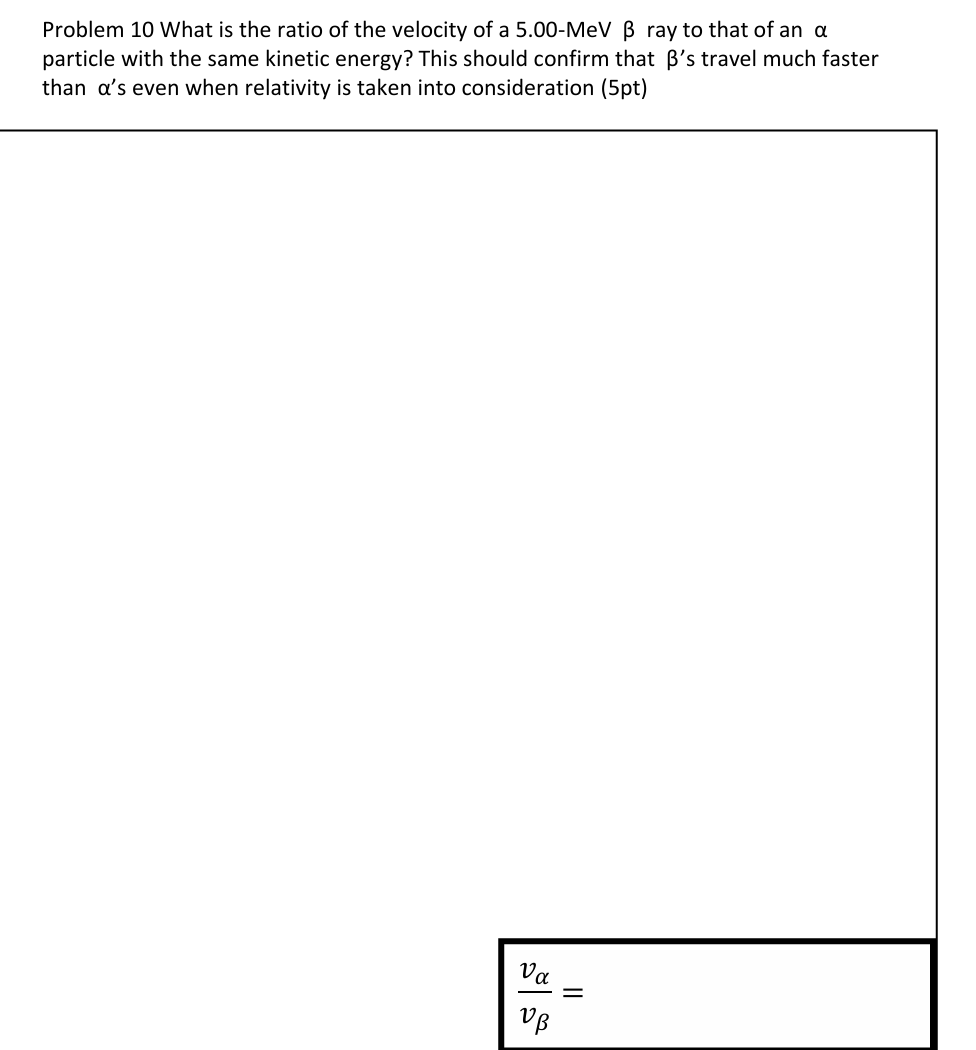 Problem 10 What is the ratio of the velocity of a 5.00-MeV B ray to that ofan a
particle with the same kinetic energy? This should confirm that B’s travel much faster
than a’s even when relativity is taken into consideration (5pt)
Va
Up
This is AI generated Response.
Asked by: Rahul
Created at: 2025-11-29 05:47:07
Asked by: Rahul
Created at: 2025-11-29 05:47:07
Final Answer:
Rendered
Raw Text
Did you like this answer?
## Step 1: Identify Key Information and Relativistic Formula
- **Given:**
- Kinetic energy (\(K\)) = 5.00 MeV for both particles
- \(\beta\) ray = electron, mass \(m_\beta = m_e = .511\,\text{MeV}/c^2\)
- \(\alpha\) particle mass \(m_\alpha = 4 \times 938.3\,\text{MeV}/c^2 = 3727.2\,\text{MeV}/c^2\) (since it's 4 protons/neutrons)
- **Relativistic Kinetic Energy Equation:**
\[
K = (\gamma - 1)mc^2
\]
where \(\gamma = \frac{1}{\sqrt{1 - v^2/c^2}}\).
Rearranged:
\[
\gamma = 1 + \frac{K}{mc^2}
\]
To find \(v\):
\[
v = c \sqrt{1 - \frac{1}{\gamma^2}}
\]
### **For the \(\beta\) particle (electron):**
\[
\gamma_\beta = 1 + \frac{5.00}{.511} = 10.78
\]
\[
v_\beta = c \sqrt{1 - \frac{1}{(10.78)^2}} = c \sqrt{1 - .00860} = c \times .9957
\]
**Explanation:**
We calculated the relativistic \(\gamma\) factor for the electron using its rest mass and kinetic energy, then solved for velocity as a fraction of \(c\).
---
## Step 2: Repeat for Alpha Particle and Find Ratio
### **For the \(\alpha\) particle:**
\[
\gamma_\alpha = 1 + \frac{5.00}{3727.2} = 1.00134
\]
\[
v_\alpha = c \sqrt{1 - \frac{1}{(1.00134)^2}}
\]
Calculate:
\[
(1.00134)^2 \approx 1.00268
\]
\[
\frac{1}{1.00268} \approx .99733
\]
\[
v_\alpha = c \sqrt{1 - .99733} = c \sqrt{.00267} = c \times .0517
\]
### **Velocity Ratio:**
\[
\frac{v_\alpha}{v_\beta} = \frac{.0517}{.9957} \approx .052
\]
---
## **Final Answer**
\[
\boxed{\frac{v_\alpha}{v_\beta} \approx .052}
\]
**Conclusion:**
The velocity of a 5.00-MeV \(\alpha\) particle is only about 5.2% that of a 5.00-MeV \(\beta\) particle (electron), confirming that even with the same kinetic energy, \(\beta\) rays travel much faster than \(\alpha\) particles due to their much smaller mass.
📢 Instructions:
- Ask anything relatd to above question only.
- For new Question goto :