This is AI generated Response.
Asked by: Rahul
Created at: 2025-11-29 04:34:27
Final Answer:
RenderedRaw Text
Did you like this answer?
## Step : Understanding the Problem
- The plate is rotating around the **z-axis**.
- The hinge attached is rotating around the **–y axis**.
- The link is pointing along the **+x axis**.
- We are asked about the **rotational acceleration** of point B (the end of the link), specifically the directions of the components of \(\vec{a}_B\).
### Explanation
- **Rotational acceleration** at a point due to angular acceleration \(\vec{\alpha}\) is given by:
\(\vec{a}_B = \vec{\alpha} \times \vec{r}_{B/A}\)
- **Point B** is at a distance along the +x direction from A.
- The **angular acceleration** is around the **–y axis**.
## Step 2: Determining the Direction
- **\(\vec{\alpha}\)**: Since the rotation is around the **–y axis**, \(\vec{\alpha}\) points in the **–y direction**.
- **\(\vec{r}_{B/A}\)**: This is the position vector from A to B, which is in the **+x direction**.
Now, calculate the cross product:
- \(\vec{a}_B = \vec{\alpha} \times \vec{r}_{B/A} = (-\hat{y}) \times (+\hat{x})\)
From the right-hand rule:
- \( \hat{y} \times \hat{x} = -\hat{z} \)
- So, \( -\hat{y} \times \hat{x} = -(-\hat{z}) = +\hat{z} \)
### Explanation
- The acceleration component at B due to the rotational acceleration is in the **+z direction**.
---
## **Final Answer**
- The correct direction for the acceleration of point B is:
**[+] z**
---
### **Summary Table**
| Direction | Select? | Reason |
|-----------|---------|--------------------------------------------------|
| +x | No | Not in cross product result |
| –x | No | Not in cross product result |
| +y | No | Not in cross product result |
| –y | No | Not in cross product result |
| +z | **Yes** | Result of the cross product |
| –z | No | Opposite of the result |
| Not accel.| No | Point B is accelerating due to rotation |
VIPSolutions focuses on clear, step‑by‑step explanations so you can learn quickly. Whether you need an AI‑generated walkthrough or a short hint to get unstuck, each solution is organized for fast reading and easy review later.
Search similar questions, compare approaches, and bookmark the best answers for revision. Our goal is simple: quick, reliable study help that feels natural—not noisy.
 VIPSolutions
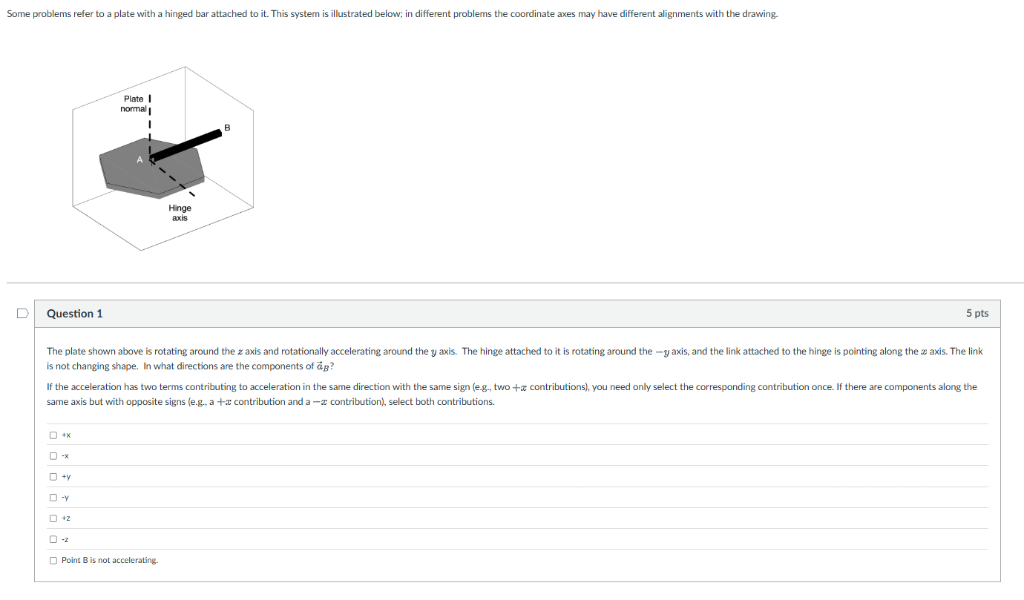 ‘Some problems refer to 2 pate with a hinged bar attached to i. Tris system is strated below: in different problems the coordinate axes may have diferent alignments with the drawing.
pio |
nom)
' .t
~~ -
©] Question Sots
Th pate shown above is Foaling round th 2 xs and rotationally accelerating round the y xs. Th Hing attached t Is rotating round the —y as, and the nk attached to th hinge is pcinting long th & ai. The Ik
{snot changing shape. In what directions ve the components of
18h acceleration has bw terms conruting 0 acceleration i the same direction withthe same 7 o, two +: contributions), you need only slet the corresponding contribution ace. If thre re components lng the
same xis but with opposite signs e.2.3-+ contribution and 3 —= conruton, select both contributions.
on
ow
Er rTe—