 VIPSolutions
give answer in 2 step with all parts explanation at the end of each step and final answer at the end:‘QUESTION 4 Blocks D and E have a mass of 4 kg and 6 kg, respectively. If x = 2 m determine de distance sag s . without units, for equilibrium. om—— — x —— B C 5 A
Question:
give answer in 2 step with all parts explanation at the end of each step and final answer at the end: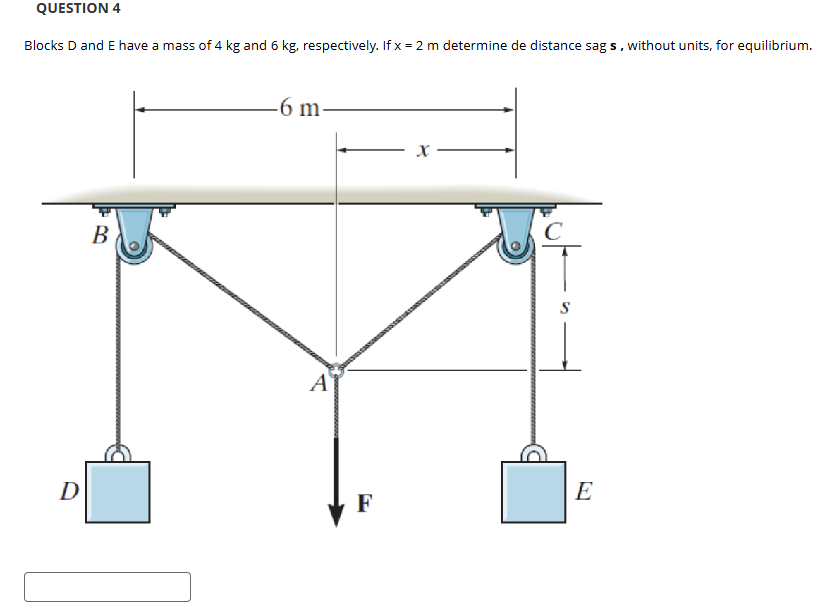 ‘QUESTION 4
Blocks D and E have a mass of 4 kg and 6 kg, respectively. If x = 2 m determine de distance sag s . without units, for equilibrium.
om——
— x ——
B C
5
A
This is AI generated Response.
Asked by: Rahul
Created at: 2025-11-29 04:31:24
Asked by: Rahul
Created at: 2025-11-29 04:31:24
Final Answer:
Rendered
Raw Text
Did you like this answer?
## Step 1: **Free-Body Diagram and Tension Analysis**
Let’s analyze the forces at point \(A\):
- The weight of block \(D\): \(W_D = 4g\)
- The weight of block \(E\): \(W_E = 6g\)
- Tension in \(AB\): \(T_1\)
- Tension in \(AC\): \(T_2\)
- The downward force at \(A\): \(F\)
**Horizontal and Vertical Components:**
- For equilibrium at \(A\):
\[
\sum F_x = \implies T_1 \cos\theta_1 = T_2 \cos\theta_2
\]
\[
\sum F_y = \implies T_1 \sin\theta_1 + T_2 \sin\theta_2 = F
\]
**Geometry:**
- \(AB\) and \(AC\) have horizontal lengths:
- \(AB = 6-x = 4\)
- \(AC = x = 2\)
- Both have vertical distance \(s\).
So,
\[
\cos\theta_1 = \frac{4}{\sqrt{4^2 + s^2}}
\]
\[
\sin\theta_1 = \frac{s}{\sqrt{4^2 + s^2}}
\]
\[
\cos\theta_2 = \frac{2}{\sqrt{2^2 + s^2}}
\]
\[
\sin\theta_2 = \frac{s}{\sqrt{2^2 + s^2}}
\]
**Tension values:**
- \(T_1 = W_D = 4g\)
- \(T_2 = W_E = 6g\)
**End of Step 1 Explanation:**
We have resolved the geometry and set up equations for equilibrium at point \(A\), relating the sag \(s\) to the weights and positions of the blocks.
---
## Step 2: **Set Up the Equilibrium and Solve for \(s\)**
**Horizontal equilibrium:**
\[
T_1 \cos\theta_1 = T_2 \cos\theta_2
\]
\[
4g \frac{4}{\sqrt{16 + s^2}} = 6g \frac{2}{\sqrt{4 + s^2}}
\]
\(g\) cancels:
\[
4 \cdot \frac{4}{\sqrt{16 + s^2}} = 6 \cdot \frac{2}{\sqrt{4 + s^2}}
\]
\[
\frac{16}{\sqrt{16 + s^2}} = \frac{12}{\sqrt{4 + s^2}}
\]
Cross-multiplied:
\[
16\sqrt{4 + s^2} = 12\sqrt{16 + s^2}
\]
Divide both sides by 4:
\[
4\sqrt{4 + s^2} = 3\sqrt{16 + s^2}
\]
Square both sides:
\[
16(4 + s^2) = 9(16 + s^2)
\]
\[
64 + 16s^2 = 144 + 9s^2
\]
\[
16s^2 - 9s^2 = 144 - 64
\]
\[
7s^2 = 80
\]
\[
s^2 = \frac{80}{7}
\]
\[
s = \sqrt{\frac{80}{7}}
\]
---
### **Final Answer:**
\[
\boxed{s = \sqrt{\frac{80}{7}}}
\]
---
### **End of Step 2 Explanation:**
We substituted the known values, simplified, and solved for the sag \(s\) using the conditions for equilibrium.
📢 Instructions:
- Ask anything relatd to above question only.
- For new Question goto :