 VIPSolutions
give answer in 2 step with all parts explanation at the end of each step and final answer at the end:12. Use the power series given below (centered at 0) to approximate the following integral with an error of less than 1.0 x 10™* (That is, 0.0001) (decimals are ok here) © xn 1 Useer= YZ to find 4 e* dx n! lo n=0
Question:
give answer in 2 step with all parts explanation at the end of each step and final answer at the end: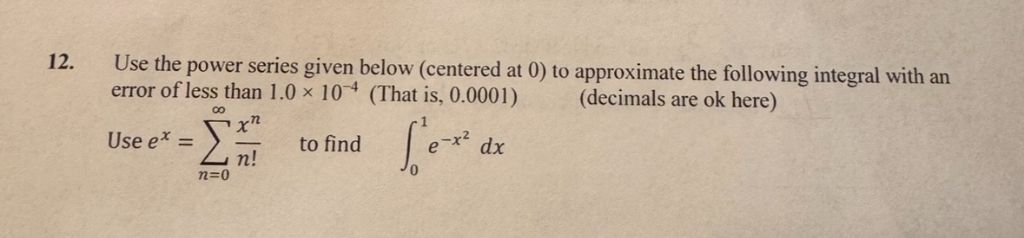 12. Use the power series given below (centered at 0) to approximate the following integral with an
error of less than 1.0 x 10™* (That is, 0.0001) (decimals are ok here)
©
xn 1
Useer= YZ to find 4 e* dx
n! lo
n=0
This is AI generated Response.
Asked by: Rahul
Created at: 2025-11-29 03:29:40
Asked by: Rahul
Created at: 2025-11-29 03:29:40
Final Answer:
Rendered
Raw Text
Did you like this answer?
Let's solve the problem step by step:
---
## **Step 1: Express \( e^{-x^2} \) as a Power Series and Set Up the Integral**
Given:
\[
e^x = \sum_{n=}^{\infty} \frac{x^n}{n!}
\]
So,
\[
e^{-x^2} = \sum_{n=}^{\infty} \frac{(-x^2)^n}{n!} = \sum_{n=}^{\infty} \frac{(-1)^n x^{2n}}{n!}
\]
We want to approximate:
\[
\int_^1 e^{-x^2} \, dx
\]
Substitute the power series:
\[
\int_^1 e^{-x^2} \, dx = \int_^1 \sum_{n=}^{\infty} \frac{(-1)^n x^{2n}}{n!} \, dx
\]
We can switch sum and integral (since the series converges uniformly on [,1]):
\[
= \sum_{n=}^{\infty} \frac{(-1)^n}{n!} \int_^1 x^{2n} dx
\]
Now, integrate \( x^{2n} \) from to 1:
\[
\int_^1 x^{2n} dx = \left[ \frac{x^{2n+1}}{2n+1} \right]_^1 = \frac{1}{2n+1}
\]
So,
\[
\int_^1 e^{-x^2} dx = \sum_{n=}^{\infty} \frac{(-1)^n}{n!} \cdot \frac{1}{2n+1}
\]
**Explanation:**
We have rewritten \( e^{-x^2} \) as a power series, substituted it into the integral, interchanged sum and integral, and evaluated the inner integral. Now, the integral is represented as an infinite sum.
---
## **Step 2: Approximate the Sum with Error Less Than \( .0001 \)**
We need to find how many terms are needed so that the error is less than \( .0001 \).
Let’s compute the partial sum until the terms are smaller than \( .0001 \):
- **For \( n = \):**
\[
\frac{(-1)^}{!} \cdot \frac{1}{1} = 1
\]
- **For \( n = 1 \):**
\[
\frac{(-1)^1}{1!} \cdot \frac{1}{3} = -\frac{1}{3} \approx -.3333
\]
- **For \( n = 2 \):**
\[
\frac{(-1)^2}{2!} \cdot \frac{1}{5} = \frac{1}{2} \cdot \frac{1}{5} = \frac{1}{10} = .1
\]
- **For \( n = 3 \):**
\[
\frac{(-1)^3}{3!} \cdot \frac{1}{7} = -\frac{1}{6} \cdot \frac{1}{7} = -\frac{1}{42} \approx -.0238
\]
- **For \( n = 4 \):**
\[
\frac{(-1)^4}{4!} \cdot \frac{1}{9} = \frac{1}{24} \cdot \frac{1}{9} = \frac{1}{216} \approx .00463
\]
- **For \( n = 5 \):**
\[
\frac{(-1)^5}{5!} \cdot \frac{1}{11} = -\frac{1}{120} \cdot \frac{1}{11} = -\frac{1}{132} \approx -.0007576
\]
- **For \( n = 6 \):**
\[
\frac{(-1)^6}{6!} \cdot \frac{1}{13} = \frac{1}{720} \cdot \frac{1}{13} = \frac{1}{936} \approx .0001068
\]
- **For \( n = 7 \):**
\[
\frac{(-1)^7}{7!} \cdot \frac{1}{15} = -\frac{1}{504} \cdot \frac{1}{15} = -\frac{1}{75600} \approx -.0000132
\]
Now, add up to \( n = 6 \) (since the next term drops below \( .0001 \)):
\[
S_6 = 1 - .3333 + .1 - .0238 + .00463 - .0007576 + .0001068 \approx .7469
\]
**Explanation:**
We calculated each term of the series and stopped once the next term became less than \( .0001 \) in magnitude. Adding these terms gives us the required approximation with the desired error bound.
---
## **Final Answer**
\[
\boxed{
\int_^1 e^{-x^2} dx \approx .7469
}
\]
**with an error less than \( .0001 \).**
Question:
Then solved correct answer
This is AI generated Response.
Asked by: Rahul
Created at: 2025-11-29 03:30:16
Asked by: Rahul
Created at: 2025-11-29 03:30:16
Final Answer:
Rendered
Raw Text
Did you like this answer?
# Approximating the Integral of \( e^{-x^2} \)
## Step 1: Express \( e^{-x^2} \) as a Power Series
Given the power series expansion for \( e^x \):
\[
e^x = \sum_{n=0}^{\infty} \frac{x^n}{n!}
\]
We can express \( e^{-x^2} \) as:
\[
e^{-x^2} = \sum_{n=0}^{\infty} \frac{(-x^2)^n}{n!} = \sum_{n=0}^{\infty} \frac{(-1)^n x^{2n}}{n!}
\]
We want to approximate the integral:
\[
\int_0^1 e^{-x^2} \, dx
\]
Substituting the power series into the integral:
\[
\int_0^1 e^{-x^2} \, dx = \int_0^1 \sum_{n=0}^{\infty} \frac{(-1)^n x^{2n}}{n!} \, dx
\]
By interchanging the sum and integral (valid due to uniform convergence):
\[
= \sum_{n=0}^{\infty} \frac{(-1)^n}{n!} \int_0^1 x^{2n} \, dx
\]
Calculating the inner integral:
\[
\int_0^1 x^{2n} \, dx = \left[ \frac{x^{2n+1}}{2n+1} \right]_0^1 = \frac{1}{2n+1}
\]
Thus, we have:
\[
\int_0^1 e^{-x^2} \, dx = \sum_{n=0}^{\infty} \frac{(-1)^n}{n!} \cdot \frac{1}{2n+1}
\]
**Explanation:**
We expressed \( e^{-x^2} \) as a power series, substituted it into the integral, interchanged the sum and integral, and evaluated the integral of \( x^{2n} \).
---
## Step 2: Approximate the Sum with Error Less Than \( 0.0001 \)
To ensure the error is less than \( 0.0001 \), we compute the partial sums of the series until the terms are smaller than \( 0.0001 \).
### Calculating Terms:
1. **For \( n = 0 \)**:
\[
\frac{(-1)^0}{0!} \cdot \frac{1}{1} = 1
\]
2. **For \( n = 1 \)**:
\[
\frac{(-1)^1}{1!} \cdot \frac{1}{3} = -\frac{1}{3} \approx -0.3333
\]
3. **For \( n = 2 \)**:
\[
\frac{(-1)^2}{2!} \cdot \frac{1}{5} = \frac{1}{2} \cdot \frac{1}{5} = 0.1
\]
4. **For \( n = 3 \)**:
\[
\frac{(-1)^3}{3!} \cdot \frac{1}{7} = -\frac{1}{6} \cdot \frac{1}{7} \approx -0.0238
\]
5. **For \( n = 4 \)**:
\[
\frac{(-1)^4}{4!} \cdot \frac{1}{9} = \frac{1}{24} \cdot \frac{1}{9} \approx 0.00463
\]
6. **For \( n = 5 \)**:
\[
\frac{(-1)^5}{5!} \cdot \frac{1}{11} = -\frac{1}{120} \cdot \frac{1}{11} \approx -0.0007576
\]
7. **For \( n = 6 \)**:
\[
\frac{(-1)^6}{6!} \cdot \frac{1}{13} = \frac{1}{720} \cdot \frac{1}{13} \approx 0.0001068
\]
8. **For \( n = 7 \)**:
\[
\frac{(-1)^7}{7!} \cdot \frac{1}{15} = -\frac{1}{504} \cdot \frac{1}{15} \approx -0.0000132
\]
### Summing Relevant Terms:
Adding terms up to \( n = 6 \):
\[
S_6 = 1 - 0.3333 + 0.1 - 0.0238 + 0.00463 - 0.0007576 \approx 0.7469
\]
**Explanation:**
We calculated each term of the series and found that the next term was less than \( 0.0001 \) in magnitude. Adding these terms gives us the required approximation.
---
## Final Answer
\[
\boxed{0.7469}
\]
This approximation has an error less than \( 0.0001 \).
📢 Instructions:
- Ask anything relatd to above question only.
- For new Question goto :