 VIPSolutions
give answer in 2 step with all parts explanation at the end of each step and final answer at the end:1. Calculate the component of the forces (Fx and Fy) shown in the figure. EN A. 7 | I a b / | y r \ | | | 8 c x d OT
Question:
give answer in 2 step with all parts explanation at the end of each step and final answer at the end: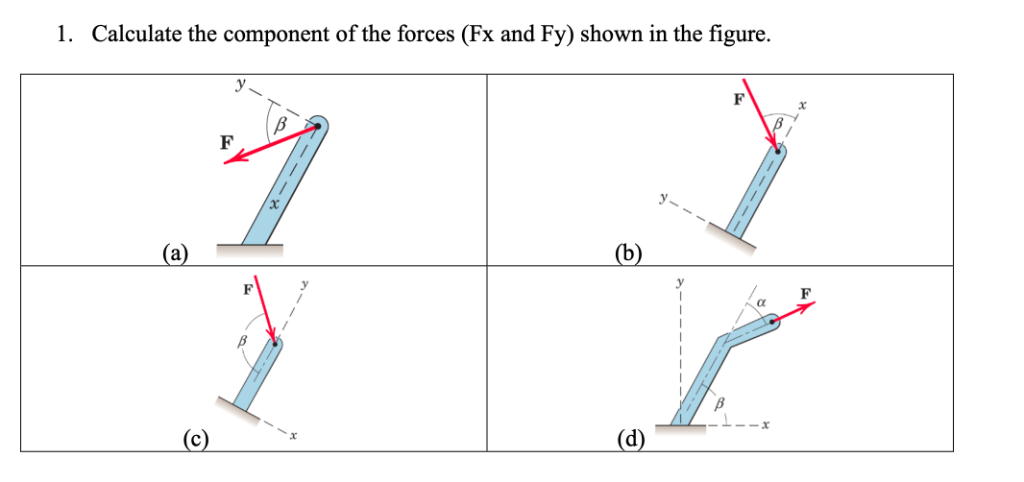 1. Calculate the component of the forces (Fx and Fy) shown in the figure.
EN A.
7 |
I
a b
/ | y
r
\ |
|
|
8
c x d OT
This is AI generated Response.
Asked by: Rahul
Created at: 2025-11-29 03:17:42
Asked by: Rahul
Created at: 2025-11-29 03:17:42
Final Answer:
Rendered
Raw Text
Did you like this answer?
# Step 1: **Express Force Components in Terms of Angles**
For each case, de the force \( F \) into its \( x \) and \( y \) components using trigonometry.
Assume \( F \) is the magnitude of the force, and \( \beta \) (or \( \alpha \)) is the angle as shown.
---
### (a)
- \( F \) is directed *upward and to the left*.
- The angle \( \beta \) is measured **from the positive \( x \)-axis toward the force**.
**Components:**
- \( F_x = -F \cos \beta \)
- \( F_y = F \sin \beta \)
**Explanation:**
Since the force is to the left, the \( x \)-component is negative. The \( y \)-component is positive (upward).
---
### (b)
- \( F \) is directed *downward and to the right*.
- The angle \( \beta \) is measured **from the positive \( x \)-axis toward the force**.
**Components:**
- \( F_x = F \cos \beta \)
- \( F_y = -F \sin \beta \)
**Explanation:**
The force is to the right (positive \( x \)), but downward (negative \( y \)).
---
### (c)
- \( F \) is directed *downward and to the left*.
- The angle \( \beta \) is measured **from the positive \( x \)-axis toward the force**.
**Components:**
- \( F_x = -F \cos \beta \)
- \( F_y = -F \sin \beta \)
**Explanation:**
Both components are negative: left and down.
---
### (d)
- \( F \) is directed *upward and to the right*.
- The angle \( \alpha \) is measured **from the positive \( x \)-axis toward the force**.
**Components:**
- \( F_x = F \cos \alpha \)
- \( F_y = F \sin \alpha \)
**Explanation:**
Both \( x \) and \( y \) components are positive: right and up.
---
# Step 2: **Summary Table**
| Part | \( F_x \) | \( F_y \) |
|------|----------------------|----------------------|
| (a) | \( -F \cos \beta \) | \( F \sin \beta \) |
| (b) | \( F \cos \beta \) | \( -F \sin \beta \) |
| (c) | \( -F \cos \beta \) | \( -F \sin \beta \) |
| (d) | \( F \cos \alpha \) | \( F \sin \alpha \) |
---
## **Final Answer**
\[
\boxed{
\begin{aligned}
&\text{(a)} \quad F_x = -F \cos \beta,\quad F_y = F \sin \beta \\
&\text{(b)} \quad F_x = F \cos \beta, \quad F_y = -F \sin \beta \\
&\text{(c)} \quad F_x = -F \cos \beta, \quad F_y = -F \sin \beta \\
&\text{(d)} \quad F_x = F \cos \alpha,\quad F_y = F \sin \alpha \\
\end{aligned}
}
\]
📢 Instructions:
- Ask anything relatd to above question only.
- For new Question goto :