VIPSolutions logo ✨ VIPSolutions

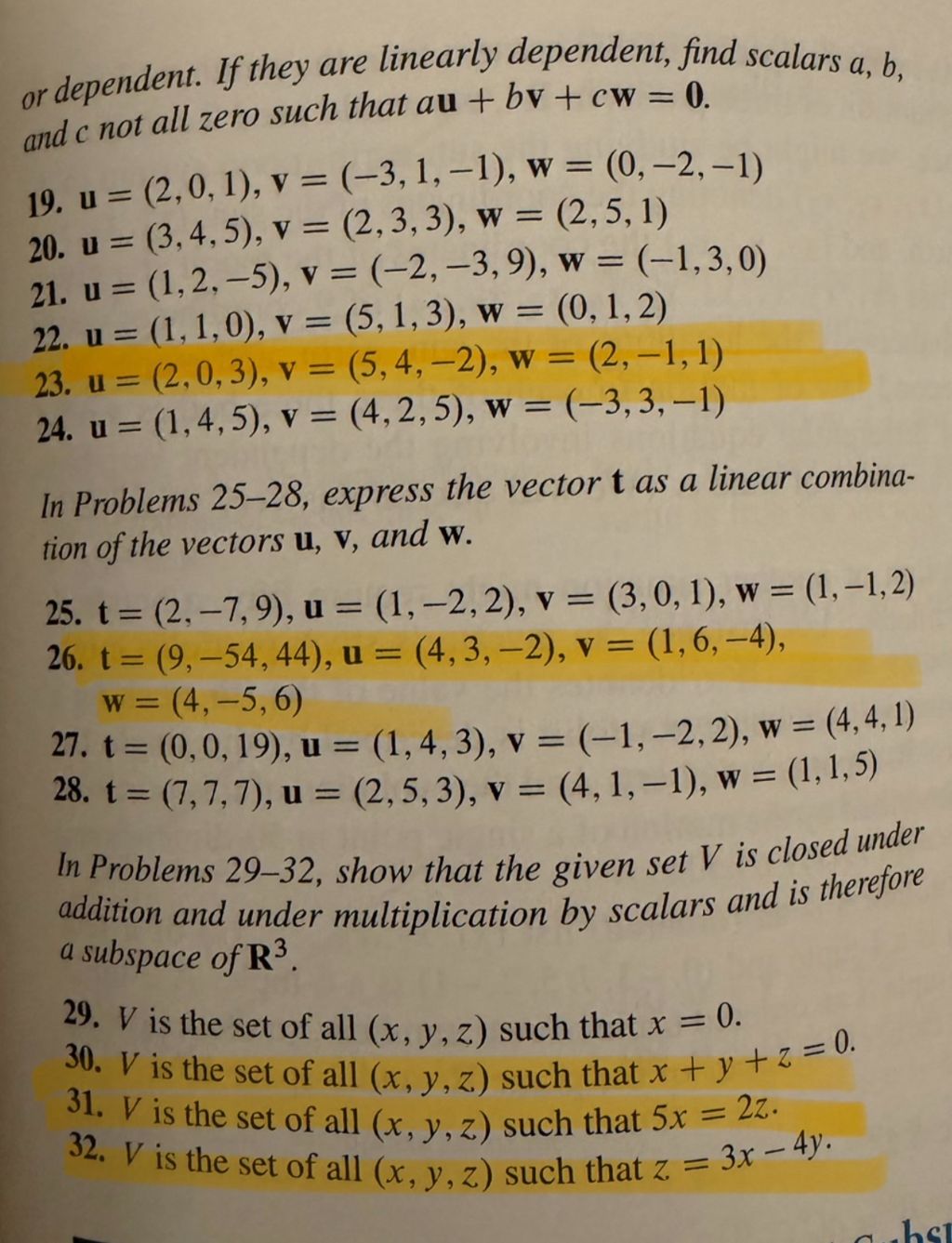
give answer in 2 step all parts with explanation at the end of each step and final answer at the end:b or dependent. If they are linearly dependent, find scalars 4 |, 3 4 ic not all zero such that au + bv + cw =0. bl Ro. E=(2,0,1),v= EE) w= ©0,-2,-1) 20. u=(3.45.V= 2.3.3), w= (2,51) 21 n= (9, 2,5), y= (-2, =3 9, a= (-1, 3,0) 2. u=(1,1,0,v=061 3), w = (0,1,2) P=1(2.0,3), v= (5.4,-2),w=02.-11 oU u=(1,45,v=*2 5), w= (=3,3,-1) In Problems 25-28, express the vector tas a linear combina- tion of the vectors u, V, and Ww. %.1=(2.-7,9,u=(1,-2.2.v=G0 1, w=(1,-12 b t: (9,—54,44),u = (4,3, a Ni—(1,6, =4), ~ wW=(4,-5,6) t= 0,0,19),u = (1,4,3), v= (-1, _2.2),w= (44 1) t=(17.7),u=(2.53),v=* 1,-1), w= (1.15 ; ob lems 29-32, show that the given set Vis closed we i and under multiplication by scalars and is ther for space of R3, +4 gheserof all (x,y,z) such that x = 0- " — setof all (x, y, z) such that x + dud” ps thesetof all (x, y, z) such that 5x = 2. he set of ll (x, y, 2) such that 2 = 3% “= ea. as 0
Question:

give answer in 2 step all parts with explanation at the end of each step and final answer at the end:Uploaded Imageb or dependent. If they are linearly dependent, find scalars 4 |, 3 4 ic not all zero such that au + bv + cw =0. bl Ro. E=(2,0,1),v= EE) w= ©0,-2,-1) 20. u=(3.45.V= 2.3.3), w= (2,51) 21 n= (9, 2,5), y= (-2, =3 9, a= (-1, 3,0) 2. u=(1,1,0,v=061 3), w = (0,1,2) P=1(2.0,3), v= (5.4,-2),w=02.-11 oU u=(1,45,v=*2 5), w= (=3,3,-1) In Problems 25-28, express the vector tas a linear combina- tion of the vectors u, V, and Ww. %.1=(2.-7,9,u=(1,-2.2.v=G0 1, w=(1,-12 b t: (9,—54,44),u = (4,3, a Ni—(1,6, =4), ~ wW=(4,-5,6) t= 0,0,19),u = (1,4,3), v= (-1, _2.2),w= (44 1) t=(17.7),u=(2.53),v=* 1,-1), w= (1.15 ; ob lems 29-32, show that the given set Vis closed we i and under multiplication by scalars and is ther for space of R3, +4 gheserof all (x,y,z) such that x = 0- " — setof all (x, y, z) such that x + dud” ps thesetof all (x, y, z) such that 5x = 2. he set of ll (x, y, 2) such that 2 = 3% “= ea. as 0

This is AI generated Response.
Asked by: Rahul
Created at: 2025-12-13 05:18:37

Final Answer:

Rendered Raw Text
Did you like this answer?
Let's solve **Problem 23** step-by-step as requested: --- ### **Problem 23** Given: - **u** = (2, , 3) - **v** = (5, 4, -2) - **w** = (2, -1, 1) Are these vectors linearly dependent? If so, find scalars **a**, **b**, **c** (not all zero) such that: \[ a\mathbf{u} + b\mathbf{v} + c\mathbf{w} = \mathbf{} \] --- ## **Step 1: Set Up the Equation** Write the linear combination and set equal to zero: \[ a(2, , 3) + b(5, 4, -2) + c(2, -1, 1) = (, , ) \] This gives us a system: \[ \begin{align*} 2a + 5b + 2c &= \\ a + 4b - 1c &= \\ 3a - 2b + 1c &= \end{align*} \] **Explanation:** We express the requirement for linear dependence as a homogeneous system of linear equations. --- ## **Step 2: Solve the System** From the second equation: \[ 4b - c = \implies c = 4b \] Substitute \(c = 4b\) into the other equations: **First equation:** \[ 2a + 5b + 2c = \implies 2a + 5b + 2(4b) = \implies 2a + 13b = \implies a = -\frac{13}{2}b \] **Third equation:** \[ 3a - 2b + c = \] Substitute \(a = -\frac{13}{2}b\) and \(c = 4b\): \[ 3(-\frac{13}{2}b) - 2b + 4b = \implies -\frac{39}{2}b - 2b + 4b = \] \[ -\frac{39}{2}b + 2b = \implies -\frac{39}{2}b + \frac{4}{2}b = \implies -\frac{35}{2}b = \implies b = \] If \(b = \), then \(a = \) and \(c = \). **But we are looking for nontrivial solutions! Let's check the calculations:** #### Let's try using matrices: \[ \begin{bmatrix} 2 & 5 & 2 \\ & 4 & -1 \\ 3 & -2 & 1 \end{bmatrix} \begin{bmatrix} a \\ b \\ c \end{bmatrix} = \begin{bmatrix} \\ \\ \end{bmatrix} \] Row 2: \(4b - c = \to c = 4b\) Plug into Row 1: \(2a + 5b + 2(4b) = \implies 2a + 13b = \implies a = -\frac{13}{2}b\) Plug into Row 3: \(3a - 2b + 4b = \implies 3a + 2b = \implies a = -\frac{2}{3}b\) Now, equate the two expressions for a: \[ -\frac{13}{2}b = -\frac{2}{3}b \implies \frac{13}{2}b = \frac{2}{3}b \] Multiply both sides by 6: \[ 39b = 4b \implies 39b - 4b = \implies 35b = \implies b = \] So, \(b = \implies a = , c = \). --- ## **Final Answer** ### The only solution is the trivial solution: \( a = , b = , c = \). **Conclusion:** The vectors **u**, **v**, and **w** are **linearly independent**. There are **no nontrivial scalars** \( a, b, c \) (not all zero) such that \( a\mathbf{u} + b\mathbf{v} + c\mathbf{w} = \). --- **Let me know if you want the next problem solved!**

📢 Instructions:

  • Ask anything relatd to above question only.
  • For new Question goto :

Study Help, Fast Answers

VIPSolutions focuses on clear, step‑by‑step explanations so you can learn quickly. Whether you need an AI‑generated walkthrough or a short hint to get unstuck, each solution is organized for fast reading and easy review later.

Search similar questions, compare approaches, and bookmark the best answers for revision. Our goal is simple: quick, reliable study help that feels natural—not noisy.