 VIPSolutions
give answer in 2 step all parts with explanation at the end of each step and final answer at the end:m— pe ———————-— PO JE E@aEg. -c=- al i =o J Foe I» J —— ; i mE =’ N I i to " Provide Feedback
Question:
give answer in 2 step all parts with explanation at the end of each step and final answer at the end: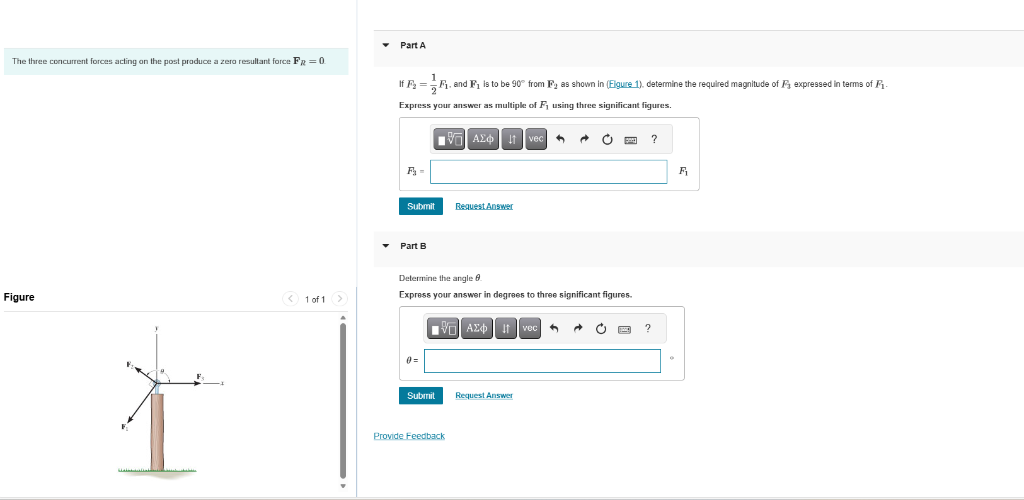 m—
pe ———————-—
PO
JE
E@aEg. -c=-
al i
=o
J
Foe I» J ——
; i mE =’
N I
i to
" Provide Feedback
This is AI generated Response.
Asked by: Rahul
Created at: 2025-12-13 03:05:29
Asked by: Rahul
Created at: 2025-12-13 03:05:29
Final Answer:
Rendered
Raw Text
Did you like this answer?
Let's solve each part step-by-step, with explanations after each step.
---
## **Part A: Find \( F_3 \) in terms of \( F_1 \)**
### **Step 1: Setting up the Equilibrium Condition**
Since the three forces produce a zero resultant force (\(\vec{F}_R = \)), their vector sum must be zero:
\[
\vec{F}_1 + \vec{F}_2 + \vec{F}_3 =
\]
Given:
- \( F_2 = \frac{1}{2} F_1 \)
- \( F_1 \) is along the x-axis
- \( F_2 \) is at 90° from \( F_1 \) (so along y-axis)
- \( F_3 \) makes an angle \(\theta\) with the x-axis (direction unknown yet)
Let’s write the components:
- \( \vec{F}_1 = F_1 \hat{i} \)
- \( \vec{F}_2 = \frac{1}{2}F_1 \hat{j} \)
- \( \vec{F}_3 = F_3(\cos\theta \hat{i} + \sin\theta \hat{j}) \)
Sum the x and y components:
\[
F_1 + F_3 \cos\theta = \quad \text{(x-component)}
\]
\[
\frac{1}{2}F_1 + F_3 \sin\theta = \quad \text{(y-component)}
\]
**Explanation:**
We break each force into components and set up the equilibrium equations along both axes.
---
### **Step 2: Solving for \( F_3 \) in terms of \( F_1 \)**
From the x-equation:
\[
F_1 + F_3 \cos\theta = \implies F_3 \cos\theta = -F_1
\]
From the y-equation:
\[
\frac{1}{2}F_1 + F_3 \sin\theta = \implies F_3 \sin\theta = -\frac{1}{2}F_1
\]
Now, square and add both equations:
\[
(F_3 \cos\theta)^2 + (F_3 \sin\theta)^2 = F_1^2 + \left(\frac{1}{2}F_1\right)^2
\]
\[
F_3^2 (\cos^2\theta + \sin^2\theta) = F_1^2 + \frac{1}{4}F_1^2
\]
\[
F_3^2 (1) = \frac{5}{4} F_1^2
\]
\[
F_3 = \frac{\sqrt{5}}{2} F_1
\]
**Explanation:**
By squaring and adding, we use the Pythagorean identity (\(\sin^2\theta + \cos^2\theta = 1\)) to eliminate \(\theta\) and solve for \(F_3\).
---
### **Final Answer for Part A:**
\[
\boxed{F_3 = \frac{\sqrt{5}}{2} F_1}
\]
---
## **Part B: Find the Angle \( \theta \)**
### **Step 1: Use Component Equations to Get \( \theta \)**
From above:
\[
F_3 \cos\theta = -F_1 \\
F_3 \sin\theta = -\frac{1}{2}F_1
\]
Divide the second equation by the first:
\[
\frac{F_3 \sin\theta}{F_3 \cos\theta} = \frac{-\frac{1}{2}F_1}{-F_1}
\]
\[
\tan\theta = \frac{1}{2}
\]
**Explanation:**
Divide y by x component equations to get \(\tan\theta\), eliminating \(F_3\) and \(F_1\).
---
### **Step 2: Solve for \( \theta \)**
\[
\theta = \arctan\left(\frac{1}{2}\right)
\]
\[
\theta \approx 26.6^\circ
\]
**Explanation:**
Use the arctangent function to find the angle.
---
### **Final Answer for Part B:**
\[
\boxed{\theta = 26.6^\circ}
\]
---
## **Summary of Answers**
- **Part A:** \( F_3 = \frac{\sqrt{5}}{2} F_1 \)
- **Part B:** \( \theta = 26.6^\circ \)
📢 Instructions:
- Ask anything relatd to above question only.
- For new Question goto :