 VIPSolutions
give answer in 2 step all parts with explanation at the end of each step and final answer at the end:© LCR Fee! Toth a Tp i ¥ 3) Propose mechanisms to explain the opposite regiochemistry observed in the following two reactions. . Use curved arrows to show elec fron m ovement. id oi or THE CHyCHy H SCHy SCH a hiss Ir HBr —— Bi
Question:
give answer in 2 step all parts with explanation at the end of each step and final answer at the end: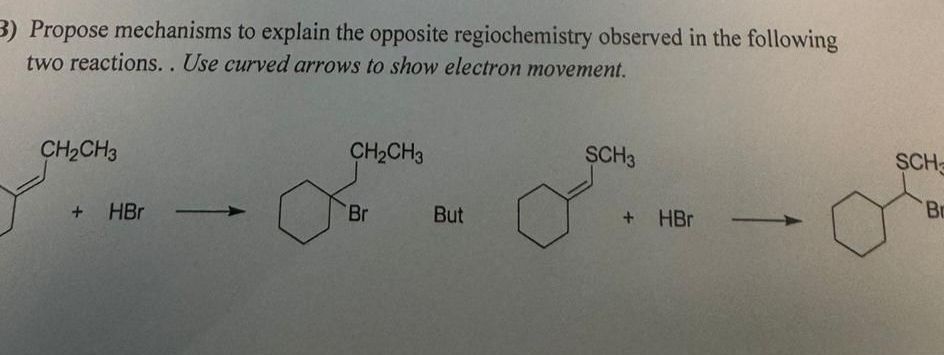 © LCR Fee! Toth a Tp i ¥
3) Propose mechanisms to explain the opposite regiochemistry observed in the following
two reactions. . Use curved arrows to show elec fron m ovement.
id oi
or THE
CHyCHy H SCHy SCH
a hiss
Ir HBr —— Bi
This is AI generated Response.
Asked by: Rahul
Created at: 2025-12-13 02:41:28
Asked by: Rahul
Created at: 2025-12-13 02:41:28
Final Answer:
Rendered
Raw Text
Did you like this answer?
## Step-by-Step Mechanisms with Explanations
---
## **Part 1: Ethyl-Substituted Cyclohexene with HBr**
### **Step 1: Protonation of the Alkene**
- The double bond in the starting alkene reacts with HBr.
- The π electrons attack the proton (**H⁺**), leading to the formation of a carbocation.
- The more stable carbocation forms at the carbon adjacent to the ethyl group (due to hyperconjugation and inductive effects).
**Curved arrow:**
Double bond → H of HBr
Br⁻ leaves as an anion.
**Result:**
Carbocation at the more substituted carbon (next to ethyl group).
**Explanation:**
Carbocations are more stable when they are more substituted. The ethyl group stabilizes the carbocation via hyperconjugation and inductive effects.
---
### **Step 2: Nucleophilic Attack by Br⁻**
- The bromide ion (**Br⁻**) attacks the carbocation.
- The product is a **Markovnikov addition**: Br attaches to the more substituted carbon.
**Curved arrow:**
Lone pair on Br⁻ → carbocation.
**Explanation:**
Br⁻ always attacks the carbocation formed in the previous step, giving Markovnikov addition.
---
## **Part 1 Final Answer:**
**Markovnikov addition** occurs; Br adds to the more substituted carbon (next to the ethyl group).
---
## **Part 2: SCH₃-Substituted Cyclohexene with HBr**
### **Step 1: Protonation of the Alkene**
- The double bond reacts with HBr.
- Protonation occurs, but the **SCH₃** group is an electron-donating group by resonance (lone pairs on S can stabilize positive charge via resonance).
**Curved arrow:**
Double bond → H of HBr
Br⁻ leaves as an anion.
**Result:**
Carbocation forms at the carbon **further from** the SCH₃ group so that the positive charge can be stabilized by resonance with the SCH₃ group.
**Explanation:**
The SCH₃ group stabilizes a carbocation via resonance if the positive charge is adjacent to it (on the carbon next to SCH₃).
---
### **Step 2: Nucleophilic Attack by Br⁻**
- Br⁻ attacks the carbocation.
- The product is **anti-Markovnikov**: Br attaches to the less substituted carbon (further from SCH₃).
**Curved arrow:**
Lone pair on Br⁻ → carbocation.
**Explanation:**
Resonance stabilization by SCH₃ makes the carbocation at the less substituted position more stable, overriding the usual Markovnikov rule.
---
## **Part 2 Final Answer:**
**Anti-Markovnikov addition** occurs; Br adds to the less substituted carbon (further from SCH₃), due to resonance stabilization of the carbocation by the SCH₃ group.
---
## **Summary Table**
| Substituent | Carbocation stabilization | Product type | Br attaches to... |
|-------------|-----------------------------|----------------------|---------------------------|
| Ethyl | Inductive/hyperconjugation | Markovnikov | More substituted carbon |
| SCH₃ | Resonance | Anti-Markovnikov | Less substituted carbon |
---
**In essence:**
- Markovnikov addition dominates unless a strong resonance-donating group (like SCH₃) stabilizes a different carbocation, leading to anti-Markovnikov addition.
- The key is to analyze **how the substituent stabilizes the intermediate carbocation**.
📢 Instructions:
- Ask anything relatd to above question only.
- For new Question goto :