 VIPSolutions
give answer in 2 step all parts with explanation at the end of each step and final answer at the end:Suppose N23 ond f: R">R 5 C'. Cmsider Fx, a) =O bat Bl dole dhe solu sek fo), so Sts 0 subsel surg hob S =D. fri tT ee ey Sl Gr rons ano 2 nd i Pe Bs @ Lot Foy) = Refral =) So that S 16 the solution 3 to XEyread- 1=0. Clearly, |S 1s dhe und spleen [RE Sho that OP) #5 of each pot Pm S. This panes that (oserpckd!) he tm} splee 15 a smooth 2-dwneasirnal mankld in R23, a smo sua Nn spa. ORT BEET 2 el 0 By fileng on opproch amlogus to the oe mM (@ aon to pove Mat S 8 a smooth surface in space. Apt het he he Re ly metry
Question:
give answer in 2 step all parts with explanation at the end of each step and final answer at the end: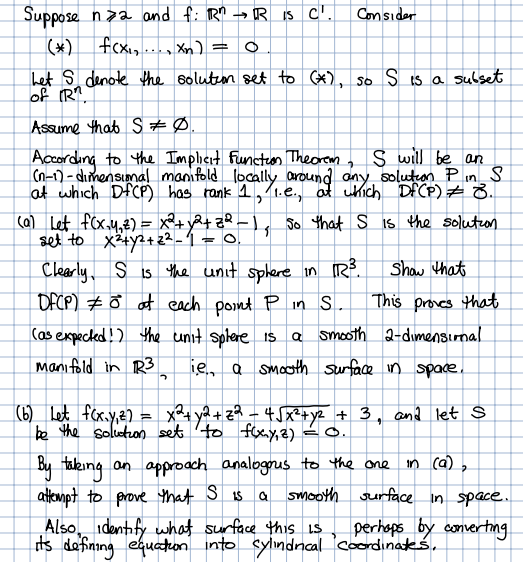 Suppose N23 ond f: R">R 5 C'. Cmsider
Fx, a) =O
bat Bl dole dhe solu sek fo), so Sts 0 subsel
surg hob S =D.
fri tT ee ey Sl
Gr rons ano 2 nd i Pe Bs
@ Lot Foy) = Refral =) So that S 16 the solution
3 to XEyread- 1=0.
Clearly, |S 1s dhe und spleen [RE Sho that
OP) #5 of each pot Pm S. This panes that
(oserpckd!) he tm} splee 15 a smooth 2-dwneasirnal
mankld in R23, a smo sua Nn spa.
ORT BEET 2 el 0
By fileng on opproch amlogus to the oe mM (@
aon to pove Mat S 8 a smooth surface in space.
Apt het he he Re ly metry
This is AI generated Response.
Asked by: Rahul
Created at: 2025-12-13 02:31:01
Asked by: Rahul
Created at: 2025-12-13 02:31:01
Final Answer:
Rendered
Raw Text
Did you like this answer?
Let's break the problem into the required two-step answers for both (a) and (b), with explanations at each step and a final answer at the end.
---
## (a) \( f(x_1, x_2, x_3) = x_1^2 + x_2^2 + x_3^2 - 1 \)
### **Step 1: Compute \( Df(P) \) and show \( Df(P) \neq \) for all \( P \in S \)**
- \( S \) is the solution set to \( x_1^2 + x_2^2 + x_3^2 = 1 \), i.e., the **unit sphere** in \( \mathbb{R}^3 \).
- Compute the gradient (Jacobian):
\[
Df(x_1, x_2, x_3) = \left( \frac{\partial f}{\partial x_1}, \frac{\partial f}{\partial x_2}, \frac{\partial f}{\partial x_3} \right) = (2x_1, 2x_2, 2x_3)
\]
- For any point \( P = (x_1, x_2, x_3) \in S \), we have \( x_1^2 + x_2^2 + x_3^2 = 1 \), so at least one coordinate is nonzero. Thus, the gradient is never the zero vector on \( S \).
**Explanation:**
The Jacobian (gradient) is nonzero everywhere on the sphere because at least one coordinate is always nonzero. This satisfies the condition for the Implicit Function Theorem.
---
### **Step 2: Conclude \( S \) is a smooth 2D surface**
- By the Implicit Function Theorem, since \( Df(P) \neq \) for all \( P \in S \), the solution set \( S \) is a smooth manifold of dimension \( 3-1 = 2 \) (a surface) in \( \mathbb{R}^3 \).
**Explanation:**
The unit sphere is a smooth 2D surface (manifold) in \( \mathbb{R}^3 \) because the conditions of the Implicit Function Theorem are met everywhere on \( S \).
---
### **Final answer for (a):**
> **The unit sphere is a smooth 2-dimensional manifold in \( \mathbb{R}^3 \) because the gradient of \( f \) is nonzero everywhere on the sphere.**
---
## (b) \( f(x_1, x_2, x_3) = x_1^4 + x_2^4 + x_3^4 + 4x_1^2x_2^2 + 3 \), \( S \) is the solution set to \( f = \)
### **Step 1: Compute \( Df(P) \) and check if \( Df(P) \neq \) on \( S \)**
- \( f(x_1, x_2, x_3) = x_1^4 + x_2^4 + x_3^4 + 4x_1^2x_2^2 + 3 \)
- Compute the gradient:
\[
\frac{\partial f}{\partial x_1} = 4x_1^3 + 8x_1x_2^2
\]
\[
\frac{\partial f}{\partial x_2} = 4x_2^3 + 8x_2x_1^2
\]
\[
\frac{\partial f}{\partial x_3} = 4x_3^3
\]
So,
\[
Df(x_1, x_2, x_3) = (4x_1^3 + 8x_1x_2^2, \; 4x_2^3 + 8x_2x_1^2, \; 4x_3^3)
\]
- For points on \( S \), \( f(x_1, x_2, x_3) = \implies x_1^4 + x_2^4 + x_3^4 + 4x_1^2x_2^2 = -3 \).
- All terms on the left except the constant are **non-negative**, so the only way this can happen is if all terms are zero and \( 3 = -3 \), which is impossible **unless** negative values are allowed via complex numbers.
- Let's check for real solutions:
- All terms \( x_1^4, x_2^4, x_3^4, 4x_1^2x_2^2 \geq \) for real numbers.
- Their sum \( \geq \), so the left side is always \( \geq 3 \), never \( \).
- Therefore, **there are no real solutions** for \( S \) in \( \mathbb{R}^3 \).
**Explanation:**
The equation \( x_1^4 + x_2^4 + x_3^4 + 4x_1^2x_2^2 + 3 = \) has **no real solutions** because the sum of non-negative terms plus 3 cannot be zero.
---
### **Step 2: Attempt to identify the surface and convert to cylindrical coordinates**
- Set \( x_1 = r\cos\theta \), \( x_2 = r\sin\theta \), \( x_3 = z \).
- \( x_1^2 = r^2\cos^2\theta \), \( x_2^2 = r^2\sin^2\theta \).
- \( x_1^4 + x_2^4 + 4x_1^2x_2^2 = (x_1^2 + x_2^2)^2 = r^4 \).
- \( x_3^4 = z^4 \).
- So \( f = r^4 + z^4 + 3 \).
- The equation \( r^4 + z^4 + 3 = \) again cannot have real solutions, as all terms are non-negative.
**Explanation:**
Even in cylindrical coordinates, the equation has no real solutions. Thus, \( S = \emptyset \) in \( \mathbb{R}^3 \).
---
### **Final answer for (b):**
> **The solution set \( S \) is empty in \( \mathbb{R}^3 \), so there is no smooth surface in real space defined by this equation.**
---
Let me know if you'd like further clarification or if you want to consider complex solutions!
📢 Instructions:
- Ask anything relatd to above question only.
- For new Question goto :