give all parts answer in 2 step with explanation at the end of each step and final answer at the end:2. Answer ALL parts.
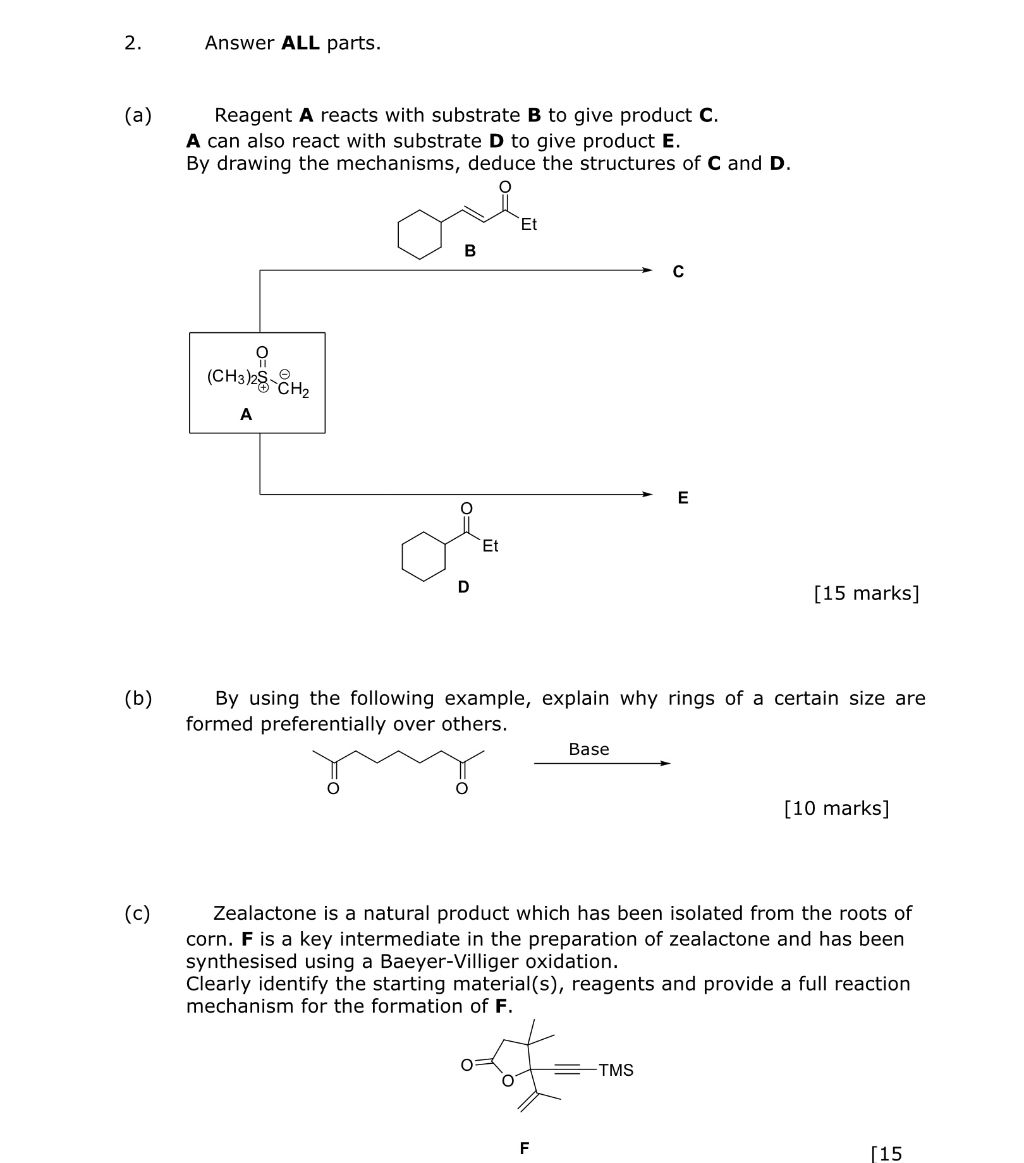
(a) Reagent A reacts with substrate B to give product C.
A can also react with substrate D to give product E.
By drawing the mechanisms, deduce the structures of C and D.
9
ore
B
c
Cl 2 [)
(CHaG8,,
A
) E
on
Do [15 marks]
(b) By using the following example, explain why rings of a certain size are
formed preferentially over others.
NY Base
o o
[10 marks]
() Zealactone is a natural product which has been isolated from the roots of
corn. F is a key intermediate in the preparation of zealactone and has been
synthesised using a Baeyer-Villiger oxidation.
Clearly identify the starting material(s), reagents and provide a full reaction
mechanism for the formation of F.
0 —
Question:
give all parts answer in 2 step with explanation at the end of each step and final answer at the end:2. Answer ALL parts.
(a) Reagent A reacts with substrate B to give product C.
A can also react with substrate D to give product E.
By drawing the mechanisms, deduce the structures of C and D.
9
ore
B
c
Cl 2 [)
(CHaG8,,
A
) E
on
Do [15 marks]
(b) By using the following example, explain why rings of a certain size are
formed preferentially over others.
NY Base
o o
[10 marks]
() Zealactone is a natural product which has been isolated from the roots of
corn. F is a key intermediate in the preparation of zealactone and has been
synthesised using a Baeyer-Villiger oxidation.
Clearly identify the starting material(s), reagents and provide a full reaction
mechanism for the formation of F.
0 —
This is AI generated Response.
Asked by: Rahul
Created at: 2025-12-06 15:39:36
Final Answer:
RenderedRaw Text
Did you like this answer?
Let's answer each part step-by-step, with explanations and final answers.
---
## (a) Mechanisms and Structure Deduction
### Step 1: Identify Reagent A
- Reagent A: **(CH₃)₂S=O (Dimethyl sulfoxide, DMSO) + CH₂** (should be read as **(CH₃)₂S(CH₂)**, i.e., dimethylsulfonium ylide)
- This is a classic reagent for the **Corey-Chaykovsky reaction**, which converts carbonyls into epoxides.
### Step 2: Apply the Mechanism to B and D
#### Reaction with B:
**Substrate B:**
Cyclohexyl-CO-CH₂CH₃ (a phenyl ketone with ethyl group)
- The ylide attacks the carbonyl carbon (electrophilic center), forming a betaine intermediate.
- Intramolecular displacement yields an **epoxide** at the site of the carbonyl.
**Product C:**
- The carbonyl is replaced by an epoxide between the alpha and carbonyl carbon.
- **Structure:**

(Cyclohexyl-CH(epoxy)-CH₂CH₃)
#### Reaction with D:
**Substrate D:**
Cyclohexyl-CH₂-CO-CH₂CH₃ (the carbonyl is one carbon further from the ring)
- The ylide reacts with the carbonyl carbon, forming an epoxide between the carbonyl carbon and the carbon (alpha position).
- **Product E:**
Epoxide between the carbonyl carbon and the alpha-carbon (next to CH₂CH₃).
**Structure:**
Cyclohexyl-CH₂-C(epoxy)-CH₂CH₃
---
**Final answers (a):**
- **C:** Cyclohexyl group attached to an epoxide ring with ethyl substituent.
- **E:** Cyclohexyl-CH₂ attached to an epoxide ring with ethyl substituent at the next carbon.
---
## (b) Ring Size Preference in Cyclisation
### Step 1: Mechanism Overview
- The base deprotonates the central methylene, making it nucleophilic.
- Intramolecular attack forms a ring by closing onto a carbonyl group.
### Step 2: Explanation of Ring Size Preference
- **5- and 6-membered rings** are most stable due to minimal ring strain (Baeyer strain theory).
- The system forms a **5-membered ring** preferentially (enolate attacks 5 carbons away).
#### Why?
- 5- and 6-membered rings have optimal bond angles and minimal torsional strain.
- Smaller rings (3, 4) have angle strain; larger rings (7+) have transannular strain and entropy penalties.
**Final answer (b):**
- **5- and 6-membered rings** form preferentially due to minimal ring strain and favorable enthalpy/entropy considerations.
---
## (c) Baeyer-Villiger Oxidation to F
### Step 1: Identify Baeyer-Villiger Oxidation
- Converts ketones to esters/lactones using **peracids** (e.g., mCPBA).
### Step 2: Mechanism and Starting Material
- **Starting material:** Cyclohexanone derivative with the correct substituents to give F after oxidation.
- The migration group in Baeyer-Villiger determines the position of the oxygen insertion.
- **Mechanism:**
- Peracid attacks the carbonyl to form a Criegee intermediate.
- Alkyl or aryl group migrates, forming an ester or lactone.
**For F:**
- Starting material should be a cyclohexanone with a TMS-alkyne substituent.
- Oxidation will insert an oxygen next to the more substituted carbon, forming a lactone.
**Final answer (c):**
- **Starting material:** Cyclohexanone derivative with TMS-alkyne.
- **Reagent:** mCPBA or another peracid.
- **Mechanism:** Baeyer-Villiger oxidation; migration of the more substituted group forms the lactone structure of F.
---
## **Summary of Final Answers**
- **(a):**
- C and E are epoxides formed from B and D via the Corey-Chaykovsky reaction with dimethylsulfonium ylide.
- **(b):**
- 5- and 6-membered rings form preferentially due to minimal ring strain and optimal stability.
- **(c):**
- F is formed from a cyclohexanone derivative via Baeyer-Villiger oxidation (using mCPBA) to give a lactone. The mechanism involves migration of the appropriate group to form the observed product.
VIPSolutions focuses on clear, step‑by‑step explanations so you can learn quickly. Whether you need an AI‑generated walkthrough or a short hint to get unstuck, each solution is organized for fast reading and easy review later.
Search similar questions, compare approaches, and bookmark the best answers for revision. Our goal is simple: quick, reliable study help that feels natural—not noisy.
 VIPSolutions
 2. Answer ALL parts.
(a) Reagent A reacts with substrate B to give product C.
A can also react with substrate D to give product E.
By drawing the mechanisms, deduce the structures of C and D.
9
ore
B
c
Cl 2 [)
(CHaG8,,
A
) E
on
Do [15 marks]
(b) By using the following example, explain why rings of a certain size are
formed preferentially over others.
NY Base
o o
[10 marks]
() Zealactone is a natural product which has been isolated from the roots of
corn. F is a key intermediate in the preparation of zealactone and has been
synthesised using a Baeyer-Villiger oxidation.
Clearly identify the starting material(s), reagents and provide a full reaction
mechanism for the formation of F.
0 —