 VIPSolutions
give step by step answer and give final summaryIRR Analysis - Problem 1 | 150000 ! —e— NPV vs Discount Rate | === IRR = 12.42% i 100000 ! i i 50000 | 4 i Q | S = Of mmm mmm mm ee : | 9 | 8 -50000 i 5 =z —-100000 ! i i —150000 t ~200000 i 0 10 20 30 40 50 Discount Rate (%) A company invests $400,000 in a project. Cash inflows: Year 1 £100,000, Year 2 ¥120,000, Year 3 X130,000, Year 4 £110,000, Year 5 ¥100,000. Find IRR where NPV = 0.
Question:
give step by step answer and give final summary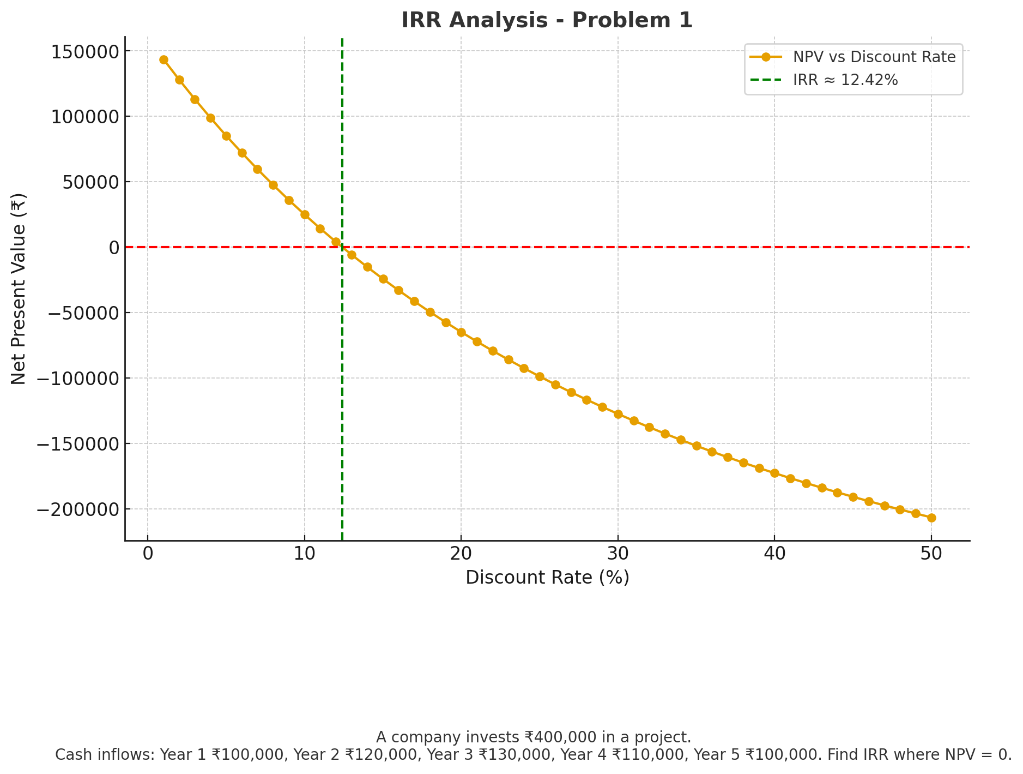 IRR Analysis - Problem 1
|
150000 ! —e— NPV vs Discount Rate
| === IRR = 12.42%
i
100000 !
i
i
50000 |
4 i
Q |
S
= Of mmm mmm mm ee
: |
9 |
8 -50000 i
5
=z —-100000 !
i
i
—150000 t
~200000 i
0 10 20 30 40 50
Discount Rate (%)
A company invests $400,000 in a project.
Cash inflows: Year 1 £100,000, Year 2 ¥120,000, Year 3 X130,000, Year 4 £110,000, Year 5 ¥100,000. Find IRR where NPV = 0.
This is AI generated Response.
Asked by: lincy
Created at: 2025-10-03 12:08:51
Asked by: lincy
Created at: 2025-10-03 12:08:51
Final Answer:
Rendered
Raw Text
Did you like this answer?
# Step-by-Step Solution to IRR Problem
## Problem Recap
- **Investment:** ₹400,000 (outflow at Year )
- **Cash Inflows:**
- Year 1: ₹100,000
- Year 2: ₹120,000
- Year 3: ₹130,000
- Year 4: ₹110,000
- Year 5: ₹100,000
- **Task:** Find the Internal Rate of Return (IRR), i.e., the discount rate where the Net Present Value (NPV) is zero.
---
## Step 1: Understand the NPV Equation
The NPV of the project is given by:
\[
NPV = -400,000 + \frac{100,000}{(1+r)^1} + \frac{120,000}{(1+r)^2} + \frac{130,000}{(1+r)^3} + \frac{110,000}{(1+r)^4} + \frac{100,000}{(1+r)^5}
\]
Where \( r \) is the discount rate (as a decimal).
---
## Step 2: Set NPV to Zero to Find IRR
\[
= -400,000 + \frac{100,000}{(1+r)^1} + \frac{120,000}{(1+r)^2} + \frac{130,000}{(1+r)^3} + \frac{110,000}{(1+r)^4} + \frac{100,000}{(1+r)^5}
\]
---
## Step 3: Use the Graph
- The graph shows the relationship between NPV and the discount rate.
- The **IRR** is where the NPV curve crosses the zero line.
- According to the graph, this occurs at approximately **12.42%** (indicated by the green dashed vertical line).
---
## Step 4: Verify with Calculation (Optional)
For confirmation, substitute \( r = 12.42\% = .1242 \) into the NPV formula:
\[
NPV = -400,000 + \frac{100,000}{1.1242} + \frac{120,000}{(1.1242)^2} + \frac{130,000}{(1.1242)^3} + \frac{110,000}{(1.1242)^4} + \frac{100,000}{(1.1242)^5}
\]
Calculate each term, sum them, and you should get NPV ≈ , confirming the IRR.
---
## Final Summary
- **The IRR for the project is approximately 12.42%.**
- This means if the project's cost of capital is less than 12.42%, the project adds value (NPV > ).
- If the cost of capital is higher, the project destroys value (NPV < ).
**Conclusion:**
The internal rate of return (IRR) for the given cash flows and investment is **12.42%**, as shown on the graph.
Question:
give 2 sentnence summary in each steps
This is AI generated Response.
Asked by: lincy
Created at: 2025-10-03 12:11:53
Asked by: lincy
Created at: 2025-10-03 12:11:53
Final Answer:
Rendered
Raw Text
Did you like this answer?
# Step-by-Step Summary of IRR Calculation
## Step 1: Understand the NPV Equation
The NPV equation factors in the initial investment and the cash inflows over the project duration, discounted by the rate \( r \). It illustrates how the investment and returns relate to the discount rate.
## Step 2: Set NPV to Zero to Find IRR
To find the IRR, we set the NPV equation equal to zero. This allows us to identify the discount rate at which the project breaks even.
## Step 3: Use the Graph
The graph visually depicts the NPV versus discount rate relationship. The IRR is identified where the NPV curve intersects the zero line, which is approximately 12.42%.
## Step 4: Verify with Calculation (Optional)
To confirm the IRR, substitute \( r = 12.42\% \) into the NPV formula and calculate. This step ensures that the chosen IRR indeed results in an NPV of zero.
## Final Summary
The computed IRR for the project is about 12.42%. This indicates that if the project's cost of capital is below this rate, it is a worthwhile investment.
📢 Instructions:
- Ask anything relatd to above question only.
- For new Question goto :