 VIPSolutions
give full answer and give final summaryp gr 4 Bee rps Ei EERE “le HE Fe & iz Ect gf 5ic ol ia = A Hh] HH it + bi | Lig he Eo bale
Question:
give full answer and give final summary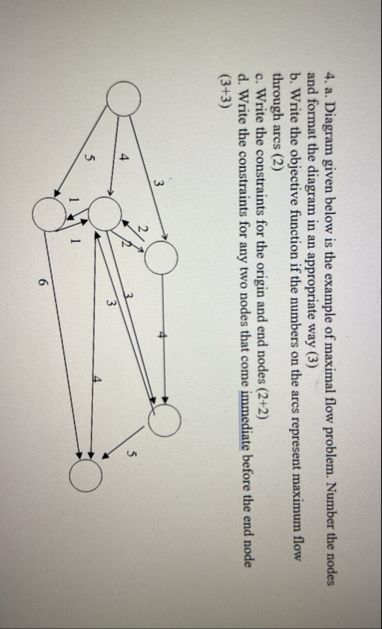 p gr 4 Bee rps
Ei
EERE
“le HE
Fe
& iz Ect
gf 5ic
ol ia =
A Hh]
HH
it +
bi
| Lig
he Eo bale
This is AI generated Response.
Asked by: sreegeeth
Created at: 2025-11-17 16:59:30
Asked by: sreegeeth
Created at: 2025-11-17 16:59:30
Final Answer:
Rendered
Raw Text
Did you like this answer?
# Maximal Flow Problem Solution
Let's solve each part step by step.
---
## a. Number the Nodes and Redraw the Diagram
Let's number the nodes from left to right, top to bottom:
- **Node 1:** Top left
- **Node 2:** Middle left
- **Node 3:** Top middle
- **Node 4:** Bottom middle
- **Node 5:** Middle right
- **Node 6:** Bottom right
Here is the labeled diagram (you can redraw in your notes):
```
3
(5)----->(3)
/ \ / \
4/ \2 /3 \2
/ v / v
(1) (2)----->(5)
\ 1/ \ 4/
6\ / \5 /
v v
(4)----->(6)
5
```
**Edge capacities (from diagram):**
- 1 → 2: 4
- 1 → 3: 5
- 1 → 4: 6
- 2 → 3: 1
- 2 → 4: 3
- 2 → 5: 5
- 3 → 5: 3
- 3 → 6: 2
- 4 → 6: 5
- 5 → 6: 4
---
## b. Objective Function (Maximize Flow)
Let \( x_{ij} \) be the flow from node \( i \) to node \( j \).
The objective is to **maximize the total flow from the source (Node 1) to the sink (Node 6):**
\[
\text{Maximize:} \quad Z = x_{16} + x_{26} + x_{36} + x_{46} + x_{56}
\]
But usually, you pick **one source** and **one sink**. In this diagram, Node 1 is the source and Node 6 is the sink. The total flow out of Node 1 that eventually reaches Node 6 is the objective.
So,
\[
\text{Maximize:} \quad x_{16} + x_{26} + x_{36} + x_{46} + x_{56}
\]
But since only flows from 1 to others are direct, you can also write:
\[
\text{Maximize:} \quad x_{16}
\]
Or more generally, the sum of flows leaving the source (Node 1):
\[
\text{Maximize:} \quad x_{12} + x_{13} + x_{14}
\]
---
## c. Constraints for the Origin and End Nodes
### **For the origin node (Node 1):**
\[
x_{12} + x_{13} + x_{14} \leq \text{total flow out of Node 1}
\]
But, since Node 1 is only a source:
\[
\text{Flow out of Node 1: } x_{12} + x_{13} + x_{14}
\]
\[
\text{Flow into Node 1: }
\]
So,
\[
x_{12} + x_{13} + x_{14} = \text{total flow}
\]
### **For the sink node (Node 6):**
\[
x_{36} + x_{46} + x_{56} = x_{16} + x_{26} + x_{36} + x_{46} + x_{56}
\]
But, more generally, **flow into Node 6** should equal the **total flow**:
\[
x_{36} + x_{46} + x_{56} = \text{total flow}
\]
---
## d. Constraints for Two Intermediate Nodes
Let’s pick Node 2 and Node 5 as intermediate nodes.
### **Node 2:**
- Inflow: \( x_{12} \)
- Outflow: \( x_{23} + x_{24} + x_{25} \)
**Constraint:**
\[
x_{12} = x_{23} + x_{24} + x_{25}
\]
### **Node 5:**
- Inflow: \( x_{25} + x_{35} \)
- Outflow: \( x_{56} \)
**Constraint:**
\[
x_{25} + x_{35} = x_{56}
\]
---
## e. Capacity Constraints (for all arcs)
For every arc \( (i, j) \) with capacity \( c_{ij} \):
\[
\leq x_{ij} \leq c_{ij}
\]
For example:
- \( \leq x_{12} \leq 4 \)
- \( \leq x_{13} \leq 5 \)
- \( \leq x_{14} \leq 6 \)
- etc.
---
# **Final Summary**
**1. Nodes are numbered 1 (source) to 6 (sink).**
**2. Objective:** Maximize total flow from node 1 to node 6: \( x_{12} + x_{13} + x_{14} \)
**3. Constraints:**
- **Node 1 (source):** \( x_{12} + x_{13} + x_{14} = \text{Total Flow} \)
- **Node 6 (sink):** \( x_{36} + x_{46} + x_{56} = \text{Total Flow} \)
- **Node 2:** \( x_{12} = x_{23} + x_{24} + x_{25} \)
- **Node 5:** \( x_{25} + x_{35} = x_{56} \)
- **Capacity on each arc:** \( \leq x_{ij} \leq \text{arc capacity} \)
**This forms a standard linear programming formulation for the maximum flow problem.**
Question:
give 2 sentence summary in each steps
This is AI generated Response.
Asked by: sreegeeth
Created at: 2025-11-17 17:00:44
Asked by: sreegeeth
Created at: 2025-11-17 17:00:44
Final Answer:
Rendered
Raw Text
Did you like this answer?
# Step-by-Step Summary of Maximal Flow Problem
## a. Number the Nodes and Redraw the Diagram
Nodes are numbered from 1 to 6, with Node 1 as the source and Node 6 as the sink. The diagram should reflect these nodes and their connections.
## b. Objective Function (Maximize Flow)
The goal is to maximize the flow from Node 1 (source) to Node 6 (sink). This can be expressed mathematically as \( Z = x_{16} + x_{26} + x_{36} + x_{46} + x_{56} \).
## c. Constraints for the Origin and End Nodes
For Node 1, the flow out must equal the total flow, while for Node 6, the inflow should equal the total flow reaching the sink. These constraints ensure balance at the source and sink.
## d. Constraints for Two Intermediate Nodes
For Node 2, the inflow must equal the sum of its outflows to other nodes. Similarly, for Node 5, the total inflow must equal the outflow to Node 6, maintaining flow conservation.
## e. Capacity Constraints (for all arcs)
Each connection (arc) between nodes has a capacity limit that the flow cannot exceed. These capacity constraints ensure that the flow through each path remains within defined limits.
# Final Summary
The problem involves maximizing flow from a designated source to a sink while adhering to certain constraints at each node. The formulation includes flow conservation and capacity limits, providing a framework for solving the maximal flow problem.
📢 Instructions:
- Ask anything relatd to above question only.
- For new Question goto :