 VIPSolutions
give full answer and give final summaryPeriodic Inventory by Three Methods tof no tas orl tn yn wir ns JA —— ro rue sume se preps) Wo sis suntan i 75 eH DARA SR a; oli oon sy ri od { bse evr ct a st ot Fa ) cm 5 do So A 5 FH 6 §
Question:
give full answer and give final summary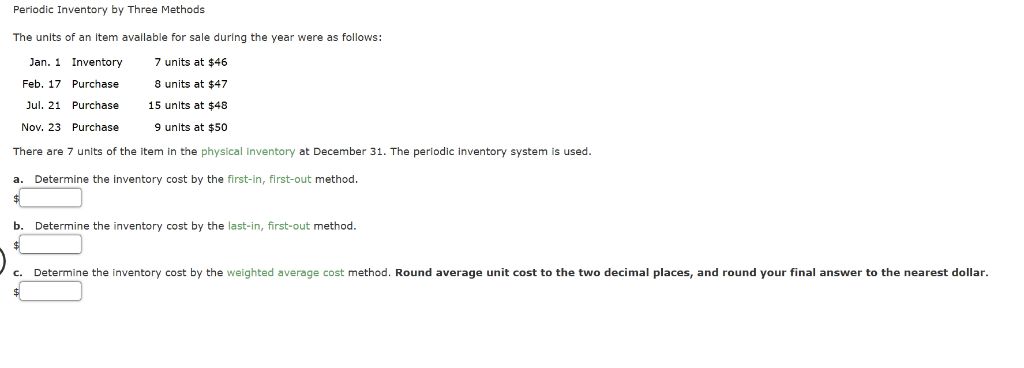 Periodic Inventory by Three Methods
tof no tas orl tn yn wir ns
JA ——
ro rue sume se
preps)
Wo sis suntan
i 75 eH DARA SR
a; oli oon sy ri od
{
bse evr ct a st ot
Fa
) cm 5 do So A 5 FH 6
§
This is AI generated Response.
Asked by: sreegeeth
Created at: 2025-10-30 00:21:19
Asked by: sreegeeth
Created at: 2025-10-30 00:21:19
Final Answer:
Rendered
Raw Text
Did you like this answer?
Let's solve each part step by step:
---
## Inventory Data
| Date | Description | Units | Unit Cost |
|-----------|-------------|-------|-----------|
| Jan. 1 | Inventory | 7 | $46 |
| Feb. 17 | Purchase | 8 | $47 |
| Jul. 21 | Purchase | 15 | $48 |
| Nov. 23 | Purchase | 9 | $50 |
**Total units available:** 7 + 8 + 15 + 9 = **39 units**
**Physical inventory at year-end:** **7 units**
---
### a. First-In, First-Out (FIFO)
FIFO assumes the oldest inventory items are sold first. So, the ending inventory consists of the newest purchases.
**Ending Inventory (7 units):**
- Take the most recent purchase(s) first.
1. Nov. 23: 9 units @ $50 → Use 7 units @ $50
\[
\text{Ending Inventory} = 7 \text{ units} \times \$50 = \$350
\]
**Answer:**
**a. $350**
---
### b. Last-In, First-Out (LIFO)
LIFO assumes the newest inventory items are sold first. So, the ending inventory consists of the oldest items.
**Ending Inventory (7 units):**
- Take the oldest inventory first.
1. Jan. 1: 7 units @ $46 → Use 7 units @ $46
\[
\text{Ending Inventory} = 7 \text{ units} \times \$46 = \$322
\]
**Answer:**
**b. $322**
---
### c. Weighted Average Cost
**Step 1: Find total cost and total units.**
\[
\text{Total Cost} = (7 \times 46) + (8 \times 47) + (15 \times 48) + (9 \times 50)
\]
\[
= 322 + 376 + 720 + 450 = \$1,868
\]
\[
\text{Total Units} = 7 + 8 + 15 + 9 = 39
\]
\[
\text{Weighted Average Cost per Unit} = \frac{1,868}{39} \approx \$47.90
\]
**Step 2: Calculate ending inventory (7 units):**
\[
7 \times 47.90 = \$335.30
\]
**Round to the nearest dollar:**
\[
\$335.30 \approx \$335
\]
**Answer:**
**c. $335**
---
## **Final Summary Table**
| Method | Ending Inventory Cost |
|----------|----------------------|
| FIFO | $350 |
| LIFO | $322 |
| Weighted Average | $335 |
**Summary:**
- FIFO gives the highest ending inventory ($350).
- LIFO gives the lowest ($322).
- Weighted average falls in between ($335).
Question:
give correct table
This is AI generated Response.
Asked by: sreegeeth
Created at: 2025-10-30 00:22:10
Asked by: sreegeeth
Created at: 2025-10-30 00:22:10
Final Answer:
Rendered
Raw Text
Did you like this answer?
# Periodic Inventory by Three Methods
## Inventory Data
| Date | Description | Units | Unit Cost |
|-----------|-------------|-------|-----------|
| Jan. 1 | Inventory | 7 | $46 |
| Feb. 17 | Purchase | 8 | $47 |
| Jul. 21 | Purchase | 15 | $48 |
| Nov. 23 | Purchase | 9 | $50 |
**Total units available:** 7 + 8 + 15 + 9 = **39 units**
**Physical inventory at year-end:** **7 units**
---
## a. First-In, First-Out (FIFO)
FIFO assumes the oldest inventory items are sold first, meaning the ending inventory consists of the newest purchases.
### Ending Inventory Calculation:
- Use the most recent purchase(s) first.
1. Nov. 23: 9 units @ $50 → Use 7 units @ $50
\[
\text{Ending Inventory} = 7 \text{ units} \times \$50 = \$350
\]
**Answer:**
**a. $350**
---
## b. Last-In, First-Out (LIFO)
LIFO assumes the newest inventory items are sold first, meaning the ending inventory consists of the oldest items.
### Ending Inventory Calculation:
- Use the oldest inventory first.
1. Jan. 1: 7 units @ $46 → Use 7 units @ $46
\[
\text{Ending Inventory} = 7 \text{ units} \times \$46 = \$322
\]
**Answer:**
**b. $322**
---
## c. Weighted Average Cost
### Step 1: Calculate Total Cost and Total Units
\[
\text{Total Cost} = (7 \times 46) + (8 \times 47) + (15 \times 48) + (9 \times 50)
\]
\[
= 322 + 376 + 720 + 450 = \$1,868
\]
\[
\text{Total Units} = 7 + 8 + 15 + 9 = 39
\]
\[
\text{Weighted Average Cost per Unit} = \frac{1,868}{39} \approx \$47.90
\]
### Step 2: Calculate Ending Inventory (7 units)
\[
7 \times 47.90 = \$335.30
\]
**Round to the nearest dollar:**
\[
\$335.30 \approx \$335
\]
**Answer:**
**c. $335**
---
## Final Summary Table
| Method | Ending Inventory Cost |
|---------------------|----------------------|
| FIFO | $350 |
| LIFO | $322 |
| Weighted Average | $335 |
---
## Summary
- **FIFO** results in the highest ending inventory cost of **$350**.
- **LIFO** results in the lowest ending inventory cost of **$322**.
- **Weighted Average Cost** results in an ending inventory cost of **$335**.
Question:
give 2 sentence summary in each steps
This is AI generated Response.
Asked by: sreegeeth
Created at: 2025-10-30 00:24:10
Asked by: sreegeeth
Created at: 2025-10-30 00:24:10
Final Answer:
Rendered
Raw Text
Did you like this answer?
# Periodic Inventory Summary by Method
## Inventory Data Overview
The inventory contains four transactions with a total of 39 units available, and a physical count of 7 units at year-end. The data is essential for calculating the ending inventory costs using different methods.
---
## a. First-In, First-Out (FIFO)
Under FIFO, the oldest inventory is sold first, leaving the most recent purchases in ending inventory. For 7 units, the calculation results in an ending inventory value of **$350**.
---
## b. Last-In, First-Out (LIFO)
In LIFO, the newest inventory items are sold first, which means the ending inventory consists of the oldest units. The calculation for 7 units yields an ending inventory value of **$322**.
---
## c. Weighted Average Cost
This method averages the cost of all units available for sale, resulting in a cost per unit of approximately **$47.90**. Consequently, the ending inventory for 7 units amounts to **$335** after rounding.
---
## Final Summary
The three inventory methods yield different ending inventory costs: FIFO at **$350**, LIFO at **$322**, and Weighted Average at **$335**. These variations highlight the impact of inventory valuation methods on financial reporting.
📢 Instructions:
- Ask anything relatd to above question only.
- For new Question goto :