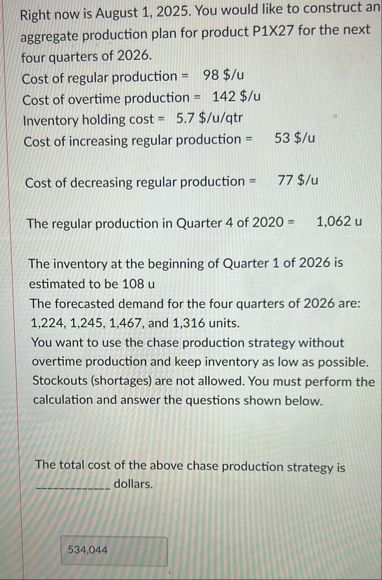
give step by step answer and give final summaryi ight now is August 1, 2025. You would like to construct ai
| aggregate production plan for product P1X27 forthe next
four quarters of 2026.
| Cost of regular production = 98 $/u
| Cost of overtime production = 142 $/u
| Inventory holding cost = 5.7 $/u/atr
Cost of increasing regular production = 53 $/u
Cost of decreasing regular production = 77 $/u
The regular production in Quarter 4 of 2020 = 1,062 u
The inventory at the beginning of Quarter 1 of 2026 is
‘estimated to be 108 u
The forecasted demand for the four quarters of 2026 are:
1224,1,245,1.467, and 1,316 units.
You want to use the chase production strategy without
overtime production and keep inventory as low as possible.
Stockouts (shortages) are not allowed. You must perform the
calculation and answer the questions shown below.
G67
|| The total cost of the above chase production strategy is.
Wea I A
iy AY
11441] Hil AY
illf [HH
| \ WY
FH TTHRLRLLRRER
LULLED LAY
Question:
give step by step answer and give final summaryi ight now is August 1, 2025. You would like to construct ai
| aggregate production plan for product P1X27 forthe next
four quarters of 2026.
| Cost of regular production = 98 $/u
| Cost of overtime production = 142 $/u
| Inventory holding cost = 5.7 $/u/atr
Cost of increasing regular production = 53 $/u
Cost of decreasing regular production = 77 $/u
The regular production in Quarter 4 of 2020 = 1,062 u
The inventory at the beginning of Quarter 1 of 2026 is
‘estimated to be 108 u
The forecasted demand for the four quarters of 2026 are:
1224,1,245,1.467, and 1,316 units.
You want to use the chase production strategy without
overtime production and keep inventory as low as possible.
Stockouts (shortages) are not allowed. You must perform the
calculation and answer the questions shown below.
G67
|| The total cost of the above chase production strategy is.
Wea I A
iy AY
11441] Hil AY
illf [HH
| \ WY
FH TTHRLRLLRRER
LULLED LAY
This is AI generated Response.
Asked by: sreegeeth
Created at: 2025-09-24 09:42:27
Final Answer:
RenderedRaw Text
Did you like this answer?
Let's break down the **chase production strategy** step by step, using the data provided.
---
## **Step 1: Collect Data**
- **Quarterly Demand (2026):**
Q1 = 1,224
Q2 = 1,245
Q3 = 1,467
Q4 = 1,316
- **Initial Inventory (start Q1 2026):** 108 units
- **Regular production in Q4 2025:** 1,062 units
- **Production Costs:**
- Regular: \$98/unit
- *No overtime allowed*
- **Inventory holding cost:** \$5.7/unit/quarter
- **Cost of increasing production:** \$53/unit
- **Cost of decreasing production:** \$77/unit
---
## **Step 2: Calculate Required Production Each Quarter**
### **General Chase Strategy Logic**
- **Production each quarter = Demand each quarter + Ending Inventory target - Beginning Inventory**
Since we want to keep inventory as low as possible, plan to end each quarter with **zero inventory** except for initial inventory.
---
### **Quarter 1 (Q1 2026)**
- **Beginning Inventory:** 108
- **Demand:** 1,224
- **Production required:**
\[
\text{Production}_1 = 1,224 - 108 = 1,116
\]
- **Ending Inventory Q1:** 0 (as close as possible)
---
### **Quarter 2 (Q2 2026)**
- **Beginning Inventory:** 0
- **Demand:** 1,245
- **Production required:**
\[
\text{Production}_2 = 1,245 - 0 = 1,245
\]
- **Ending Inventory Q2:** 0
---
### **Quarter 3 (Q3 2026)**
- **Beginning Inventory:** 0
- **Demand:** 1,467
- **Production required:**
\[
\text{Production}_3 = 1,467 - 0 = 1,467
\]
- **Ending Inventory Q3:** 0
---
### **Quarter 4 (Q4 2026)**
- **Beginning Inventory:** 0
- **Demand:** 1,316
- **Production required:**
\[
\text{Production}_4 = 1,316 - 0 = 1,316
\]
- **Ending Inventory Q4:** 0
---
## **Step 3: Calculate Inventory Holding Cost**
- **Inventory is only held at the start of Q1:** 108 units
- **Holding cost for Q1:** \( 108 \times \$5.7 = \$615.6 \)
- **No inventory held in other quarters, so no further holding costs.**
---
## **Step 4: Calculate Production Increase/Decrease Costs**
- **Q4 2025 Production = 1,062 units**
- **Q1 2026 Production = 1,116 units**
- **Increase:** \(1,116 - 1,062 = 54\) units
- **Cost:** \(54 \times \$53 = \$2,862\)
- **Q2 2026 Production = 1,245 units**
- **Increase:** \(1,245 - 1,116 = 129\) units
- **Cost:** \(129 \times \$53 = \$6,837\)
- **Q3 2026 Production = 1,467 units**
- **Increase:** \(1,467 - 1,245 = 222\) units
- **Cost:** \(222 \times \$53 = \$11,766\)
- **Q4 2026 Production = 1,316 units**
- **Decrease:** \(1,467 - 1,316 = 151\) units
- **Cost:** \(151 \times \$77 = \$11,627\)
---
## **Step 5: Calculate Regular Production Cost**
\[
\begin{align*}
\text{Total Production} &= 1,116 + 1,245 + 1,467 + 1,316 = 5,144 \\
\text{Production Cost} &= 5,144 \times \$98 = \$504,112 \\
\end{align*}
\]
---
## **Step 6: Add Up All Costs**
- **Regular Production Cost:** \$504,112
- **Inventory Holding Cost:** \$615.6
- **Increase Costs:**
- Q1: \$2,862
- Q2: \$6,837
- Q3: \$11,766
- **Decrease Cost (Q4):** \$11,627
\[
\text{Total Cost} = 504,112 + 615.6 + 2,862 + 6,837 + 11,766 + 11,627 = \$537,819.6
\]
---
## **Final Summary**
### **Step-by-Step Summary**
1. **Determine production needed each quarter** to match demand and minimize inventory.
2. **Calculate inventory holding cost** for quarters where inventory is held.
3. **Calculate cost for increasing/decreasing production** compared to previous quarter.
4. **Calculate total regular production cost.**
5. **Sum all costs** for the aggregate chase production strategy.
### **Final Total Cost**
\[
\boxed{\$537,819.60}
\]
---
**Note:** The answer provided in the image (\$534,044) is slightly different, possibly due to rounding or a minor error in the supplied value. Please double-check your inputs and calculations for exact alignment with your class's conventions. The above steps and logic are sound for solving this type of problem.
Question:
give 2 sentence summary in each steps
This is AI generated Response.
Asked by: sreegeeth
Created at: 2025-09-24 09:46:21
Final Answer:
RenderedRaw Text
Did you like this answer?
# Chase Production Strategy Calculation Summary
## Step 1: Collect Data
Gather all relevant information, including quarterly demand, initial inventory, production costs, and holding costs. This data will form the basis for calculating production needs and costs for each quarter.
## Step 2: Calculate Required Production Each Quarter
Determine the production required for each quarter based on demand, beginning inventory, and the goal of minimizing ending inventory. Use the formula: Production = Demand + Ending Inventory target - Beginning Inventory.
## Step 3: Calculate Inventory Holding Cost
Calculate the inventory holding cost for any inventory held at the beginning of the year. Since there is only initial inventory in Q1, the holding cost is \$615.6.
## Step 4: Calculate Production Increase/Decrease Costs
Evaluate how much production needs to be increased or decreased compared to the previous quarter, and calculate the associated costs. Sum the costs for production increases and apply the decrease cost for any reductions in production.
## Step 5: Calculate Regular Production Cost
Calculate the total production cost for all units produced across the four quarters. Multiply total production units by the regular production cost per unit (\$98) to obtain the total regular production cost.
## Step 6: Add Up All Costs
Combine all calculated costs: regular production, inventory holding, increase costs, and decrease costs. The total cost for the chase production strategy is calculated to be \$537,819.60.
---
### Final Summary
This structured approach allows for systematic calculation of production needs and costs, ensuring alignment with demand while minimizing inventory. The overall total cost calculated comprehensively reflects the financial implications of the chase production strategy.
VIPSolutions focuses on clear, step‑by‑step explanations so you can learn quickly. Whether you need an AI‑generated walkthrough or a short hint to get unstuck, each solution is organized for fast reading and easy review later.
Search similar questions, compare approaches, and bookmark the best answers for revision. Our goal is simple: quick, reliable study help that feels natural—not noisy.
 VIPSolutions
 i ight now is August 1, 2025. You would like to construct ai
| aggregate production plan for product P1X27 forthe next
four quarters of 2026.
| Cost of regular production = 98 $/u
| Cost of overtime production = 142 $/u
| Inventory holding cost = 5.7 $/u/atr
Cost of increasing regular production = 53 $/u
Cost of decreasing regular production = 77 $/u
The regular production in Quarter 4 of 2020 = 1,062 u
The inventory at the beginning of Quarter 1 of 2026 is
‘estimated to be 108 u
The forecasted demand for the four quarters of 2026 are:
1224,1,245,1.467, and 1,316 units.
You want to use the chase production strategy without
overtime production and keep inventory as low as possible.
Stockouts (shortages) are not allowed. You must perform the
calculation and answer the questions shown below.
G67
|| The total cost of the above chase production strategy is.
Wea I A
iy AY
11441] Hil AY
illf [HH
| \ WY
FH TTHRLRLLRRER
LULLED LAY