 VIPSolutions
give step by step answer and final summaryeae EE or trees ones mo 5 sen de URRY PIIPEIIIEiiass 31H fsicirin Prt aia es A Vimar RE lS TIE LULL LEE
Question:
give step by step answer and final summary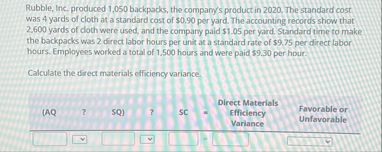 eae
EE
or trees ones mo 5 sen
de URRY
PIIPEIIIEiiass 31H
fsicirin Prt aia
es A Vimar RE
lS TIE LULL LEE
This is AI generated Response.
Asked by: sreegeeth
Created at: 2025-09-17 21:01:29
Asked by: sreegeeth
Created at: 2025-09-17 21:01:29
Final Answer:
Rendered
Raw Text
Did you like this answer?
Let's break down the problem and solve it step by step.
### **Step 1: Understand the Problem**
**Given:**
- Backpacks produced: **1,050**
- Standard cost: **4 yards of cloth/backpack** **$0.90/yard**
- Actual cloth used: **2,600 yards**
- Actual cost per yard: **$1.05**
- **Calculate:** **Direct Materials Efficiency Variance**
---
### **Step 2: Find the Relevant Formulas**
#### **Direct Materials Efficiencyance:**
\[
\text{Efficiency Variance} = (\text{Actual Quantity Used} - \text{Standard Quantity Allowed}) \times \text{Standard Cost per Yard}
\]
Where:
- **Actual Quantity Used (AQ):** Actual yards of cloth used = **2,600 yards**
- **Standard Quantity Allowed (SQ):** Standard yards allowed for actual production = **Number of backpacks produced} \times \text{Standard yards per backpack}**
- **Standard Cost per Yard (SC):** $0.90
---
### **Step 3: Calculate the Standard Quantity Allowed (SQ)**
\[
\text{SQ} = 1,050 \text{ backpacks} \times 4 \text{ yards/backpack} = 4,200 \text{ yards}
\]
---
### **Step 4: Plug Values into the Formula**
\[
\text{Efficiency Variance} = (2,600 - 4,200) \times \$0.90
\]
\[
= (-1,600) \times \$0.90
\]
\[
= -\$1,440
\]
---
### **Step 5: Determine Favorable or Unfavorable**
- If AQ < SQ, it's **favorable** (used less material than allowed)
- If AQ > SQ, it's **unfavorable** (used more material than allowed)
Since **AQ < SQ** (2,600 < 4,200), this is **favorable**.
---
## **Summary Table**
| AQ | SQ | SC | Direct Materials Efficiency Variance | Favorable or Unfavorable |
|------------|------------|-------|--------------------------------------|-------------------------|
| 2,600 | 4,200 | $0.90 | $1,440 | Favorable |
---
## **Final Summary**
- **Direct Materials Efficiency Variance:** $1,440 Favorable
- **Reason:** The company used 1,600 yards less than the standard allowed, saving $1,440 in direct material costs.
Question:
give 2 sentence summary in each steps
This is AI generated Response.
Asked by: sreegeeth
Created at: 2025-09-17 21:07:45
Asked by: sreegeeth
Created at: 2025-09-17 21:07:45
Final Answer:
Rendered
Raw Text
Did you like this answer?
### **Step 1: Understand the Problem**
Identify the key data: 1,050 backpacks produced, standard of 4 yards per backpack at $0.90/yard, actual usage of 2,600 yards, and actual cost of $1.05/yard. The goal is to compute the Direct Materials Efficiency Variance.
### **Step 2: Find the Relevant Formula**
Use the formula:
\[
\text{Efficiency Variance} = (\text{Actual Quantity} - \text{Standard Quantity Allowed}) \times \text{Standard Cost per Yard}
\]
This measures the cost impact of using more or less material than standard.
### **Step 3: Calculate Standard Quantity Allowed (SQ)**
Multiply the number of backpacks by standard yards per backpack:
\[
1,050 \times 4 = 4,200 \text{ yards}
\]
This is the expected material usage for actual production.
### **Step 4: Plug Values into the Formula**
Subtract actual yards from standard yards:
\[
2,600 - 4,200 = -1,600 \text{ yards}
\]
Multiply by standard cost per yard:
\[
-1,600 \times \$0.90 = -\$1,440
\]
A negative result indicates a favorable variance.
### **Step 5: Determine Favorable or Unfavorable**
Since actual usage is less than standard, the variance is favorable. The company saved $1,440 in material costs due to efficiency.
### **Final Summary**
The direct materials efficiency variance is **$1,440 Favorable**, indicating less material was used than planned, resulting in cost savings.
Question:
2 sentence summary only text answer
This is AI generated Response.
Asked by: sreegeeth
Created at: 2025-09-17 21:22:43
Asked by: sreegeeth
Created at: 2025-09-17 21:22:43
Final Answer:
Rendered
Raw Text
Did you like this answer?
The company's direct materials efficiency variance is $1,440 favorable, as it used 1,600 yards less than the standard allowance. This reflects cost savings resulting from more efficient material usage.
📢 Instructions:
- Ask anything relatd to above question only.
- For new Question goto :