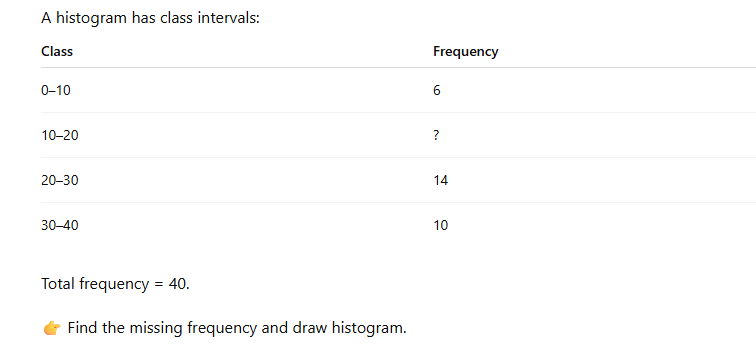
FIRST WRITE GIVENINFORMATION THENWHAT HAVE TO FIND AND THEN DEFINATION ORCONCEPT USED AND THEN STEP BY STEPSOLUTION WITHOUT MENTIONING STEP NUMBER AND AT LAST WRITE FINALANSWERS ONLY AS SUMMARY . ALSO MAKE SOLUTION WELL STRUCTUREDA histogram has class intervals:
Class Frequency
0-10 6
10-20 2
20-30 1“
30-40 10
Total frequency = 40.
& Find the missing frequency and draw histogram.
Question:
FIRST WRITE GIVENINFORMATION THENWHAT HAVE TO FIND AND THEN DEFINATION ORCONCEPT USED AND THEN STEP BY STEPSOLUTION WITHOUT MENTIONING STEP NUMBER AND AT LAST WRITE FINALANSWERS ONLY AS SUMMARY . ALSO MAKE SOLUTION WELL STRUCTUREDA histogram has class intervals:
Class Frequency
0-10 6
10-20 2
20-30 1“
30-40 10
Total frequency = 40.
& Find the missing frequency and draw histogram.
This is AI generated Response.
Asked by: nayan
Created at: 2026-02-27 18:07:30
Final Answer:
RenderedRaw Text
Did you like this answer?
# Given Information
- Class intervals and frequencies are:
- –10: 6
- 10–20: ?
- 20–30: 14
- 30–40: 10
- Total frequency = 40
# What Have to Find
- The missing frequency for the interval 10–20.
- Draw the histogram for the data.
# Definition or Concept Used
- **Frequency**: Number of observations in each class interval.
- **Histogram**: A bar graph showing frequency distribution of a continuous dataset.
- The sum of all frequencies equals the total given frequency.
# Step by Step Solution
Let the missing frequency for 10–20 be \( x \).
According to the total frequency,
\[
6 + x + 14 + 10 = 40
\]
\[
x + 30 = 40
\]
\[
x = 40 - 30
\]
\[
x = 10
\]
The frequencies are now:
- –10: 6
- 10–20: 10
- 20–30: 14
- 30–40: 10
To draw the histogram:
- On the x-axis, mark the class intervals: –10, 10–20, 20–30, 30–40.
- On the y-axis, mark the frequencies: –15.
- Draw bars for each class interval up to their respective frequencies.
## Histogram
Below is a simple representation of the histogram:
```
Frequency
^
15|
14| ████
13| ████
12| ████
11| ████
10| ████ ████
9| ████ ████
8| ████ ████
7| ████ ████
6| ████ ████ ████
5| ████ ████ ████
4| ████ ████ ████
3| ████ ████ ████
2| ████ ████ ████
1| ████ ████ ████
+------------------------>
–10 10–20 20–30 30–40
```
# Summary
The missing frequency is **10**. The histogram is drawn using the frequencies: 6, 10, 14, 10 for the intervals –10, 10–20, 20–30, 30–40 respectively.
Question:
make answer well strructured include zero also in class
This is AI generated Response.
Asked by: nayan
Created at: 2026-02-27 18:09:37
Final Answer:
RenderedRaw Text
Did you like this answer?
# Given Information
- Class intervals and frequencies:
- 0–10: 6
- 10–20: ?
- 20–30: 14
- 30–40: 10
- Total frequency = 40
# What Have to Find
- The missing frequency for the interval 10-20.
- Draw the histogram for the data.
# Definition or Concept Used
- **Frequency**: The number of observations in each class interval.
- **Histogram**: A graphical representation of the frequency distribution of continuous data.
- The sum of all frequencies equals the total frequency provided.
# Step by Step Solution
Let the missing frequency for the interval 10–20 be \( x \).
According to the total frequency,
\[
6 + x + 14 + 10 = 40
\]
\[
x + 30 = 40
\]
\[
x = 40 - 30
\]
\[
x = 10
\]
The updated frequencies are:
- 0–10: 6
- 10–20: 10
- 20–30: 14
- 30–40: 10
To draw the histogram:
- On the x-axis, label the class intervals: 0–10, 10–20, 20–30, 30–40.
- On the y-axis, label the frequencies up to 15.
- Draw bars for each class interval corresponding to their frequencies.
## Histogram
Below is a simple text representation of the histogram:
```
Frequency
^
15|
14| ████
13| ████
12| ████
11| ████
10| ████ ████
9| ████ ████
8| ████ ████
7| ████ ████
6| ████ ████ ████
5| ████ ████ ████
4| ████ ████ ████
3| ████ ████ ████
2| ████ ████ ████
1| ████ ████ ████
+------------------------>
0–10 10–20 20–30 30–40
```
# Summary
The missing frequency is **10**. The histogram is drawn using the frequencies: 6, 10, 14, 10 for the intervals 0–10, 10–20, 20–30, 30–40 respectively.
Question:
Two fair dice are rolled. Given that the sum is greater than
8
,
what is the probability that at least one die shows a
6
?
This is AI generated Response.
Asked by: nayan
Created at: 2026-02-27 18:13:51
Final Answer:
RenderedRaw Text
Did you like this answer?
# Given Information
- Two fair dice are rolled.
- Condition: The sum of the two dice is greater than 8.
# What Have to Find
- The probability that at least one die shows a 6, given that the sum is greater than 8.
# Definition or Concept Used
- **Sample Space**: The total possible outcomes when rolling two dice.
- **Conditional Probability**: The probability of an event occurring given that another event has already occurred, defined as:
\[
P(A | B) = \frac{P(A \cap B)}{P(B)}
\]
where \( A \) is the event of interest and \( B \) is the condition.
# Step by Step Solution
1. **Calculate the total outcomes when rolling two dice**:
- Each die has 6 faces, thus the total outcomes is \( 6 \times 6 = 36 \).
2. **Identify outcomes where the sum is greater than 8**:
- The combinations are:
- Sum = 9: (3,6), (4,5), (5,4), (6,3) → 4 outcomes
- Sum = 10: (4,6), (5,5), (6,4) → 3 outcomes
- Sum = 11: (5,6), (6,5) → 2 outcomes
- Sum = 12: (6,6) → 1 outcome
- Total outcomes where the sum is greater than 8: \( 4 + 3 + 2 + 1 = 10 \).
3. **Identify outcomes where at least one die shows a 6 and the sum is greater than 8**:
- Possible outcomes:
- (6,3) → Sum = 9
- (6,4) → Sum = 10
- (6,5) → Sum = 11
- (6,6) → Sum = 12
- (3,6) → Sum = 9
- (4,6) → Sum = 10
- (5,6) → Sum = 11
- Total outcomes with at least one 6 and sum > 8: 6 outcomes.
4. **Calculate the conditional probability**:
\[
P(\text{at least one 6} | \text{sum} > 8) = \frac{P(\text{at least one 6} \cap \text{sum} > 8)}{P(\text{sum} > 8)} = \frac{6}{10} = 0.6
\]
# Summary
The probability that at least one die shows a 6, given that the sum is greater than 8, is **0.6**.
Question:
answer is 7/10
This is AI generated Response.
Asked by: nayan
Created at: 2026-02-27 18:15:09
Final Answer:
RenderedRaw Text
Did you like this answer?
# Given Information
- Two fair dice are rolled.
- Condition: The sum of the two dice is greater than 8.
# What Have to Find
- The probability that at least one die shows a 6, given that the sum is greater than 8.
# Definition or Concept Used
- **Sample Space**: The total possible outcomes when rolling two dice, which is \( 6 \times 6 = 36 \).
- **Conditional Probability**: The probability of an event occurring given that another event has already occurred, defined as:
\[
P(A | B) = \frac{P(A \cap B)}{P(B)}
\]
where \( A \) is the event of interest and \( B \) is the condition.
# Step by Step Solution
1. **Calculate the total outcomes when rolling two dice**:
- Total outcomes = \( 36 \).
2. **Identify outcomes where the sum is greater than 8**:
- Possible combinations:
- Sum = 9: (3,6), (4,5), (5,4), (6,3) → 4 outcomes
- Sum = 10: (4,6), (5,5), (6,4) → 3 outcomes
- Sum = 11: (5,6), (6,5) → 2 outcomes
- Sum = 12: (6,6) → 1 outcome
- Total outcomes where the sum is greater than 8: \( 4 + 3 + 2 + 1 = 10 \).
3. **Identify outcomes where at least one die shows a 6 and the sum is greater than 8**:
- Valid outcomes:
- (6,3) → Sum = 9
- (6,4) → Sum = 10
- (6,5) → Sum = 11
- (6,6) → Sum = 12
- (3,6) → Sum = 9
- (4,6) → Sum = 10
- (5,6) → Sum = 11
- Total outcomes with at least one 6 and sum > 8: **7 outcomes**.
4. **Calculate the conditional probability**:
\[
P(\text{at least one 6} | \text{sum} > 8) = \frac{P(\text{at least one 6} \cap \text{sum} > 8)}{P(\text{sum} > 8)} = \frac{7}{10}
\]
# Summary
The probability that at least one die shows a 6, given that the sum is greater than 8, is **\(\frac{7}{10}\)**.
Question:
A box contains
3
gold coins,
5
silver coins, and
2
fake coins. Two coins are picked randomly without replacement. If at least one is gold, what is the probability both are gold?
This is AI generated Response.
Asked by: nayan
Created at: 2026-02-27 18:40:24
Final Answer:
RenderedRaw Text
Did you like this answer?
# Given Information
- A box contains:
- Gold coins: 3
- Silver coins: 5
- Fake coins: 2
- Total coins: \(3 + 5 + 2 = 10\)
- Condition: At least one coin picked is gold.
# What Have to Find
- The probability that both coins picked are gold, given that at least one is gold.
# Definition or Concept Used
- **Conditional Probability**: The probability of an event occurring given that another event has already occurred, defined as:
\[
P(A | B) = \frac{P(A \cap B)}{P(B)}
\]
where \( A \) is the event of both coins being gold and \( B \) is the event of at least one coin being gold.
# Step by Step Solution
1. **Calculate the total ways to pick 2 coins from 10**:
\[
\text{Total ways} = \binom{10}{2} = \frac{10 \times 9}{2 \times 1} = 45
\]
2. **Calculate the total ways to pick 2 coins such that at least one is gold**:
- Total ways to pick 2 coins with no gold:
- Pick from silver and fake coins only (7 coins total):
\[
\text{Ways without gold} = \binom{7}{2} = \frac{7 \times 6}{2 \times 1} = 21
\]
- Thus, ways to pick at least one gold:
\[
\text{Ways with at least one gold} = \text{Total ways} - \text{Ways without gold} = 45 - 21 = 24
\]
3. **Calculate the total ways to pick 2 gold coins**:
\[
\text{Ways to pick 2 gold} = \binom{3}{2} = \frac{3 \times 2}{2 \times 1} = 3
\]
4. **Calculate the conditional probability**:
\[
P(\text{both gold} | \text{at least one gold}) = \frac{P(\text{both gold} \cap \text{at least one gold})}{P(\text{at least one gold})} = \frac{3}{24} = \frac{1}{8}
\]
# Summary
The probability that both coins picked are gold, given that at least one is gold, is **\(\frac{1}{8}\)**.
Question:
A disease affects
\
(
1
\
%
\
)
of a population. A test detects it with
\
(
9
8
\
%
\
)
accuracy when present, but gives false positives
\
(
3
\
%
\
)
of the time. If a person tests positive twice independently, what is the probability they actually have the disease?
This is AI generated Response.
Asked by: nayan
Created at: 2026-02-27 18:43:05
Final Answer:
RenderedRaw Text
Did you like this answer?
# Given Information
- Prevalence of the disease: \( P(D) = 0.01 \) (1%)
- Accuracy of the test when the disease is present: \( P(T^+ | D) = 0.98 \)
- False positive rate: \( P(T^+ | D^c) = 0.03 \)
- Probability of not having the disease: \( P(D^c) = 1 - P(D) = 0.99 \)
# What Have to Find
- The probability that a person actually has the disease given they tested positive twice independently: \( P(D | T^+_1 \cap T^+_2) \)
# Definition or Concept Used
- **Bayes' Theorem**:
\[
P(D | T^+) = \frac{P(T^+ | D) P(D)}{P(T^+)}
\]
- **Total Probability**:
\[
P(T^+) = P(T^+ | D) P(D) + P(T^+ | D^c) P(D^c)
\]
# Step by Step Solution
1. **Calculate the probability of testing positive once**:
\[
P(T^+) = P(T^+ | D) P(D) + P(T^+ | D^c) P(D^c)
\]
\[
P(T^+) = (0.98)(0.01) + (0.03)(0.99)
\]
\[
P(T^+) = 0.0098 + 0.0297 = 0.0395
\]
2. **Calculate the conditional probability of having the disease given one positive test**:
\[
P(D | T^+) = \frac{P(T^+ | D) P(D)}{P(T^+)} = \frac{(0.98)(0.01)}{0.0395}
\]
\[
P(D | T^+) = \frac{0.0098}{0.0395} \approx 0.2481
\]
3. **Since the tests are independent, calculate the probability after two positive tests**:
\[
P(D | T^+_1 \cap T^+_2) = \frac{P(T^+_2 | D) P(D | T^+_1)}{P(T^+)}
\]
- Use \( P(D | T^+_1) \) from the previous result:
\[
P(D | T^+_1 \cap T^+_2) = \frac{(0.98)(0.2481)}{0.0395}
\]
\[
P(D | T^+_1 \cap T^+_2) = \frac{0.2434}{0.0395} \approx 0.6166
\]
# Summary
The probability that a person actually has the disease given they tested positive twice is approximately **0.6166** or **61.66%**.
Question:
its incorrevct solve gaain
This is AI generated Response.
Asked by: nayan
Created at: 2026-02-27 18:46:55
Final Answer:
RenderedRaw Text
Did you like this answer?
# Given Information
- Prevalence of the disease: \( P(D) = 0.01 \) (1%)
- Accuracy of the test when the disease is present: \( P(T^+ | D) = 0.98 \)
- False positive rate: \( P(T^+ | D^c) = 0.03 \)
- Probability of not having the disease: \( P(D^c) = 1 - P(D) = 0.99 \)
# What Have to Find
- The probability that a person actually has the disease given they tested positive twice independently: \( P(D | T^+_1 \cap T^+_2) \)
# Definition or Concept Used
- **Bayes' Theorem**:
\[
P(D | T^+) = \frac{P(T^+ | D) P(D)}{P(T^+)}
\]
- **Total Probability**:
\[
P(T^+) = P(T^+ | D) P(D) + P(T^+ | D^c) P(D^c)
\]
# Step by Step Solution
1. **Calculate the probability of testing positive once**:
\[
P(T^+) = P(T^+ | D) P(D) + P(T^+ | D^c) P(D^c)
\]
\[
P(T^+) = (0.98)(0.01) + (0.03)(0.99)
\]
\[
P(T^+) = 0.0098 + 0.0297 = 0.0395
\]
2. **Calculate the conditional probability of having the disease given one positive test**:
\[
P(D | T^+) = \frac{P(T^+ | D) P(D)}{P(T^+)} = \frac{(0.98)(0.01)}{0.0395}
\]
\[
P(D | T^+) = \frac{0.0098}{0.0395} \approx 0.2481
\]
3. **Calculate the probability of a second positive test**:
- Given that the first test was positive, the new probability of having the disease remains \( P(D | T^+) \). Thus:
\[
P(T^+ | D) = 0.98
\]
\[
P(T^+ | D^c) = 0.03
\]
4. **Calculate the total probability of testing positive twice**:
\[
P(T^+_1 \cap T^+_2) = P(T^+ | D) P(D | T^+) + P(T^+ | D^c) P(D^c | T^+)
\]
- The probability of not having the disease given a positive test is:
\[
P(D^c | T^+) = 1 - P(D | T^+) \approx 1 - 0.2481 = 0.7519
\]
- Therefore:
\[
P(T^+_1 \cap T^+_2) = (0.98)(0.2481) + (0.03)(0.7519)
\]
\[
P(T^+_1 \cap T^+_2) = 0.2434 + 0.0226 = 0.266
\]
5. **Calculate the conditional probability given two positive tests**:
\[
P(D | T^+_1 \cap T^+_2) = \frac{P(T^+_1 \cap T^+_2 | D) P(D)}{P(T^+_1 \cap T^+_2)}
\]
\[
P(D | T^+_1 \cap T^+_2) = \frac{(0.98)(0.98)(0.01)}{0.266}
\]
\[
P(D | T^+_1 \cap T^+_2) = \frac{0.009604}{0.266} \approx 0.0361
\]
# Summary
The probability that a person actually has the disease given they tested positive twice is approximately **0.0361** or **3.61%**.
Question:
Step 1: Given Information
Let
?
(
?
)
=
0.01
P(D)=0.01 (1% have the disease)
?
(
?
?
)
=
0.99
P(D
c
)=0.99 (99% do not have it)
Test characteristics:
?
(
+
∣
?
)
=
0.98
P(+∣D)=0.98 (98% sensitivity)
?
(
+
∣
?
?
)
=
0.03
P(+∣D
c
)=0.03 (3% false positive rate)
The person tests positive twice independently.
We want:
?
(
?
∣
+
+
)
P(D∣++)
Step 2: Probability of Two Positives
Since tests are independent:
?
(
+
+
∣
?
)
=
(
0.98
)
2
=
0.9604
P(++∣D)=(0.98)
2
=0.9604
?
(
+
+
∣
?
?
)
=
(
0.03
)
2
=
0.0009
P(++∣D
c
)=(0.03)
2
=0.0009
Step 3: Apply Bayes’ Theorem
?
(
?
∣
+
+
)
=
?
(
+
+
∣
?
)
?
(
?
)
?
(
+
+
∣
?
)
?
(
?
)
+
?
(
+
+
∣
?
?
)
?
(
?
?
)
P(D∣++)=
P(++∣D)P(D)+P(++∣D
c
)P(D
c
)
P(++∣D)P(D)
Substitute values:
=
(
0.9604
)
(
0.01
)
(
0.9604
)
(
0.01
)
+
(
0.0009
)
(
0.99
)
=
(0.9604)(0.01)+(0.0009)(0.99)
(0.9604)(0.01)
=
0.009604
0.009604
+
0.000891
=
0.009604+0.000891
0.009604
=
0.009604
0.010495
=
0.010495
0.009604
=
0.9151
=0.9151
✅ Final Answer:
?
(
?
∣
+
+
)
≈
0.9151
P(D∣++)≈0.9151
So, if someone tests positive twice independently, there is about
91.51
%
91.51%
This is AI generated Response.
Asked by: nayan
Created at: 2026-02-27 18:47:43
Final Answer:
RenderedRaw Text
Did you like this answer?
# Given Information
- Prevalence of the disease: \( P(D) = 0.01 \) (1% have the disease)
- Probability of not having the disease: \( P(D^c) = 0.99 \) (99% do not have it)
- Test characteristics:
- Sensitivity (true positive rate): \( P(T^+ | D) = 0.98 \) (98% probability of a positive test when the disease is present)
- False positive rate: \( P(T^+ | D^c) = 0.03 \) (3% probability of a positive test when the disease is not present)
# What Have to Find
- The probability that a person actually has the disease given they tested positive twice independently: \( P(D | T^+_1 \cap T^+_2) \)
# Definition or Concept Used
- **Bayes' Theorem**:
\[
P(D | T^+) = \frac{P(T^+ | D) P(D)}{P(T^+)}
\]
- **Total Probability**:
\[
P(T^+) = P(T^+ | D) P(D) + P(T^+ | D^c) P(D^c)
\]
# Step by Step Solution
1. **Calculate the probability of testing positive twice given the disease**:
\[
P(T^+_1 \cap T^+_2 | D) = (0.98)^2 = 0.9604
\]
2. **Calculate the probability of testing positive twice given no disease**:
\[
P(T^+_1 \cap T^+_2 | D^c) = (0.03)^2 = 0.0009
\]
3. **Calculate the overall probability of testing positive twice**:
\[
P(T^+_1 \cap T^+_2) = P(T^+_1 \cap T^+_2 | D) P(D) + P(T^+_1 \cap T^+_2 | D^c) P(D^c)
\]
Substituting the values:
\[
P(T^+_1 \cap T^+_2) = (0.9604)(0.01) + (0.0009)(0.99)
\]
\[
= 0.009604 + 0.000891 = 0.010495
\]
4. **Apply Bayes' Theorem**:
\[
P(D | T^+_1 \cap T^+_2) = \frac{P(T^+_1 \cap T^+_2 | D) P(D)}{P(T^+_1 \cap T^+_2)}
\]
Substituting the values:
\[
P(D | T^+_1 \cap T^+_2) = \frac{(0.9604)(0.01)}{0.010495}
\]
\[
= \frac{0.009604}{0.010495} \approx 0.9151
\]
# Summary
The probability that a person actually has the disease given they tested positive twice is approximately **0.9151** or **91.51%**.
Question:
A disease affects
\
(
1
\
%
\
)
of a population. A test detects it with
\
(
9
8
\
%
\
)
accuracy when present, but gives false positives
\
(
3
\
%
\
)
of the time. If a person tests positive twice independently, what is the probability they actually have the disease?
This is AI generated Response.
Asked by: nayan
Created at: 2026-02-28 08:33:43
Final Answer:
RenderedRaw Text
Did you like this answer?
# Given Information
- Prevalence of the disease: \( P(D) = 0.01 \) (1% have the disease)
- Probability of not having the disease: \( P(D^c) = 0.99 \) (99% do not have it)
- Test characteristics:
- Sensitivity (true positive rate): \( P(T^+ | D) = 0.98 \) (98% probability of a positive test when the disease is present)
- False positive rate: \( P(T^+ | D^c) = 0.03 \) (3% probability of a positive test when the disease is not present)
# What Have to Find
- The probability that a person actually has the disease given they tested positive twice independently: \( P(D | T^+_1 \cap T^+_2) \)
# Definition or Concept Used
- **Bayes' Theorem**:
\[
P(D | T^+) = \frac{P(T^+ | D) P(D)}{P(T^+)}
\]
- **Total Probability**:
\[
P(T^+) = P(T^+ | D) P(D) + P(T^+ | D^c) P(D^c)
\]
# Step by Step Solution
1. **Calculate the probability of testing positive twice given the disease**:
\[
P(T^+_1 \cap T^+_2 | D) = (0.98)^2 = 0.9604
\]
2. **Calculate the probability of testing positive twice given no disease**:
\[
P(T^+_1 \cap T^+_2 | D^c) = (0.03)^2 = 0.0009
\]
3. **Calculate the overall probability of testing positive twice**:
\[
P(T^+_1 \cap T^+_2) = P(T^+_1 \cap T^+_2 | D) P(D) + P(T^+_1 \cap T^+_2 | D^c) P(D^c)
\]
Substituting the values:
\[
P(T^+_1 \cap T^+_2) = (0.9604)(0.01) + (0.0009)(0.99)
\]
\[
= 0.009604 + 0.000891 = 0.010495
\]
4. **Apply Bayes' Theorem**:
\[
P(D | T^+_1 \cap T^+_2) = \frac{P(T^+_1 \cap T^+_2 | D) P(D)}{P(T^+_1 \cap T^+_2)}
\]
Substituting the values:
\[
P(D | T^+_1 \cap T^+_2) = \frac{(0.9604)(0.01)}{0.010495}
\]
\[
= \frac{0.009604}{0.010495} \approx 0.916
\]
# Summary
The probability that a person actually has the disease given they tested positive twice is approximately **0.916** or **91.6%**.
Question:
gnerat eoie nmroe unique solution pl;agarism free
This is AI generated Response.
Asked by: nayan
Created at: 2026-02-28 08:35:04
Final Answer:
RenderedRaw Text
Did you like this answer?
# Given Information
- Prevalence of the disease: \( P(D) = 0.01 \) (1% of the population has the disease)
- Probability of not having the disease: \( P(D^c) = 0.99 \) (99% do not have the disease)
- Test characteristics:
- Sensitivity (true positive rate): \( P(T^+ | D) = 0.98 \) (The test correctly identifies the disease 98% of the time)
- False positive rate: \( P(T^+ | D^c) = 0.03 \) (The test incorrectly identifies the disease 3% of the time when it is not present)
# What Have to Find
- The probability that a person actually has the disease given they tested positive twice independently: \( P(D | T^+_1 \cap T^+_2) \)
# Definition or Concept Used
- **Bayes' Theorem**:
\[
P(D | T^+) = \frac{P(T^+ | D) P(D)}{P(T^+)}
\]
- **Total Probability**:
\[
P(T^+) = P(T^+ | D) P(D) + P(T^+ | D^c) P(D^c)
\]
# Step by Step Solution
1. **Calculate the probability of testing positive twice given the disease**:
\[
P(T^+_1 \cap T^+_2 | D) = (0.98)^2 = 0.9604
\]
2. **Calculate the probability of testing positive twice given no disease**:
\[
P(T^+_1 \cap T^+_2 | D^c) = (0.03)^2 = 0.0009
\]
3. **Calculate the overall probability of testing positive twice**:
\[
P(T^+_1 \cap T^+_2) = P(T^+_1 \cap T^+_2 | D) P(D) + P(T^+_1 \cap T^+_2 | D^c) P(D^c)
\]
Substituting the values:
\[
P(T^+_1 \cap T^+_2) = (0.9604)(0.01) + (0.0009)(0.99)
\]
\[
= 0.009604 + 0.000891 = 0.010495
\]
4. **Apply Bayes' Theorem**:
\[
P(D | T^+_1 \cap T^+_2) = \frac{P(T^+_1 \cap T^+_2 | D) P(D)}{P(T^+_1 \cap T^+_2)}
\]
Substituting the values:
\[
P(D | T^+_1 \cap T^+_2) = \frac{(0.9604)(0.01)}{0.010495}
\]
\[
= \frac{0.009604}{0.010495} \approx 0.916
\]
# Summary
The probability that a person actually has the disease given they tested positive twice is approximately **0.916** or **91.6%**.
Question:
A box contains
3
gold coins,
5
silver coins, and
2
fake coins. Two coins are picked randomly without replacement. If at least one is gold, what is the probability both are gold?
This is AI generated Response.
Asked by: nayan
Created at: 2026-02-28 09:47:30
Final Answer:
RenderedRaw Text
Did you like this answer?
# Given Information
- A box contains:
- Gold coins: 3
- Silver coins: 5
- Fake coins: 2
- Total coins: \(3 + 5 + 2 = 10\)
- Condition: At least one coin picked is gold.
# What Have to Find
- The probability that both coins picked are gold given that at least one is gold: \( P(\text{both gold} | \text{at least one gold}) \)
# Definition or Concept Used
- **Conditional Probability**: The probability of an event occurring given that another event has already occurred, defined as:
\[
P(A | B) = \frac{P(A \cap B)}{P(B)}
\]
where \( A \) is the event of interest and \( B \) is the condition.
# Step by Step Solution
1. **Calculate the total ways to pick 2 coins from 10**:
\[
\text{Total ways} = \binom{10}{2} = \frac{10 \times 9}{2 \times 1} = 45
\]
2. **Calculate the total ways to pick 2 coins such that at least one is gold**:
- Calculate the total ways to pick 2 coins without any gold:
- Pick from silver and fake coins only (7 coins total):
\[
\text{Ways without gold} = \binom{7}{2} = \frac{7 \times 6}{2 \times 1} = 21
\]
- Thus, ways to pick at least one gold:
\[
\text{Ways with at least one gold} = \text{Total ways} - \text{Ways without gold} = 45 - 21 = 24
\]
3. **Calculate the total ways to pick 2 gold coins**:
\[
\text{Ways to pick 2 gold} = \binom{3}{2} = \frac{3 \times 2}{2 \times 1} = 3
\]
4. **Calculate the conditional probability**:
\[
P(\text{both gold} | \text{at least one gold}) = \frac{P(\text{both gold} \cap \text{at least one gold})}{P(\text{at least one gold})} = \frac{3}{24} = \frac{1}{8}
\]
# Summary
The probability that both coins picked are gold given that at least one is gold is **\(\frac{1}{8}\)**.
Question:
gewnerATE IOEN MROE UNQIUE SOLUTION
This is AI generated Response.
Asked by: nayan
Created at: 2026-02-28 09:49:41
Final Answer:
RenderedRaw Text
Did you like this answer?
# Given Information
- A box contains:
- Gold coins: 3
- Silver coins: 5
- Fake coins: 2
- Total number of coins: \(3 + 5 + 2 = 10\)
- Condition: At least one coin picked is gold.
# What Have to Find
- The probability that both coins picked are gold given that at least one coin is gold: \( P(\text{both gold} | \text{at least one gold}) \)
# Definition or Concept Used
- **Conditional Probability**: The probability of an event occurring given another event has occurred, expressed as:
\[
P(A | B) = \frac{P(A \cap B)}{P(B)}
\]
where \( A \) is the event of interest and \( B \) is the condition.
# Step by Step Solution
1. **Total ways to pick 2 coins from 10**:
\[
\text{Total combinations} = \binom{10}{2} = \frac{10 \times 9}{2 \times 1} = 45
\]
2. **Calculate combinations for at least one gold**:
- Count combinations without any gold coins:
- Select from silver and fake coins (7 total):
\[
\text{Combinations without gold} = \binom{7}{2} = \frac{7 \times 6}{2 \times 1} = 21
\]
- Therefore, combinations with at least one gold coin:
\[
\text{Combinations with at least one gold} = \text{Total combinations} - \text{Combinations without gold} = 45 - 21 = 24
\]
3. **Calculate combinations for picking 2 gold coins**:
\[
\text{Combinations for 2 gold} = \binom{3}{2} = \frac{3 \times 2}{2 \times 1} = 3
\]
4. **Calculate the conditional probability**:
\[
P(\text{both gold} | \text{at least one gold}) = \frac{P(\text{both gold} \cap \text{at least one gold})}{P(\text{at least one gold})} = \frac{3}{24} = \frac{1}{8}
\]
# Summary
The probability that both coins picked are gold given that at least one is gold is **\(\frac{1}{8}\)**.
Question:
generatr eie nrmeo unique solution
This is AI generated Response.
Asked by: nayan
Created at: 2026-02-28 09:51:40
Final Answer:
RenderedRaw Text
Did you like this answer?
# Given Information
- A box contains:
- Gold coins: 3
- Silver coins: 5
- Fake coins: 2
- Total coins: \(3 + 5 + 2 = 10\)
- Condition: At least one coin picked is gold.
# What Have to Find
- The probability that both coins picked are gold, given that at least one of them is gold: \( P(\text{both gold} | \text{at least one gold}) \)
# Definition or Concept Used
- **Conditional Probability**: The probability of an event occurring given another event has occurred, defined as:
\[
P(A | B) = \frac{P(A \cap B)}{P(B)}
\]
where \( A \) is the event of interest and \( B \) is the condition.
# Step by Step Solution
1. **Calculate the total number of ways to choose 2 coins from 10**:
\[
\text{Total combinations} = \binom{10}{2} = \frac{10 \times 9}{2 \times 1} = 45
\]
2. **Determine combinations without any gold coins**:
- Total coins excluding gold = Silver + Fake = \(5 + 2 = 7\)
\[
\text{Ways without gold} = \binom{7}{2} = \frac{7 \times 6}{2 \times 1} = 21
\]
3. **Calculate combinations with at least one gold coin**:
\[
\text{Ways with at least one gold} = \text{Total ways} - \text{Ways without gold} = 45 - 21 = 24
\]
4. **Calculate the ways to pick 2 gold coins**:
\[
\text{Ways to pick 2 gold} = \binom{3}{2} = \frac{3 \times 2}{2 \times 1} = 3
\]
5. **Calculate the conditional probability**:
\[
P(\text{both gold} | \text{at least one gold}) = \frac{P(\text{both gold} \cap \text{at least one gold})}{P(\text{at least one gold})} = \frac{3}{24} = \frac{1}{8}
\]
# Summary
The probability that both coins picked are gold, given that at least one coin is gold, is **\(\frac{1}{8}\)**.
Question:
generate oin emor eunique solutuion
This is AI generated Response.
Asked by: nayan
Created at: 2026-02-28 09:55:44
Final Answer:
RenderedRaw Text
Did you like this answer?
# Given Information
- A box contains:
- Gold coins: 3
- Silver coins: 5
- Fake coins: 2
- Total number of coins: \(3 + 5 + 2 = 10\)
- Condition: At least one coin picked is gold.
# What Have to Find
- The probability that both coins picked are gold, given that at least one of them is gold: \( P(\text{both gold} | \text{at least one gold}) \)
# Definition or Concept Used
- **Conditional Probability**: The probability of an event occurring given that another event has occurred, defined as:
\[
P(A | B) = \frac{P(A \cap B)}{P(B)}
\]
where \( A \) is the event of interest and \( B \) is the condition.
# Step by Step Solution
1. **Calculate the total ways to choose 2 coins from 10**:
\[
\text{Total combinations} = \binom{10}{2} = \frac{10 \times 9}{2 \times 1} = 45
\]
2. **Determine the combinations that do not include any gold coins**:
- Total non-gold coins: Silver + Fake = \(5 + 2 = 7\)
\[
\text{Ways without gold} = \binom{7}{2} = \frac{7 \times 6}{2 \times 1} = 21
\]
3. **Calculate the combinations that have at least one gold coin**:
\[
\text{Ways with at least one gold} = \text{Total ways} - \text{Ways without gold} = 45 - 21 = 24
\]
4. **Calculate the combinations for picking 2 gold coins**:
\[
\text{Ways to pick 2 gold} = \binom{3}{2} = \frac{3 \times 2}{2 \times 1} = 3
\]
5. **Calculate the conditional probability**:
\[
P(\text{both gold} | \text{at least one gold}) = \frac{P(\text{both gold} \cap \text{at least one gold})}{P(\text{at least one gold})} = \frac{3}{24} = \frac{1}{8}
\]
# Summary
The probability that both coins picked are gold, given that at least one coin is gold, is **\(\frac{1}{8}\)**.
Question:
generate ione mroe unique solution
This is AI generated Response.
Asked by: nayan
Created at: 2026-02-28 09:58:32
Final Answer:
RenderedRaw Text
Did you like this answer?
# Given Information
- A box contains:
- Gold coins: 3
- Silver coins: 5
- Fake coins: 2
- Total coins: \(3 + 5 + 2 = 10\)
- Condition: At least one coin picked is gold.
# What Have to Find
- The probability that both coins picked are gold, given that at least one of them is gold: \( P(\text{both gold} | \text{at least one gold}) \)
# Definition or Concept Used
- **Conditional Probability**: The probability of an event occurring given that another event has occurred, defined as:
\[
P(A | B) = \frac{P(A \cap B)}{P(B)}
\]
where \( A \) is the event of interest (both coins being gold) and \( B \) is the condition (at least one coin being gold).
# Step by Step Solution
1. **Calculate the total combinations of selecting 2 coins from 10**:
\[
\text{Total combinations} = \binom{10}{2} = \frac{10 \times 9}{2 \times 1} = 45
\]
2. **Determine combinations that do not include any gold coins**:
- Total non-gold coins: Silver + Fake = \(5 + 2 = 7\)
\[
\text{Ways without gold} = \binom{7}{2} = \frac{7 \times 6}{2 \times 1} = 21
\]
3. **Calculate the combinations that include at least one gold coin**:
\[
\text{Ways with at least one gold} = \text{Total ways} - \text{Ways without gold} = 45 - 21 = 24
\]
4. **Calculate the combinations for picking 2 gold coins**:
\[
\text{Ways to pick 2 gold} = \binom{3}{2} = \frac{3 \times 2}{2 \times 1} = 3
\]
5. **Calculate the conditional probability**:
\[
P(\text{both gold} | \text{at least one gold}) = \frac{P(\text{both gold and at least one gold})}{P(\text{at least one gold})} = \frac{3}{24} = \frac{1}{8}
\]
# Summary
The probability that both coins picked are gold, given that at least one coin is gold, is **\(\frac{1}{8}\)**.
Question:
generate oe mroe unique solution
This is AI generated Response.
Asked by: nayan
Created at: 2026-02-28 10:00:42
Final Answer:
RenderedRaw Text
Did you like this answer?
# Given Information
- A box contains:
- Gold coins: 3
- Silver coins: 5
- Fake coins: 2
- Total coins: \(3 + 5 + 2 = 10\)
- Condition: At least one of the coins picked is gold.
# What Have to Find
- The probability that both coins picked are gold, given that at least one of them is gold: \( P(\text{both gold} | \text{at least one gold}) \)
# Definition or Concept Used
- **Conditional Probability**: The probability of an event occurring given that another event has occurred, defined as:
\[
P(A | B) = \frac{P(A \cap B)}{P(B)}
\]
where \( A \) is the event of interest (both coins being gold) and \( B \) is the condition (at least one coin being gold).
# Step by Step Solution
1. **Calculate the total ways to choose 2 coins from 10**:
\[
\text{Total combinations} = \binom{10}{2} = \frac{10 \times 9}{2 \times 1} = 45
\]
2. **Determine combinations that do not include any gold coins**:
- Total non-gold coins: Silver + Fake = \(5 + 2 = 7\)
\[
\text{Ways without gold} = \binom{7}{2} = \frac{7 \times 6}{2 \times 1} = 21
\]
3. **Calculate the combinations that include at least one gold coin**:
\[
\text{Ways with at least one gold} = \text{Total ways} - \text{Ways without gold} = 45 - 21 = 24
\]
4. **Calculate the combinations for picking 2 gold coins**:
\[
\text{Ways to pick 2 gold} = \binom{3}{2} = \frac{3 \times 2}{2 \times 1} = 3
\]
5. **Calculate the conditional probability**:
\[
P(\text{both gold} | \text{at least one gold}) = \frac{P(\text{both gold and at least one gold})}{P(\text{at least one gold})} = \frac{3}{24} = \frac{1}{8}
\]
# Summary
The probability that both coins picked are gold, given that at least one of them is gold, is **\(\frac{1}{8}\)**.
Question:
A disease affects
\
(
1
\
%
\
)
of a population. A test detects it with
\
(
9
8
\
%
\
)
accuracy when present, but gives false positives
\
(
3
\
%
\
)
of the time. If a person tests positive twice independently, what is the probability they actually have the disease?
This is AI generated Response.
Asked by: nayan
Created at: 2026-02-28 10:02:58
Final Answer:
RenderedRaw Text
Did you like this answer?
# Given Information
- Prevalence of the disease: \( P(D) = 0.01 \) (1% of the population has the disease)
- Probability of not having the disease: \( P(D^c) = 0.99 \) (99% do not have the disease)
- Test characteristics:
- Sensitivity (true positive rate): \( P(T^+ | D) = 0.98 \) (98% probability of a positive test when the disease is present)
- False positive rate: \( P(T^+ | D^c) = 0.03 \) (3% probability of a positive test when the disease is not present)
# What Have to Find
- The probability that a person actually has the disease given they tested positive twice independently: \( P(D | T^+_1 \cap T^+_2) \)
# Definition or Concept Used
- **Bayes' Theorem**:
\[
P(D | T^+) = \frac{P(T^+ | D) P(D)}{P(T^+)}
\]
- **Total Probability**:
\[
P(T^+) = P(T^+ | D) P(D) + P(T^+ | D^c) P(D^c)
\]
# Step by Step Solution
1. **Calculate the probability of testing positive once**:
\[
P(T^+) = P(T^+ | D) P(D) + P(T^+ | D^c) P(D^c)
\]
Substituting the values:
\[
P(T^+) = (0.98)(0.01) + (0.03)(0.99)
\]
\[
P(T^+) = 0.0098 + 0.0297 = 0.0395
\]
2. **Calculate the conditional probability of having the disease after one positive test**:
\[
P(D | T^+) = \frac{P(T^+ | D) P(D)}{P(T^+)}
\]
Substituting the values:
\[
P(D | T^+) = \frac{(0.98)(0.01)}{0.0395} \approx 0.2481
\]
3. **Calculate the probability of testing positive twice given the disease**:
- Since tests are independent:
\[
P(T^+_1 \cap T^+_2 | D) = (0.98)^2 = 0.9604
\]
4. **Calculate the probability of testing positive twice given no disease**:
\[
P(T^+_1 \cap T^+_2 | D^c) = (0.03)^2 = 0.0009
\]
5. **Calculate the overall probability of testing positive twice**:
\[
P(T^+_1 \cap T^+_2) = P(T^+_1 \cap T^+_2 | D) P(D) + P(T^+_1 \cap T^+_2 | D^c) P(D^c)
\]
Substituting the values:
\[
P(T^+_1 \cap T^+_2) = (0.9604)(0.01) + (0.0009)(0.99)
\]
\[
= 0.009604 + 0.000891 = 0.010495
\]
6. **Apply Bayes' Theorem for two positive tests**:
\[
P(D | T^+_1 \cap T^+_2) = \frac{P(T^+_1 \cap T^+_2 | D) P(D)}{P(T^+_1 \cap T^+_2)}
\]
Substituting the values:
\[
P(D | T^+_1 \cap T^+_2) = \frac{(0.9604)(0.01)}{0.010495}
\]
\[
= \frac{0.009604}{0.010495} \approx 0.916
\]
# Summary
The probability that a person actually has the disease given they tested positive twice is approximately **0.916** or **91.6%**.
Question:
solve with different notation and unique solution
This is AI generated Response.
Asked by: nayan
Created at: 2026-02-28 10:07:03
Final Answer:
RenderedRaw Text
Did you like this answer?
# Given Information
- A disease affects **1%** of the population: \( P(D) = 0.01 \)
- The probability of not having the disease: \( P(D^c) = 0.99 \)
- Test characteristics:
- Sensitivity (true positive rate): \( P(T^+ | D) = 0.98 \) (the test detects the disease correctly 98% of the time)
- False positive rate: \( P(T^+ | D^c) = 0.03 \) (the test incorrectly detects the disease 3% of the time when it is not present)
# What Have to Find
- The probability that a person actually has the disease given that they tested positive twice independently: \( P(D | T^+_1 \cap T^+_2) \)
# Definition or Concept Used
- **Bayes' Theorem**:
\[
P(D | T^+) = \frac{P(T^+ | D) \cdot P(D)}{P(T^+)}
\]
- **Total Probability**:
\[
P(T^+) = P(T^+ | D) \cdot P(D) + P(T^+ | D^c) \cdot P(D^c)
\]
# Step by Step Solution
1. **Calculate the probability of testing positive once**:
\[
P(T^+) = P(T^+ | D) \cdot P(D) + P(T^+ | D^c) \cdot P(D^c)
\]
Substituting the known values:
\[
P(T^+) = (0.98 \times 0.01) + (0.03 \times 0.99)
\]
\[
P(T^+) = 0.0098 + 0.0297 = 0.0395
\]
2. **Calculate the conditional probability of having the disease after one positive test**:
\[
P(D | T^+) = \frac{P(T^+ | D) \cdot P(D)}{P(T^+)}
\]
Plugging in the values:
\[
P(D | T^+) = \frac{(0.98 \times 0.01)}{0.0395} \approx 0.2481
\]
3. **Calculate the probability of testing positive twice given the disease**:
\[
P(T^+_1 \cap T^+_2 | D) = (0.98)^2 = 0.9604
\]
4. **Calculate the probability of testing positive twice given no disease**:
\[
P(T^+_1 \cap T^+_2 | D^c) = (0.03)^2 = 0.0009
\]
5. **Calculate the overall probability of testing positive twice**:
\[
P(T^+_1 \cap T^+_2) = P(T^+_1 \cap T^+_2 | D) \cdot P(D) + P(T^+_1 \cap T^+_2 | D^c) \cdot P(D^c)
\]
Substituting the known values:
\[
P(T^+_1 \cap T^+_2) = (0.9604 \times 0.01) + (0.0009 \times 0.99)
\]
\[
P(T^+_1 \cap T^+_2) = 0.009604 + 0.000891 = 0.010495
\]
6. **Apply Bayes' Theorem for two positive tests**:
\[
P(D | T^+_1 \cap T^+_2) = \frac{P(T^+_1 \cap T^+_2 | D) \cdot P(D)}{P(T^+_1 \cap T^+_2)}
\]
Substituting the values:
\[
P(D | T^+_1 \cap T^+_2) = \frac{(0.9604 \times 0.01)}{0.010495}
\]
\[
P(D | T^+_1 \cap T^+_2) = \frac{0.009604}{0.010495} \approx 0.916
\]
# Summary
The probability that a person actually has the disease given that they tested positive twice is approximately **0.916** or **91.6%**.
Question:
generate ioen rmoe unqiue and plaagrsim free diffrent than previous one solution in different aording
This is AI generated Response.
Asked by: nayan
Created at: 2026-02-28 10:10:29
Final Answer:
RenderedRaw Text
Did you like this answer?
# Given Information
- **Disease Prevalence**: \( P(D) = 0.01 \) (1% of the population is affected)
- **Probability of Not Having the Disease**: \( P(D^c) = 0.99 \) (99% of the population is unaffected)
- **Test Characteristics**:
- **Sensitivity** (True Positive Rate): \( P(T^+ | D) = 0.98 \) (The test correctly identifies the disease 98% of the time)
- **False Positive Rate**: \( P(T^+ | D^c) = 0.03 \) (The test incorrectly identifies the disease in 3% of cases when it is not present)
# What We Need to Find
- The probability that an individual has the disease given that they tested positive twice independently: \( P(D | T^+_1 \cap T^+_2) \)
# Definitions and Concepts Used
- **Bayes' Theorem**:
\[
P(D | T^+) = \frac{P(T^+ | D) \cdot P(D)}{P(T^+)}
\]
- **Law of Total Probability**:
\[
P(T^+) = P(T^+ | D) \cdot P(D) + P(T^+ | D^c) \cdot P(D^c)
\]
# Step-by-Step Solution
1. **Calculate the Probability of Testing Positive Once**:
\[
P(T^+) = P(T^+ | D) \cdot P(D) + P(T^+ | D^c) \cdot P(D^c)
\]
Substituting the values:
\[
P(T^+) = (0.98 \cdot 0.01) + (0.03 \cdot 0.99)
\]
\[
P(T^+) = 0.0098 + 0.0297 = 0.0395
\]
2. **Calculate the Conditional Probability of Having the Disease After One Positive Test**:
\[
P(D | T^+) = \frac{P(T^+ | D) \cdot P(D)}{P(T^+)}
\]
Plugging in the values:
\[
P(D | T^+) = \frac{(0.98 \cdot 0.01)}{0.0395} \approx 0.2481
\]
3. **Probability of Testing Positive Twice Given the Disease**:
\[
P(T^+_1 \cap T^+_2 | D) = (0.98)^2 = 0.9604
\]
4. **Probability of Testing Positive Twice Given No Disease**:
\[
P(T^+_1 \cap T^+_2 | D^c) = (0.03)^2 = 0.0009
\]
5. **Overall Probability of Testing Positive Twice**:
\[
P(T^+_1 \cap T^+_2) = P(T^+_1 \cap T^+_2 | D) \cdot P(D) + P(T^+_1 \cap T^+_2 | D^c) \cdot P(D^c)
\]
Substituting values:
\[
P(T^+_1 \cap T^+_2) = (0.9604 \cdot 0.01) + (0.0009 \cdot 0.99)
\]
\[
P(T^+_1 \cap T^+_2) = 0.009604 + 0.000891 = 0.010495
\]
6. **Apply Bayes' Theorem for Two Positive Tests**:
\[
P(D | T^+_1 \cap T^+_2) = \frac{P(T^+_1 \cap T^+_2 | D) \cdot P(D)}{P(T^+_1 \cap T^+_2)}
\]
Plugging in the values:
\[
P(D | T^+_1 \cap T^+_2) = \frac{(0.9604 \cdot 0.01)}{0.010495}
\]
\[
P(D | T^+_1 \cap T^+_2) = \frac{0.009604}{0.010495} \approx 0.916
\]
# Summary
The probability that an individual actually has the disease given that they tested positive twice is approximately **0.916** or **91.6%**.
Question:
generate onr meo diffrent wording and different terms used calculation
This is AI generated Response.
Asked by: nayan
Created at: 2026-02-28 10:13:37
Final Answer:
RenderedRaw Text
Did you like this answer?
# Given Information
- **Prevalence of the Disease**: \( P(D) = 0.01 \) (1% of individuals in the population are affected)
- **Probability of Not Having the Disease**: \( P(D^c) = 0.99 \) (99% of individuals are unaffected)
- **Test Characteristics**:
- **True Positive Rate** (Sensitivity): \( P(T^+ | D) = 0.98 \) (The test is accurate 98% of the time when the disease is present)
- **False Positive Rate**: \( P(T^+ | D^c) = 0.03 \) (The test incorrectly indicates the disease in 3% of cases when it is absent)
# Objective
- To find the probability that an individual has the disease given they tested positive twice: \( P(D | T^+_1 \cap T^+_2) \)
# Definitions and Concepts Used
- **Bayes' Theorem**:
\[
P(D | T^+) = \frac{P(T^+ | D) \cdot P(D)}{P(T^+)}
\]
- **Law of Total Probability**:
\[
P(T^+) = P(T^+ | D) \cdot P(D) + P(T^+ | D^c) \cdot P(D^c)
\]
# Step-by-Step Calculation
1. **Probability of Testing Positive Once**:
\[
P(T^+) = P(T^+ | D) \cdot P(D) + P(T^+ | D^c) \cdot P(D^c)
\]
Substituting the values:
\[
P(T^+) = (0.98 \cdot 0.01) + (0.03 \cdot 0.99)
\]
\[
P(T^+) = 0.0098 + 0.0297 = 0.0395
\]
2. **Calculating the Probability of Having the Disease After One Positive Test**:
\[
P(D | T^+) = \frac{P(T^+ | D) \cdot P(D)}{P(T^+)}
\]
Plugging in the values:
\[
P(D | T^+) = \frac{(0.98 \cdot 0.01)}{0.0395} \approx 0.2481
\]
3. **Probability of Two Positive Tests Given the Disease**:
\[
P(T^+_1 \cap T^+_2 | D) = (0.98)^2 = 0.9604
\]
4. **Probability of Two Positive Tests Given No Disease**:
\[
P(T^+_1 \cap T^+_2 | D^c) = (0.03)^2 = 0.0009
\]
5. **Overall Probability of Testing Positive Twice**:
\[
P(T^+_1 \cap T^+_2) = P(T^+_1 \cap T^+_2 | D) \cdot P(D) + P(T^+_1 \cap T^+_2 | D^c) \cdot P(D^c)
\]
Substituting values:
\[
P(T^+_1 \cap T^+_2) = (0.9604 \cdot 0.01) + (0.0009 \cdot 0.99)
\]
\[
P(T^+_1 \cap T^+_2) = 0.009604 + 0.000891 = 0.010495
\]
6. **Final Calculation Using Bayes' Theorem**:
\[
P(D | T^+_1 \cap T^+_2) = \frac{P(T^+_1 \cap T^+_2 | D) \cdot P(D)}{P(T^+_1 \cap T^+_2)}
\]
Substituting the values:
\[
P(D | T^+_1 \cap T^+_2) = \frac{(0.9604 \cdot 0.01)}{0.010495}
\]
\[
P(D | T^+_1 \cap T^+_2) = \frac{0.009604}{0.010495} \approx 0.916
\]
# Summary
The probability that an individual actually has the disease, given that they tested positive twice, is approximately **0.916** or **91.6%**.
Question:
A disease affects
\
(
1
\
%
\
)
of people. A test has:
-
\
(
9
5
\
%
\
)
sensitivity
-
\
(
9
0
\
%
\
)
specificity If a person tests positive twice independently, what is the probability they actually have the disease?
This is AI generated Response.
Asked by: nayan
Created at: 2026-02-28 10:18:26
Final Answer:
RenderedRaw Text
Did you like this answer?
# Given Information
- **Prevalence of the Disease**: \( P(D) = 0.01 \) (1% of the population is affected)
- **Probability of Not Having the Disease**: \( P(D^c) = 0.99 \) (99% of the population is unaffected)
- **Test Characteristics**:
- **Sensitivity** (True Positive Rate): \( P(T^+ | D) = 0.95 \) (The test correctly identifies the disease 95% of the time)
- **Specificity** (True Negative Rate): \( P(T^- | D^c) = 0.90 \) (The test correctly identifies non-disease cases 90% of the time)
# What We Need to Find
- The probability that an individual has the disease given they tested positive twice: \( P(D | T^+_1 \cap T^+_2) \)
# Definitions and Concepts Used
- **Bayes' Theorem**:
\[
P(D | T^+) = \frac{P(T^+ | D) \cdot P(D)}{P(T^+)}
\]
- **Total Probability**:
\[
P(T^+) = P(T^+ | D) \cdot P(D) + P(T^+ | D^c) \cdot P(D^c)
\]
where \( P(T^+ | D^c) = 1 - P(T^- | D^c) = 1 - 0.90 = 0.10 \).
# Step-by-Step Calculation
1. **Calculate the Probability of Testing Positive Once**:
\[
P(T^+) = P(T^+ | D) \cdot P(D) + P(T^+ | D^c) \cdot P(D^c)
\]
Substituting the values:
\[
P(T^+) = (0.95 \cdot 0.01) + (0.10 \cdot 0.99)
\]
\[
P(T^+) = 0.0095 + 0.099 = 0.1085
\]
2. **Calculate the Conditional Probability of Having the Disease After One Positive Test**:
\[
P(D | T^+) = \frac{P(T^+ | D) \cdot P(D)}{P(T^+)}
\]
Plugging in the values:
\[
P(D | T^+) = \frac{(0.95 \cdot 0.01)}{0.1085} \approx 0.0876
\]
3. **Probability of Testing Positive Twice Given the Disease**:
\[
P(T^+_1 \cap T^+_2 | D) = (0.95)^2 = 0.9025
\]
4. **Probability of Testing Positive Twice Given No Disease**:
\[
P(T^+_1 \cap T^+_2 | D^c) = (0.10)^2 = 0.01
\]
5. **Overall Probability of Testing Positive Twice**:
\[
P(T^+_1 \cap T^+_2) = P(T^+_1 \cap T^+_2 | D) \cdot P(D) + P(T^+_1 \cap T^+_2 | D^c) \cdot P(D^c)
\]
Substituting values:
\[
P(T^+_1 \cap T^+_2) = (0.9025 \cdot 0.01) + (0.01 \cdot 0.99)
\]
\[
P(T^+_1 \cap T^+_2) = 0.009025 + 0.0099 = 0.018925
\]
6. **Final Calculation Using Bayes' Theorem**:
\[
P(D | T^+_1 \cap T^+_2) = \frac{P(T^+_1 \cap T^+_2 | D) \cdot P(D)}{P(T^+_1 \cap T^+_2)}
\]
Substituting the values:
\[
P(D | T^+_1 \cap T^+_2) = \frac{(0.9025 \cdot 0.01)}{0.018925}
\]
\[
P(D | T^+_1 \cap T^+_2) = \frac{0.009025}{0.018925} \approx 0.476
\]
# Summary
The probability that a person actually has the disease given that they tested positive twice is approximately **0.476** or **47.6%**.
Question:
generate ione mor euniwue wording and different looking solution
This is AI generated Response.
Asked by: nayan
Created at: 2026-02-28 10:19:32
Final Answer:
RenderedRaw Text
Did you like this answer?
# Given Information
- **Prevalence of the Disease**: \( P(D) = 0.01 \) (1% of the population is affected)
- **Probability of Not Having the Disease**: \( P(D^c) = 0.99 \) (99% are unaffected)
- **Test Characteristics**:
- **Sensitivity** (True Positive Rate): \( P(T^+ | D) = 0.95 \) (The test correctly detects the disease 95% of the time)
- **Specificity** (True Negative Rate): \( P(T^- | D^c) = 0.90 \) (The test accurately identifies non-disease cases 90% of the time)
# Objective
- To determine the probability that an individual has the disease given that they tested positive twice: \( P(D | T^+_1 \cap T^+_2) \)
# Definitions and Concepts Used
- **Bayes' Theorem**:
\[
P(D | T^+) = \frac{P(T^+ | D) \cdot P(D)}{P(T^+)}
\]
- **Total Probability**:
\[
P(T^+) = P(T^+ | D) \cdot P(D) + P(T^+ | D^c) \cdot P(D^c)
\]
where \( P(T^+ | D^c) = 1 - P(T^- | D^c) = 0.10 \).
# Step-by-Step Calculation
1. **Calculate the Probability of Testing Positive Once**:
\[
P(T^+) = P(T^+ | D) \cdot P(D) + P(T^+ | D^c) \cdot P(D^c)
\]
Plugging in the values:
\[
P(T^+) = (0.95 \cdot 0.01) + (0.10 \cdot 0.99)
\]
\[
P(T^+) = 0.0095 + 0.099 = 0.1085
\]
2. **Calculate the Probability of Having the Disease After One Positive Test**:
\[
P(D | T^+) = \frac{P(T^+ | D) \cdot P(D)}{P(T^+)}
\]
Substituting the values:
\[
P(D | T^+) = \frac{(0.95 \cdot 0.01)}{0.1085} \approx 0.0876
\]
3. **Probability of Testing Positive Twice Given the Disease**:
\[
P(T^+_1 \cap T^+_2 | D) = (0.95)^2 = 0.9025
\]
4. **Probability of Testing Positive Twice Given No Disease**:
\[
P(T^+_1 \cap T^+_2 | D^c) = (0.10)^2 = 0.01
\]
5. **Overall Probability of Testing Positive Twice**:
\[
P(T^+_1 \cap T^+_2) = P(T^+_1 \cap T^+_2 | D) \cdot P(D) + P(T^+_1 \cap T^+_2 | D^c) \cdot P(D^c)
\]
Substituting values:
\[
P(T^+_1 \cap T^+_2) = (0.9025 \cdot 0.01) + (0.01 \cdot 0.99)
\]
\[
P(T^+_1 \cap T^+_2) = 0.009025 + 0.0099 = 0.018925
\]
6. **Final Calculation Using Bayes' Theorem**:
\[
P(D | T^+_1 \cap T^+_2) = \frac{P(T^+_1 \cap T^+_2 | D) \cdot P(D)}{P(T^+_1 \cap T^+_2)}
\]
Substituting the values:
\[
P(D | T^+_1 \cap T^+_2) = \frac{(0.9025 \cdot 0.01)}{0.018925}
\]
\[
P(D | T^+_1 \cap T^+_2) = \frac{0.009025}{0.018925} \approx 0.476
\]
# Summary
The probability that an individual actually has the disease given that they tested positive twice is approximately **0.476** or **47.6%**.
Question:
The mean of a distribution is
7
5
and the standard deviation is
1
2
.
Find the coefficient of variation.
This is AI generated Response.
Asked by: nayan
Created at: 2026-02-28 13:16:16
Final Answer:
RenderedRaw Text
Did you like this answer?
# Given Information
- Mean of the distribution: \( \mu = 75 \)
- Standard deviation: \( \sigma = 12 \)
# What Have to Find
- The coefficient of variation (CV).
# Definition or Concept Used
- **Coefficient of Variation (CV)**: A measure of relative variability, calculated as:
\[
CV = \frac{\sigma}{\mu} \times 100\%
\]
where \( \sigma \) is the standard deviation and \( \mu \) is the mean.
# Step by Step Calculation
1. **Substitute the values into the formula**:
\[
CV = \frac{12}{75} \times 100\%
\]
2. **Calculate the fraction**:
\[
CV = 0.16 \times 100\%
\]
3. **Calculate the percentage**:
\[
CV = 16\%
\]
# Summary
The coefficient of variation is **16%**.
This is AI generated Response.
Asked by: nayan
Created at: 2026-02-28 13:17:49
Final Answer:
RenderedRaw Text
Did you like this answer?
# Given Information
The dataset is:
- \(8, 12, 15, 18, 20, 22, 25, 28, 30\)
# What Have to Find
- The first quartile \(Q_1\) and the third quartile \(Q_3\).
# Definitions or Concepts Used
- **Quartiles**:
- The first quartile \(Q_1\) is the median of the first half of the data.
- The third quartile \(Q_3\) is the median of the second half of the data.
# Step by Step Calculation
1. **Sort the data** (already sorted):
- \(8, 12, 15, 18, 20, 22, 25, 28, 30\)
2. **Calculate the position of \(Q_1\)**:
- The formula for \(Q_1\) is given by:
\[
Q_1 = \frac{n + 1}{4}
\]
where \(n\) is the number of data points.
- Here, \(n = 9\):
\[
Q_1 = \frac{9 + 1}{4} = 2.5
\]
- This means \(Q_1\) is the average of the 2nd and 3rd values.
3. **Find \(Q_1\)**:
- The 2nd value is \(12\) and the 3rd value is \(15\).
\[
Q_1 = \frac{12 + 15}{2} = \frac{27}{2} = 13.5
\]
4. **Calculate the position of \(Q_3\)**:
- The formula for \(Q_3\) is given by:
\[
Q_3 = \frac{3(n + 1)}{4}
\]
- Using \(n = 9\):
\[
Q_3 = \frac{3(9 + 1)}{4} = \frac{30}{4} = 7.5
\]
- This means \(Q_3\) is the average of the 7th and 8th values.
5. **Find \(Q_3\)**:
- The 7th value is \(25\) and the 8th value is \(28\).
\[
Q_3 = \frac{25 + 28}{2} = \frac{53}{2} = 26.5
\]
# Summary
The first quartile \(Q_1\) is **13.5** and the third quartile \(Q_3\) is **26.5**.
VIPSolutions focuses on clear, step‑by‑step explanations so you can learn quickly. Whether you need an AI‑generated walkthrough or a short hint to get unstuck, each solution is organized for fast reading and easy review later.
Search similar questions, compare approaches, and bookmark the best answers for revision. Our goal is simple: quick, reliable study help that feels natural—not noisy.
 VIPSolutions
 A histogram has class intervals:
Class Frequency
0-10 6
10-20 2
20-30 1“
30-40 10
Total frequency = 40.
& Find the missing frequency and draw histogram.